
Key Takeaways
Kang Si-hyun's View. The KOSPI's single-day 18% jump looks less like a sign of recovery and more like a reaction to the price vacuum created by leverage and semiconductor concentration. What this really signals is that investors' risk tolerance was damaged before the index level itself.
July's domestic stock market ended with a sharp rebound on the final trading day after a record-breaking plunge. On a monthly basis, however, the market fell 22%, with the decline from June's peak widening to around 30% at one point. When stock prices start shaking people's vacation plans and workplace morale, the market has already penetrated real-world sentiment.
What Happened
On July 31, the KOSPI surged roughly 18%. As expectations revived for expanded AI infrastructure investment by U.S. Big Tech, buying poured into Samsung Electronics (005930) and SK Hynix. SK Hynix jumped about 30% in a single day and Samsung Electronics (005930) rose around 27%, driving the index rebound.
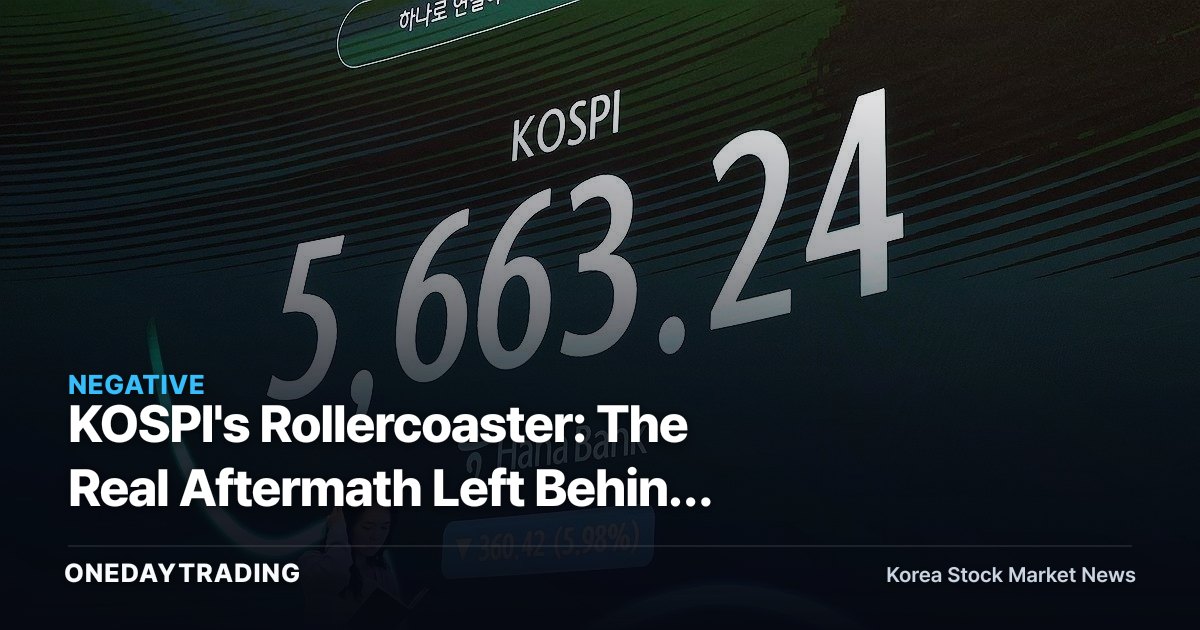
The problem is the scale of the preceding decline. On July 28, the KOSPI dropped 10.84% to close at 6,023.66, having fallen intraday to as low as 5,830.39. The Korea Exchange (KRX) triggered a market-wide circuit breaker at 10:14 a.m. Foreign investors net sold 4.97 trillion won worth of domestic stocks that day, while retail investors absorbed 4.33 trillion won.
Retail investors defended prices, but they couldn't defend sentiment. When sharp drops (plunges) and sharp rebounds alternate within days of each other, investors grow weary of uncertainty even before they register the losses. Focus at work slips, and vacation budgets get split between cash reserves and covering losses. This is where the first small cracks in consumer sentiment begin to appear.
Background and Context
AI semiconductors sit at the center of this volatility. Riding expectations for HBM and a memory-market upturn, SK Hynix and Samsung Electronics (005930) compressed a large share of the KOSPI's gains into a short period. That meant the downside was just as large. Once doubts emerged about the sustainability of AI investment, the entire index moved as if it were a semiconductor multiple correction.
Viewed through the lens of interest rates, this becomes clearer. When long-term rates stay elevated, the multiples of growth stocks — which discount distant future profits back to present value — compress. Semiconductor leaders don't fall only because their earnings deteriorate. When the discount rate applied to expected earnings rises, share prices fall even with the same earnings.
Market and Stock Impact
- SK Hynix: HBM supply capacity and expectations for customer orders support the stock (ticker), but expectations are so elevated that even a strong earnings report could be read as falling short. The fact that the stock fell about 14% during July's plunge and then rebounded 30% on the 31st shows just how sensitive it is.
- Samsung Electronics (005930): Memory recovery and AI server demand are the key variables. However, given its large weighting in market cap, it moves in tandem with KOSPI-wide supply-demand (order flow) itself. This is a phase where index-linked fund flows shake the share price before earnings do.
- Hanmi Semiconductor: If expectations for HBM equipment revive, the stock's upside can be substantial, but if downstream customers slow their capacity expansion, valuation concerns surface first. Without order disclosures, equipment makers find it hard to sustain a rally on narrative alone.
- Brokerage stocks: A surge in trading value is favorable for brokerage revenue in the short term. However, if retail investors' loss fatigue deepens, it could lead to reduced margin lending and lower turnover. For Kiwoom Securities and Mirae Asset Securities, the quality of customer balances matters more than trading value itself.
- Consumer and travel stocks: If stock-market losses translate into reduced vacation spending, indirect pressure builds on airline, travel, and leisure consumption. The impact confirmed in hard numbers so far is limited, but a sharp drop (plunge) in asset prices tends to first slow discretionary spending among high-income individuals.
Investor Checkpoints
- Reading August semiconductor earnings: HBM shipment volumes, pricing, and customer order guidance matter more than SK Hynix and Samsung Electronics (005930)'s reported profits.
- Whether foreign flows turn to net buying: If selling on the scale of July 28's 4.97 trillion won net sell-off repeats, the rebound is likely to prove short-lived.
- The won-dollar exchange rate: If the exchange rate destabilizes again, both foreign stock selling and dollar demand tend to rise together. This is the macro price that determines whether the index rebound holds.
- Margin lending and leveraged ETF balances: Volatility may ease as retail leverage unwinds, but declines can steepen during forced-liquidation phases.
Outlook
The bullish scenario is straightforward. If U.S. Big Tech maintains its AI capital expenditure, the HBM supply shortage is confirmed through pricing, and foreign investors resume buying large-cap semiconductor names, the late-July rebound could evolve from a technical bounce into an earnings-driven rally. In that case, the market leaders remain SK Hynix and Samsung Electronics (005930).
The bearish scenario has three triggers: doubts over the payback period on AI investment, supply pressure from Chinese memory makers, and elevated interest rates. What the market has already priced in is the fear of the plunge. What remains underpriced is the psychological aftermath among retail investors and the resulting pullback in consumption. The next things to watch are August foreign supply-demand (order flow), semiconductor guidance, and the exchange rate level.
This article is automatically summarized and analyzed content based on the original news report. View original (Yonhap News Agency, Securities)