
Key Takeaways
With the weak won and a wave of foreign tourists drawn by K-content converging, the department store sector has entered a stock momentum phase rivaling that of semiconductors. This rally is not simply a tourism boom — its essence lies in the exchange rate level lifting foreign visitors' real purchasing power, which flows directly into high-margin luxury sales. For investors, the key question is how to verify this profit leverage, which only holds when both the exchange rate and the number of arrivals remain favorable at the same time.
What Happened
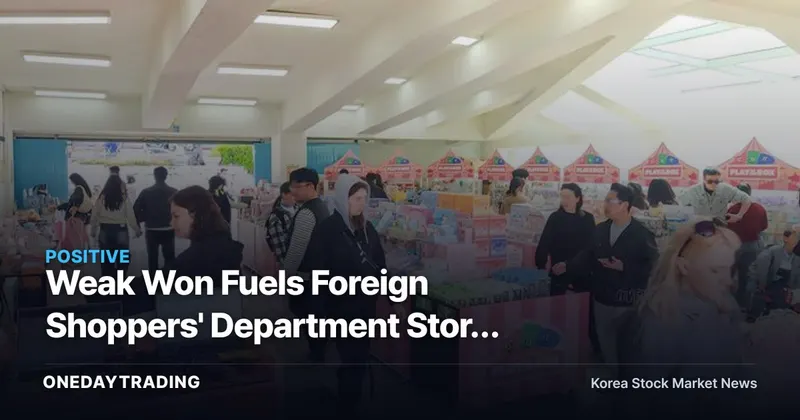
Last month, foreign nationals' domestic card spending surpassed 2 trillion won, with payments concentrated in ultra-high-end luxury purchases at duty-free shops and department store luxury galleries. As the won weakened, the same luxury goods effectively became cheaper in dollar and yen terms, prompting foreign tourists to open their wallets in pursuit of a perceived discount.
This trend was quickly reflected in share prices. Hyundai Department Store's stock has surged 86% so far this month, showing the strongest momentum among large-cap retail stocks. Expectations that operating leverage would kick in as foreign shoppers account for a larger share of department store sales rapidly translated into multiple expansion.
Background and Context
Behind this is a structural increase in demand to visit Korea, driven by the global popularity of K-content such as K-pop and K-dramas. Because duty-free luxury goods and department store luxury items account for a large share of per-tourist spending, growth in the number of arrivals contributes more to profit than to top-line revenue at department stores. This is because the department store channel carries a high proportion of rental fees and fixed store costs, meaning that once sales pass a certain break-even point, a substantial portion of incremental revenue flows straight through to profit.
Market and Stock Impact
- Hyundai Department Store — Foreign luxury demand is concentrated at its downtown stores, including the main branch and Trade Center branch, lifting the share of high-margin sales. It is the key stock (ticker) where the operating leverage effect shows up most directly.
- Shinsegae — With both department store and duty-free operations, it stands to benefit twice over as foreign inbound traffic recovers: duty-free turning profitable alongside improving luxury gallery sales.
- Lotte Shopping — While it has department store and duty-free exposure, its large discount-store and e-commerce domestic business dilutes the relative impact of foreign demand.
- Hotels, travel, and airlines — These share the upstream demand from rising arrivals, but a weaker won cuts both ways: it's a positive catalyst for department stores and duty-free, yet a mixed factor for fuel and foreign-currency costs, warranting a more differentiated view.
Investor Checkpoints
- Watch whether the monthly foreign card spending figures and duty-free foreign sales trends hold or expand beyond the 2 trillion won level.
- The key test of this leverage story is whether next quarter's earnings show department store same-store sales growth and operating margins improving faster than top-line revenue.
- The won-dollar and won-yen exchange rate levels — should the won strengthen again, foreign shoppers' perceived discount would shrink, potentially weakening the momentum.
- Monthly arrival statistics from the Korea Tourism Organization and shifts in the country mix, including China, Japan, and Southeast Asia.
Outlook
If a weak won and K-content-driven inbound tourism both persist, the department store and duty-free sectors have room to keep delivering differentiated earnings even amid sluggish domestic demand. That said, this month's 86% share-price gain has likely already priced in considerable expectations, so if earnings fall short of that bar or the exchange rate reverses, valuation concerns could quickly resurface. Ultimately, the sustainability of tourism momentum and confirmation of profit growth in quarterly earnings are likely to be the dividing line between further gains and a correction.
Hyundai Department Store: Real-Time Data Snapshot
Hyundai Department Store's most recent closing price was 204,000 won (0.00% vs. the previous day), and the signal combining foreign/institutional order flow with news and momentum reads 🟡 Neutral — Wait and See. With mixed positive and negative signals, this is a range to watch.
- ▲ 52-Week Range Position — Near the top of the 52-week range at 95% — approaching new-high territory
Recent related news skews favorable, with 1 positive catalyst and 0 negative catalysts.
※ Price and foreign/institutional order-flow data are provided by Korea Investment & Securities (KIS) and are as of the time of publication.
This article is automatically summarized and analyzed based on the original news report. View original (Maeil Business Newspaper, Securities)