
At a Glance
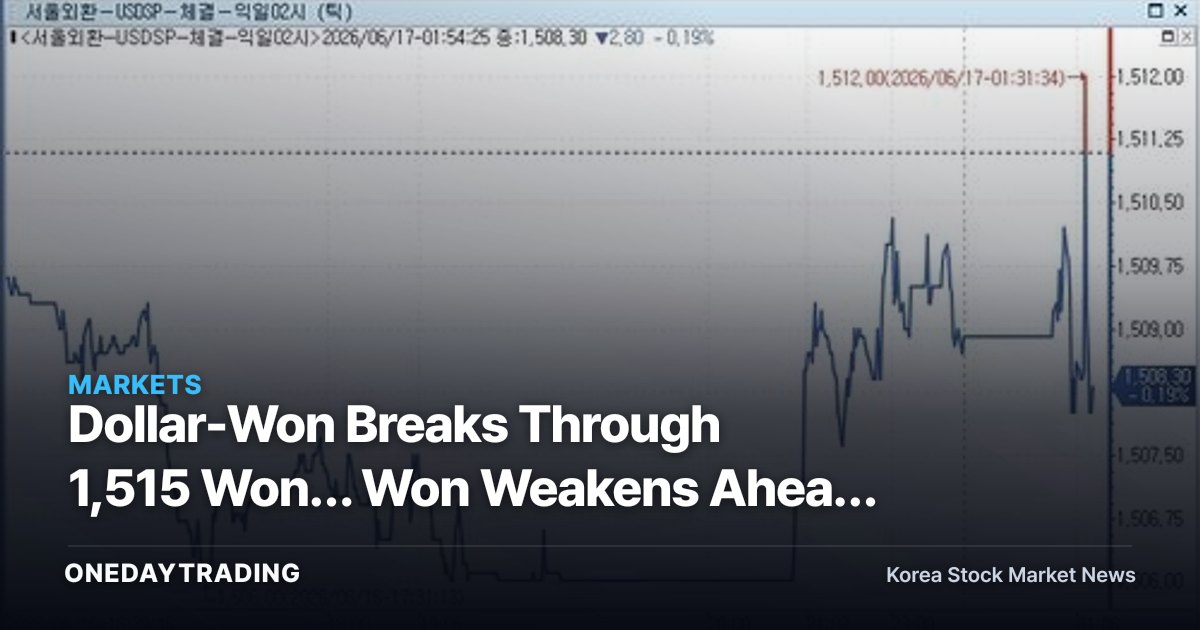
The dollar-won exchange rate widened its gains ahead of the U.S. Federal Open Market Committee (FOMC) decision, closing at 1,515.50 won. An exchange rate above the 1,500-won level is more than just a number — it simultaneously shakes up the won-converted earnings of exporters, foreign fund flow, and the import price channel. For investors, this is a phase in which positive catalysts and burdens diverge by stock (ticker), calling for a careful look at exposure structure rather than a one-size-fits-all response.
Why It Matters Now
The fact that the exchange rate is trading above 1,500 won signals overlapping concerns about global dollar strength and Korea's economic fundamentals. Amid a wait-and-see mood ahead of the FOMC, the market is betting on the pace of rate cuts and changes in the dot plot — and the more expectations build that the U.S. will keep rates higher for longer, the stronger the dollar gets and the weaker the won becomes. If the Korea-U.S. rate gap fails to narrow, further downward pressure on the won could persist.
A weaker won cuts both ways. Exporters that earn a large share of revenue overseas benefit from a currency-translation gain, as the same dollar-denominated sales convert into more won, boosting operating profit. Conversely, companies that purchase raw materials, components, and energy in dollars — and industry sectors with heavy overseas payment exposure — face rising cost burdens. If the exchange rate pushes up import prices, it could also spill over into macro-level pressure by dampening consumption and stoking inflation.
Foreign investor supply-demand (order flow) is especially key. When the exchange rate is elevated, foreign investors tend to shy away from buying domestic stocks — or move to lock in profits — out of concern over currency-translation losses. Since fund inflows back into the KOSPI depend on the exchange rate stabilizing, overall index volatility is likely to stay tied to the exchange rate level for the time being.
Frequently Asked Questions
- Why did the exchange rate rise further ahead of the FOMC? Amid uncertainty over the outcome, demand to secure the safe-haven dollar in advance combined with risk-averse sentiment, leaving won selling in the driver's seat.
- Does a weaker won automatically mean a positive catalyst for exporters? While translated earnings rise, sharp swings in the exchange rate itself make earnings harder to forecast, and companies that rely on imported components may see the benefit offset by higher costs.
- Will the exchange rate stay stuck above 1,500 won? That's hard to say definitively, as it hinges on the FOMC's rate path, the Korea-U.S. rate gap, and the trade balance trend — and whether authorities step in with smoothing intervention is another variable.
- What should retail investors watch? The priority is to separate holdings by export exposure and dollar-denominated cost exposure, checking beneficiary stocks and burdened stocks separately.
Related Stocks (Tickers) and Sector Impact
- Hyundai Motor and Kia With a large share of overseas sales, including in the U.S., and a structure that converts dollar sales into won, these are flagship beneficiaries with strong expected profitability gains from a weaker won.
- Samsung Electronics (005930) and SK Hynix Semiconductor export proceeds come in dollars, which is positive from a currency-translation standpoint, but the share of imported equipment and materials — along with foreign investor supply-demand effects — must also be watched.
- Refining and Airlines Airlines such as Korean Air and refiners settle jet fuel and crude oil purchases in dollars and carry sizable foreign-currency debt, making a high exchange rate a representative cost and currency-loss burden for this sector.
- Food & Beverage and Retail Heavy reliance on imported grains and raw materials means rising cost pressure, and since passing these costs on to sale prices takes time, margins could be squeezed.
Investment Considerations
- Exchange-rate benefits are often an accounting translation effect, so investors should avoid overpricing the expectation until it is confirmed in actual cash flow and earnings releases.
- The dollar could reverse sharply depending on the FOMC's dot plot and Chair Powell's remarks, making short-term bets on the exchange rate a high-volatility risk.
- If a high exchange rate stokes import prices, it could lead to weaker consumption and sluggish domestic-demand stocks, meaning a positive catalyst for exporters may not directly translate into a broad index rally.
- If foreign selling coincides with won weakness, supply-demand (order flow) for large-cap stocks could weaken, so trading value and the trend in foreign net buying should be monitored together.
Overall Outlook
In an optimistic scenario, the FOMC presents a rate path in line with market expectations, easing uncertainty; as the won partially retraces, exporters' expected translation gains would support index stability. Conversely, if the U.S. signals a stronger hawkish stance, dollar strength could extend, pushing the exchange rate higher still, and foreign capital outflows combined with import-price pressure could weigh on the market simultaneously. Useful indicators to track step by step include the exchange rate's reaction immediately after the FOMC decision, the dot plot, the Korea-U.S. rate gap, the next trade balance and inflation releases, and whether foreign net buying turns positive.
This article is automatically summarized and analyzed based on the original news report. View original (Yonhap Infomax)