
Summary
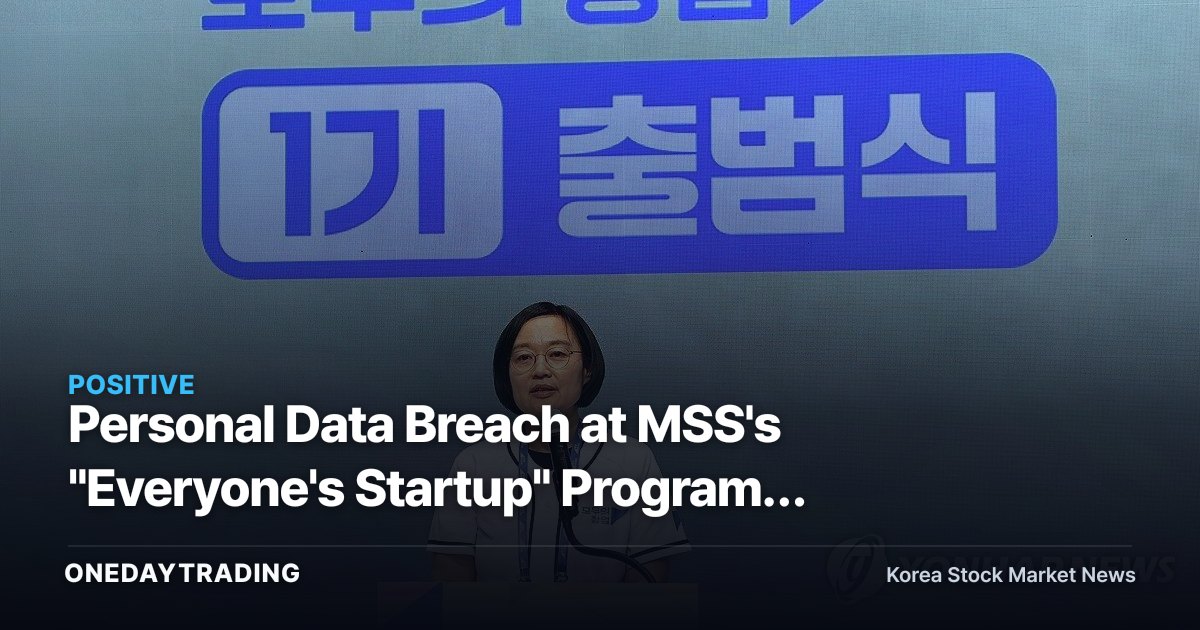
In the Ministry of SMEs and Startups' (MSS) "Everyone's Startup" entrepreneurship support program, the personal data and startup ideas of thousands of accepted applicants were leaked, with the cause traced to a hack of an external company participating in the program. The key point is that this was not a system operated directly by the public agency, but rather an indirect intrusion through a partner company — an issue worth revisiting from an investment standpoint centered on supply-chain security and demand for information security solutions.
The Full Story
This incident differs in nature from a simple personal data leak in that the targeted data belonged to accepted applicants of "Everyone's Startup," an entrepreneurship support program run by the MSS. The leaked information reportedly included not only applicants' personal details but also their startup ideas — effectively their business plans. Because ideas are intangible assets at a pre-commercialization stage, monetary damage is difficult to quantify, and once the possibility of leakage to competitors is added, the scope of secondary harm widens considerably.
The intrusion route is the part worth noting. It was not the government's main system that was breached first, but a private company participating in the project, and the data flowed out through that connection. This closely resembles a classic supply-chain attack pattern — targeting a partner with relatively weaker security defenses as a path toward the main target.
Structural Background
Recent domestic data breaches have been evolving toward exploiting the lax security of subcontractors and partner companies rather than the institutions themselves. Public-sector projects are structured so that numerous outsourced developers and operating agencies handle data in fragments, so the "weak link" problem — where breaching just one point exposes the whole — keeps recurring.
On the regulatory side, the management responsibility of outsourcing parties and the burden of fines under the Personal Information Protection Act are also on a strengthening trend. As incidents accumulate, both public agencies and the IT/SI firms that win their contracts have no choice but to increase spending on security verification and solution adoption, and this functions as a structural demand base for the information security industry.
Stock and Sector Impact
- AhnLab: As Korea's security sector bellwether spanning endpoint protection, managed monitoring, and threat response, it has the greatest revenue exposure during a phase of expanding public- and private-sector security budgets. However, public-sector orders vary widely from quarter to quarter, so investors should be mindful of earnings volatility.
- WINS: With its strength in network intrusion prevention (IPS), it stands to directly benefit if demand to block external attack routes rises. Its share of telecom and public-sector references drives its earnings.
- IGLOO Corporation: With a business structure centered on managed security monitoring and SIEM, it has a clear path to benefit from growing demand for integrated monitoring that also encompasses partner companies.
- RaonSecure: Operating in the authentication and identity management space, it is closely aligned with the trend of strengthening access controls over personal data.
- SI/IT service firms: Operators of public-system operations and maintenance face greater liability and cost burdens when incidents occur, creating a double-edged dynamic in the short term.
Bullish vs. Bearish Scenarios
On the bullish side, a major breach stokes appetite for security investment, driving an increase in managed-monitoring and solution orders, centered on the public and financial sectors. In the past, security stocks have repeatedly shown short-term, theme-driven strength immediately after high-profile breaches.
Conversely, the bearish variables are also clear. An incident does not directly translate into contract wins for any specific company, and executing orders takes budget allocation and time. Security stocks that have surged in the short term on theme expectations alone can reverse quickly, along with valuation pressure, if actual earnings fail to support them. Another risk is that many information security firms are small in scale and heavily dependent on the public sector, so the quality of their profits is uneven.
Investor Action Points
- Check policy schedules and procurement notices to see whether the next-round information security budgets and orders from the government and public agencies are actually increased after the incident.
- Separate security stocks' short-term, theme-driven sharp gains from next-quarter earnings and contract-win disclosures. Whether new contract disclosures accompany the move is the standard for separating winners from losers.
- Cross-check business portfolios to see whose solution domains align with the strengthening regulatory moves around supply-chain security and outsourcing-party management.
- For stocks with a high share of public-sector revenue, also review the possibility of order delays and budget cuts to prepare for volatility.
AhnLab Through Real-Time Data
AhnLab's latest closing price is 55,600 won (-3.14% from the prior day), and the signal light — combining foreign-investor and institutional order flow with news and momentum — is 🔴 Caution. With foreign investors, institutional investors, and momentum all negative, caution is warranted right now.
- ▼ Dual-engine selling — foreign investors −0.9 billion won and institutional investors −0.1 billion won selling in tandem
- ▼ Trend alignment — short- and mid-term aligned to the downside (intraday -3.1% · 1-week -3.0% · 1-month -7.9%)
- ▼ 52-week position — near the 52-week bottom at 2%
Recent related news is favorable, with 2 positive catalysts and 0 negative catalysts.
※ Price and foreign-investor/institutional order-flow data are provided by Korea Investment & Securities (KIS), as of the time of publication.
This article is content automatically summarized and analyzed based on the original news. View original (Yonhap News)