
Summary
A ceasefire agreement between the U.S. and Iran has driven international oil prices down roughly 30% over the past month, yet domestic gasoline and diesel prices at the pump are barely budging. This gap is not merely a matter of consumer frustration — it is a variable that directly affects refiner margins and the cost base of airlines and transport. For investors, reading the structure of the time lag in how prices pass through to retail is far more rewarding than focusing on the direction of oil prices alone.
The Full Story
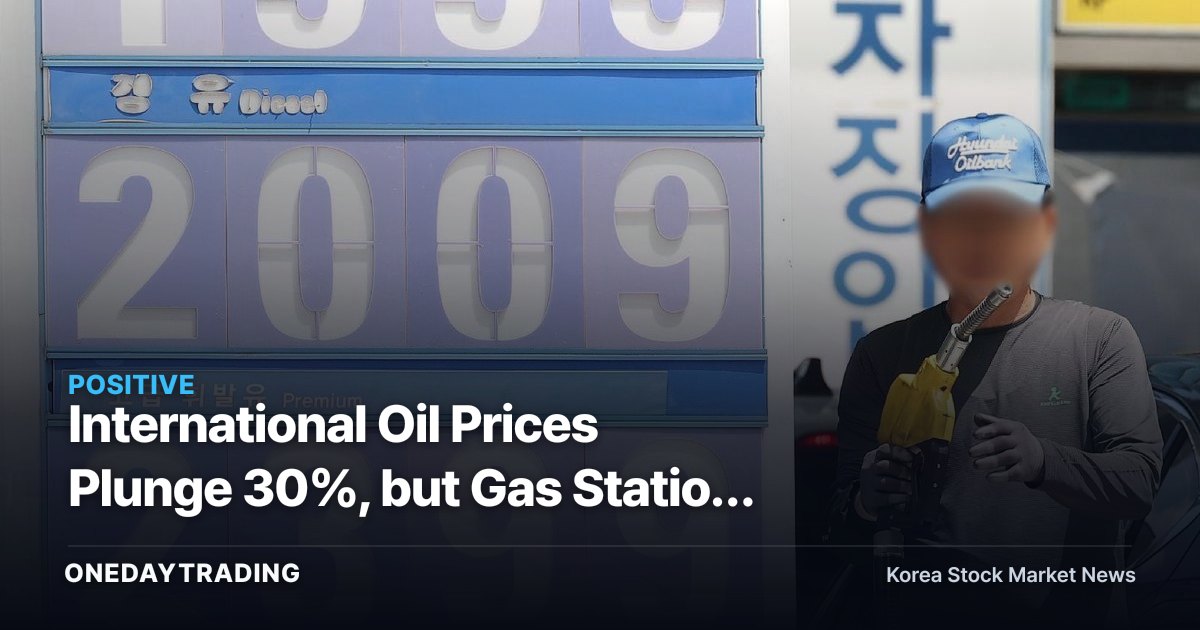
Easing geopolitical risk is one of the fastest-reflected drivers in the crude oil market. As fears of a Middle East supply disruption faded, international crude futures fell nearly 30% in just one month — a sharp correction equivalent to a double-digit drop per barrel. Yet the national average gas station price tracked by the Korea National Oil Corporation's price information system (Opinet) has remained elevated, reflecting almost none of that decline.
The key is the time lag. The fuel sold at domestic gas stations comes from inventory refined from crude that refiners purchased two to three weeks earlier. Even if international oil prices fall today, it typically takes around two weeks for that effect to reach retail prices after passing through refining, distribution, and inventory turnover. On top of this, fuel taxes, gas station rent and labor costs, and card fees make up a large fixed portion of the price unrelated to crude — further dulling the sense of any decline.
Conversely, an asymmetry has been repeatedly observed in which retail prices track quickly when oil prices rise but fall slowly when they decline. In this window, crude purchase costs drop while selling prices hold steady, so the short-term margins of refiners and gas stations can temporarily widen.
Structural Background
Taxes account for nearly half of the consumer price of domestic gasoline. Even if crude prices fall 30%, as long as taxes and distribution margins stay the same, the decline in retail prices is structurally bound to be far smaller than the drop in crude. In addition, refiner earnings are simultaneously driven by refining margins — the spread earned by refining crude — and by the valuation gains or losses on inventory held. When oil prices plunge, the profit-and-loss directions diverge between refining margins and inventory valuation, amplifying short-term volatility.
Ripple Effects on Stocks and Sectors
- Refiners (S-Oil, SK Innovation, GS): The delayed decline in retail prices may allow refining and sales margins to hold up in the short term, but a 30%-range plunge leads to valuation losses on held crude inventory, increasing quarterly earnings volatility. The key question is whether margins and inventory losses offset each other.
- Airlines (Korean Air): With fuel costs making up a large share of operating expenses, falling oil prices are a clear positive catalyst for cost savings. However, the magnitude of the savings can be diluted depending on hedging contracts and the exchange rate.
- Shipping and Transport: Given a business structure with a large share of bunker fuel and diesel, falling oil prices act to ease the cost burden.
- Petrochemicals: Lower feedstock prices such as naphtha are favorable for costs, but if oil price weakness coincides with signs of slowing downstream demand, it may not translate into improved product spreads.
Bullish vs. Bearish Scenarios
On the bullish side, falling oil prices ease inflation pressure, lightening the burden on monetary policy, and structurally improve the cost base for crude-consuming sectors such as airlines, transport, and chemicals. Thanks to the downward stickiness of retail prices, refiners can also defend their margins for a certain period.
The bearish side is also clear. If Middle East tensions flare up again after the ceasefire's effects have already been priced in, oil prices could reverse quickly. For refiners, there is a risk that inventory valuation losses during the plunge erode the margin improvement, and if the oil price weakness reflects slowing global demand, airline passenger and cargo demand itself could soften.
Investor Action Points
- Track the point at which Opinet's national average retail price begins to reflect the international oil price decline (typically around two weeks) to gauge the pace of margin normalization.
- Check the trend in Singapore complex refining margins to assess the direction of refiners' core profitability.
- In the next quarterly earnings releases from refiners, separate the scale of inventory valuation gains/losses from refining margins to judge the strength of the core business.
- Watch Middle East developments, the OPEC+ meeting schedule, and the won-dollar exchange rate level together to assess the sustainability of further oil price declines and the impact on import costs.
S-Oil Through Real-Time Data
S-Oil's latest closing price is 105,300 won (+0.19% from the previous day), and the signal light combining foreign and institutional supply-demand (order flow) with news and momentum is 🟢 buy-favored. With foreign investors and news positive, the stock is worth watching.
- ▲ Order Flow Continuity — foreign investors net buyers for 6 consecutive days (+9.5 billion won)
- ▲ News Flow — 14 positive catalysts vs. 2 negative catalysts — positive catalysts dominate
Recent related news is favorable, with 14 positive catalysts and 2 negative catalysts.
※ Price and foreign/institutional supply-demand (order flow) data are provided by Korea Investment & Securities (KIS), as of the time of publication.
This article is auto-summarized and analyzed content based on the original news. View Original (Maeil Business Newspaper, Corporate)