
3-Line Briefing
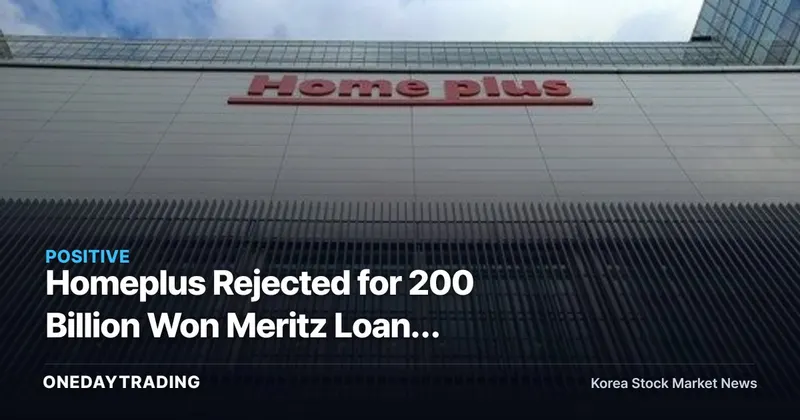
- Homeplus publicly urged the government on June 24 to provide support to prevent bankruptcy, stating that Meritz had rejected a loan of roughly 200 billion won during its rehabilitation process.
- Since Homeplus is an unlisted company held by private equity firm MBK, there is no directly listed stock affected by the cash crunch itself, but the shift in large discount store market share and the potential spillover of distress to suppliers are the key investment variables.
- Offline grocery retail rivals Emart and Lotte Shopping are seen as potential beneficiaries as commercial catchment areas shift, but since the industry itself is structurally losing ground to online retail, the extent of the benefit is likely limited.
What's Changing
The core of this issue is not simply one company's cash-flow trouble — it's that a major retailer under court receivership has had its debtor-in-possession (DIP) financing channel blocked. A company in rehabilitation needs new funding to keep operating, and when that channel is cut off, store operations, merchandise purchasing, and supplier payments are all destabilized at once. This is the background behind Homeplus directly raising the specter of bankruptcy and calling for government intervention.
From an investor's perspective, what matters is the impact along two tracks. The first is the competitive landscape. South Korea's large discount store market is a three-way race among Emart, Homeplus, and Lotte Mart. If Homeplus reduces its store count or closes locations, demand for groceries and household goods in those catchment areas could shift to nearby Emart or Lotte Mart stores. The more overlapping the store locations, the larger the market-share shift.
The second is credit contagion. Since Homeplus has relied heavily on supplier payment terms and short-term funding markets, a prolonged liquidity crunch could bring both accounts-receivable collection risk for grocery and household-goods suppliers and heightened credit caution in short-term funding markets. In other words, this is an opportunity for competitors and a risk for the supply chain — moving in tandem.
Numbers in Context
The key figure is the rejected loan of 200 billion won. Since this is largely short-term working capital for a company in rehabilitation, the more troubling signal is not the size itself but that lenders' willingness to extend funding has faltered. Whether the government will step in is a matter of policy judgment, so the timing and form remain uncertain — until public support materializes, whether supplier payments normalize will serve as the first gauge of whether the situation is stabilizing.
Stocks to Watch: Winners and Losers
- Emart: As the No. 1 large discount store chain with a high grocery weighting, Emart could see customer traffic and sales shift its way in overlapping catchment areas if Homeplus scales back stores. That said, its core business is already being slowed by online penetration, so the benefit would only be partial.
- Lotte Shopping: As a grocery retail competitor through Lotte Mart, it shares the same catchment-area transfer benefit. However, because its portfolio spans department stores and discount stores together, the effect is diluted.
- Grocery and household-goods suppliers: Listed suppliers with a high share of sales tied to Homeplus are directly exposed to payment delays and potential accounts-receivable losses.
- Card and credit-lending exposure: Financial firms linked to short-term financing and accounts payable could face provisioning variables as the rehabilitation proceeds.
Risk Check
- Because the large discount store industry itself is structurally losing ground to online players like Coupang, there's no guarantee that Homeplus's weakening will directly translate into improved earnings for competitors.
- With the scope and form of any government support uncertain, a prolonged situation could dampen investment sentiment across the retail sector as a whole.
- If distress at suppliers spreads to listed grocery and household-goods vendors, unexpected loss recognition could follow.
- Short-term share-price reactions on expectations of competitor benefits carry high volatility until valuation pressure eases and the actual market-share transfer is confirmed.
Bottom Line
Homeplus's liquidity crunch opens up a market-share transfer opportunity for rival discount chains, but with online-shift pressure and supplier/short-term-funding-market risks weighing at the same time, this is a moment to weigh both the benefits and the risks together. Key things to watch are the normalization of supplier payments, the government's support decision, and customer-traffic figures in competitors' next earnings.
Emart in Real-Time Data
Emart's most recent closing price was 80,400 won (-1.23% vs. the previous day), and the composite signal combining foreign investor/institutional investor supply-demand (order flow) with news and momentum reads 🟡 Neutral / Wait-and-see. With positive and negative signals mixed, this is a stretch worth watching closely.
- ▼ Trend Alignment — Short- and medium-term downtrend alignment (Today -1.2% · 1 Week -11.6% · 1 Month -14.3%)
Recent related news shows 1 positive catalyst and 0 negative catalysts, a favorable mix.
※ Price and foreign/institutional investor supply-demand (order flow) data are provided by Korea Investment & Securities (KIS) and reflect figures as of the time of publication.
This article is automatically summarized and analyzed content based on the original news report. View Original (Yonhap News)