
Korea Inclusive Finance Agency-Woori Card Pact Reshapes Support Pathway
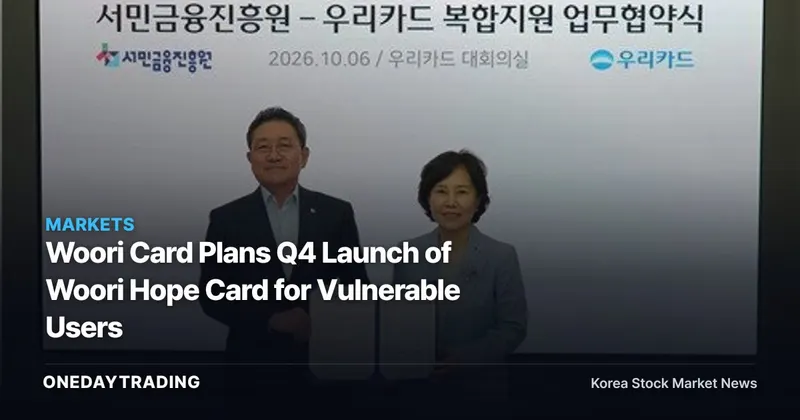
The Korea Inclusive Finance Agency and Woori Card announced a business agreement on October 6, 2026, to expand integrated support for people facing financial hardship. For investors, the key point is not the card launch itself but the structure, which connects applicants with integrated support services before providing a financial product. The announcement does not confirm any change in Woori Card’s earnings; its significance is primarily policy-related, as it creates a new pathway to identify and assist vulnerable people at risk of financial exclusion.
The Woori Hope Card (tentative name), a dedicated card for integrated support, is structured to connect applicants first with the Korea Inclusive Finance Agency’s services and then provide a specialized financial product. According to Yonhap News, the agreement is a follow-up measure to the “Suicide Prevention Measures for People Facing Financial Hardship,” jointly pursued by the Financial Services Commission and other relevant agencies. The agreement centers not only on who qualifies for the card, but also on the sequence in which eligible applicants are connected with support.
Woori Hope Card Targets Vulnerable Users Above the Bottom 20%
According to Yonhap News, the existing Sunshine Loan Card is available to people whose credit scores rank in the bottom 20% and whose disposable income is 60 million won or less. The Woori Hope Card (tentative name) targets vulnerable people whose credit scores are higher than that group’s but who still have difficulty obtaining a conventional credit card. In effect, it establishes a separate integrated-support category for people who fall outside the existing criteria yet struggle to qualify for standard card issuance.
For the existing Sunshine Loan Card program linked by the Korea Inclusive Finance Agency, the credit-score threshold is the bottom 20%, while the disposable-income ceiling is 60 million won. The new card has not been announced as a straightforward expansion of those criteria. The only confirmed detail is that it will target vulnerable people with higher credit scores than existing recipients; specific issuance criteria have not been provided.
How Financial Services Commission Measures Lead to a Card Launch
The agreement is designed to detect signs of financial hardship early and connect affected people with specialized financial products. Here, integrated support does not mean simply issuing a standalone card; it refers to a process that links applicants with the Korea Inclusive Finance Agency’s support services before card issuance. It reveals the policy’s implementation pathway as an initial step in translating measures by the Financial Services Commission and other relevant agencies into an actual consumer-facing product.
President Kim Eun-kyung emphasized that this is the first initiative in which the agency and a card issuer will work together to identify early signs of financial hardship and connect affected people with assistance. She also said the agency would practice “finance that saves lives,” helping people in financial distress avoid exclusion from the financial system and get back on their feet. Her remarks likewise focused on detecting warning signs and providing support, rather than expanding card usage.
Woori Card Investment Outlook and the Numbers Still Missing
From a stock-market perspective, the policy implications must be distinguished from any impact on corporate value. Although the agreement and launch plan have been confirmed, the Woori Hope Card’s benefits, detailed issuance criteria, number of eligible recipients, and program budget have not been disclosed. The available information is insufficient to calculate the card’s potential usage or profit impact on Woori Card, and there is no basis for identifying any listed company as a direct beneficiary.
The key decision point will be the disclosure of product details. If the fourth-quarter launch remains on schedule, the next step will be to confirm the final product name and issuance criteria. A broader scope of support would expand the policy’s reach, but the extent of that expansion cannot be assessed until the number of eligible recipients and detailed terms are released. For now, the market can evaluate the partnership structure, while the scale of the program remains too uncertain to price in.
Four Items to Check at the Fourth-Quarter Launch
- Final product name and benefits: The current name is Woori Hope Card (tentative name), and specific benefits have not been disclosed.
- Actual issuance criteria: The only confirmed direction is that eligible applicants will have higher credit scores than existing Sunshine Loan Card recipients. How vulnerable people who struggle to obtain conventional cards are defined will determine the product’s scope.
- Integrated-support referral process: The key issue is how the principle of connecting applicants with Korea Inclusive Finance Agency services before card issuance will be incorporated into the actual product process.
- Scale of support and budget: The number of eligible recipients and the program budget must be disclosed before the agreement’s policy reach and its impact on Woori Card can be assessed in detail.
The next milestone is the fourth quarter, when the two organizations plan to launch the card. Once the product name is finalized and the issuance criteria and benefits are announced, investors will be able to assess the gap between the policy’s objectives and its real-world scope. Until then, it is more accurate to keep the “creation of a new support pathway for vulnerable people” separate from any claim of a “change in corporate earnings.”
This article was automatically summarized and analyzed based on the original news report. View the original article (Yonhap News)