
At a Glance
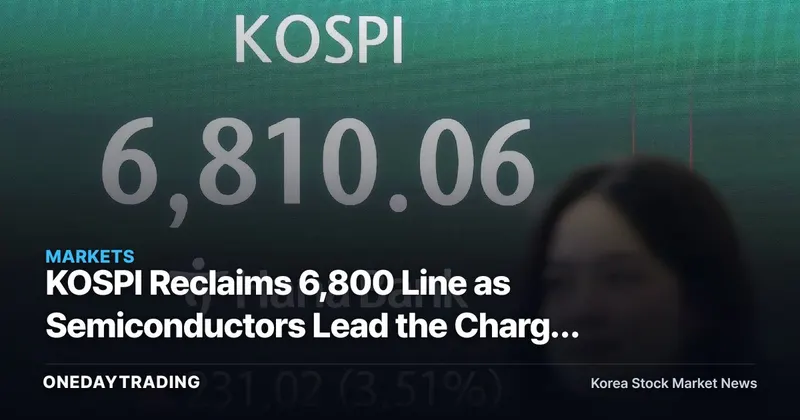
The KOSPI has climbed back above the 6,800 level, rising for four consecutive trading sessions. The advance was driven by semiconductor sector bellwethers, but it comes barely a month after the index suffered a sharp drop from the 7,000 level on the 24th of last month. Among market participants, the concern isn't so much the size of the rebound as how narrow its breadth is.
Why It Matters Now
When the index rises for four straight days, headlines read it as a KOSPI rally, but what the numbers actually reflect is a valuation adjustment in a handful of large-cap semiconductor stocks. Because the KOSPI is a market-capitalization-weighted index, moves in a few mega-cap stocks such as Samsung Electronics (005930) and SK Hynix (000660) can dictate the direction of the entire index. It's only natural for the index to rise on a day when semiconductors rally — that alone isn't a signal that earnings expectations have improved across KOSPI-listed companies broadly. Failing to distinguish between the two makes the rebound feel larger than it actually is.
More importantly, the sharp drop from the 24th of last month has not been fully reversed. The recovery from the 7,000 level to the 6,800 range only fills in part of the decline — it does not restore the index to its pre-plunge level. What the market has already priced in is short-term relief over the semiconductor industry outlook; what it has not yet priced in is whether the macro variables that triggered the plunge have actually been resolved.
For the rebound to mark a genuine trend reversal, two conditions need to be confirmed: whether the rally broadens beyond semiconductors into other industry sectors, and whether foreign investor and institutional investor supply-demand (order flow) continues for several days rather than reversing after a single session. If either condition fails, the 6,800 level turns from a support point into a precarious spot from which the index could slip again.
Frequently Asked Questions
- Is the KOSPI's four-day winning streak a genuine trend reversal? The concentration in large-cap semiconductor stocks is still too strong to read it as a sign of broad sector-wide improvement. The key thing to watch is whether the number of advancing stocks (tickers) and trading value rise together.
- Has the cause of last month's sharp drop from the 7,000 level been resolved? The index level alone can't answer that. The first thing to check is whether the macro variables that triggered the plunge are still in play.
- What does it mean that retail investors have "left" the domestic market? It's an expression describing the semiconductor-concentration phenomenon, where the index rises but the returns retail investors actually feel don't keep pace.
- Is it safe to buy into large-cap semiconductor stocks (tickers) now? Valuation pressure and where the industry stands in its cycle both need to be weighed together. A short-term rebound and an improvement in earnings are two different things.
Related Stocks and Sector Impact
- Samsung Electronics (005930) and SK Hynix (000660): With their heavy weighting in market capitalization, these two stocks have effectively driven the index rebound, and whether the rally continues will also hinge on supply-demand (order flow) in these two names.
- Semiconductor materials, parts, and equipment stocks: Whether the warmth spreads to these names with a lag — once the large-cap rebound translates into an actual demand recovery — is the real litmus test of broadening momentum.
- Export stocks that benefit from a weaker won: If the exchange rate level is one of the backdrops behind the rebound, industry sectors with heavy export exposure, such as autos and electronics, also have room to move in tandem.
- Brokerage stocks: If trading value and margin trading revive alongside the index rebound, that creates a favorable environment for brokerage earnings.
Points to Watch for Investors
- First check the gap between the index's rate of gain and the returns on your own individual holdings. If your semiconductor exposure is low, the rebound you actually feel may be smaller than what the index shows.
- Track the ratio of advancing stocks (tickers) to declining ones, along with the trend in trading value, to check whether the rebound is confined to specific names or genuinely broadening.
- Break down foreign investor and institutional investor buying by channel to see whether the net buying is a one-day event or continues over several days.
- Check the KRW/USD exchange rate level and the upcoming monetary policy schedule (the Bank of Korea's Monetary Policy Committee, the U.S. Fed's decisions) to confirm whether the macro conditions behind the rebound are holding up.
Overall Outlook
In the optimistic scenario, expectations for an improving semiconductor industry outlook are backed up by actual demand and pricing data, foreign investor flows continue for several days or more, and the rally broadens to materials, parts, and equipment makers as well as export stocks. In that case, the 6,800 level becomes a stepping stone, and a renewed attempt at 7,000 would have real grounds. Conversely, if the rebound stays confined to a handful of semiconductor names without trading value broadening, and loses steam within a few days, the risk remains that a retracement like last month's could repeat. Rather than the index level itself, the breadth of the broadening and the persistence of supply-demand (order flow) are the variables that will determine the true character of this rebound.
This content was automatically summarized and analyzed based on the original news article. View original (Maeil Business Newspaper, Securities)