
Key Takeaways
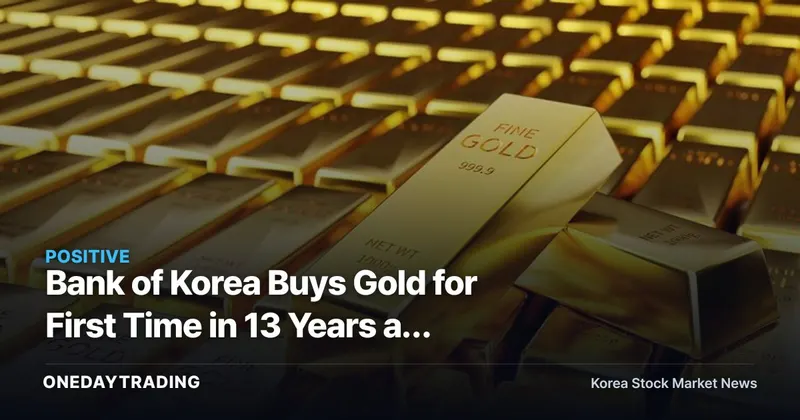
Thirteen years. That's how long it has been since the Bank of Korea last increased its gold holdings. Now, with international gold prices having pulled back from record highs to take a breather, the Bank of Korea has broken that long silence and started buying, while China's central bank has been expanding its holdings for months. The key to this round of buying is timing: central banks are purchasing not when prices are hot, but when they cool.
What Happened
According to a Maeil Business Newspaper report, central bank buying has resumed now that international gold prices, which had set an all-time high, have recently stabilized. The People's Bank of China, regarded as the single largest buyer in the gold market, is significantly increasing its holdings, and the Bank of Korea has bought gold again for the first time in 13 years.
Retail investors typically jump in late when prices are rising and pull back when they fall. Central banks move in the opposite direction. A phase in which a rally cools and prices take a breather is precisely when they replenish reserve assets. That this is exactly such a phase is the signal sent by the resumption of buying.
Background and Context
Gold pays neither interest nor dividend. That narrows the variable driving its price down to a single factor: real interest rates. When real rates are low or falling, the opportunity cost of holding a non-yielding asset like gold shrinks, pushing prices up, and central banks use such periods to rebalance foreign exchange reserves that are heavily weighted toward dollar-denominated assets. Both China's trend of trimming U.S. government bonds while raising its gold weighting, and the Bank of Korea's return to buying after a 13-year gap, rest on the same diversification logic.
The question is how much of that logic is already priced in. The record high was driven by a combination of expectations for falling real rates and central bank demand. The current pause in the rally means those expectations have taken a hit, and the central banks' buying-the-dip reads as an attempt to put a floor under prices at this lower level.
Impact on Markets and Stocks (Tickers)
- Korea Zinc: a leading domestic non-ferrous metals company that extracts and sells gold and silver as byproducts of its zinc and lead smelting process; as a floor forms under gold prices, the margin resilience of its byproduct revenue should improve as well.
- Physical gold and ETF distribution channels: in a phase where central bank demand supports a price floor, retail buying of gold bars and related products tends to follow with a lag.
- Won-denominated assets and the foreign exchange market: the Bank of Korea's resumption of purchases signals reserve diversification and could be read as a policy stance aimed at reducing reliance on any single currency or asset class.
- Precious metals processing and jewelry companies: if gold prices rise again, raw material costs increase and margins come under pressure, so it is difficult to frame this resumption of buying as a positive catalyst for every related industry sector.
Investor Checkpoints
- Check the change in the gold holdings line item and the scale of purchases in the foreign exchange reserves data the Bank of Korea releases at the start of each month.
- Watch the People's Bank of China's monthly gold holdings announcements to see whether the pace of buying holds up or slows.
- Monitor the U.S. Federal Reserve's next rate decision and the trajectory of real interest rates — if real rates rise faster than expected, gold's appeal as a non-yielding asset will diminish immediately.
- Track the dollar index and the KRW/USD exchange rate level — a renewed dollar rally could also slow the pace of central banks' diversification buying.
Outlook
In the optimistic scenario, central bank buying keeps reinforcing the floor and gold continues a gradual uptrend. But the opposite scenario also deserves attention. If real rates rise faster than the market expects, or if the dollar turns strong again, central bank buying alone may not be enough to offset an exodus of retail and speculative demand. The current price is merely a step back from the all-time high, and the only evidence so far for a new upward cycle is the central bank purchase data itself. The next confirmation points are the Monetary Policy Board's rate decision, U.S. CPI, and the level at which the KRW/USD exchange rate settles.
Korea Zinc: Real-Time Data Snapshot
Korea Zinc's most recent closing price was KRW 1,106,000 (-10.37% from the previous session), and the signal light combining foreign investor/institutional investor supply-demand (order flow) with news and momentum reads 🔴 Caution. Foreign investor flows and momentum are negative, so caution is warranted right now.
- ▼ Supply-Demand (Order Flow) Continuity — foreign investors have posted net sales for 5 straight sessions (−1.4 billion won)
※ Price and foreign/institutional investor supply-demand (order flow) data are provided by Korea Investment & Securities (KIS) and reflect the time of publication.
This article was automatically summarized and analyzed based on the original news report. View Original (Maeil Business Newspaper, Securities)