
At a Glance
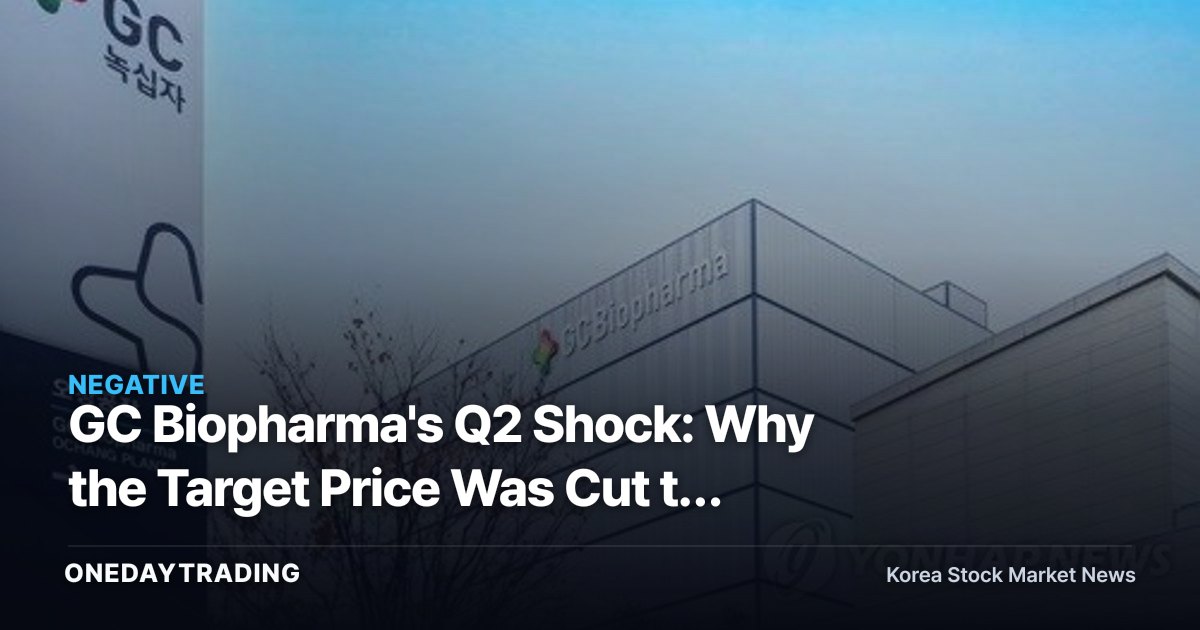
GC Biopharma's disappointing second-quarter earnings are not simply a one-off quarterly fluctuation. Daol Investment & Securities' decision to cut its target price to 210,000 won signals a widening gap between the pace of profit recovery the market expected and the company's actual bottom line.
For bio-pharma stocks, the quality of earnings tends to get priced in before revenue growth does. This development signals that GC Biopharma's share price has entered a phase of testing the profitability of its existing businesses, rather than riding expectations for new drugs.
Why It Matters Now
Share prices respond to the numbers in the income statement, not the wording of a press release. The assessment that second-quarter earnings missed expectations means that at least one of the following moved more unfavorably than the market had anticipated: the timing of revenue recognition, cost burden, or SG&A spending. This is the backdrop behind Daol Investment & Securities' decision to adjust its target price to 210,000 won.
GC Biopharma is a company where blood products, vaccines, general pharmaceuticals, and overseas operations all move in tandem. The problem is that having multiple revenue streams is not, in itself, a defense. For blood products, profitability hinges on securing raw plasma and manufacturing efficiency, while vaccines see greater quarter-to-quarter volatility due to seasonality and government/institutional demand. Even if the top line holds up, a rising cost ratio can compress operating profit faster than expected.
The key question for investors is whether this earnings miss is a one-off event or a reassessment of the company's underlying profit strength. A target price cut does not mean the analyst has abandoned the long-term growth story altogether. Rather, it reflects a judgment that the recovery scenario currently priced into the stock was not sufficiently confirmed by the second-quarter numbers.
Frequently Asked Questions
- What is the key takeaway from this news? GC Biopharma's second-quarter earnings fell short of market expectations, and Daol Investment & Securities cut its target price to 210,000 won.
- Why does the target price cut matter? Pharmaceutical stocks are valued on both clinical-trial expectations and the profitability of existing businesses. When earnings fall short, the profit assumptions built into the valuation can be lowered.
- Is this a structural negative catalyst for GC Biopharma? It is too early to conclude that. However, it is necessary to identify whether the second-quarter weakness stemmed from the cost ratio, SG&A spending, or product mix.
- What should investors watch next? In third-quarter earnings, watch for a recovery in revenue from the blood-products and vaccine segments, the operating profit margin, and the contribution from overseas sales.
Related Stocks and Sector Impact
- GC Biopharma (stock/ticker). The direct subject of this news. The target price cut to 210,000 won is a factor that lowers near-term earnings expectations.
- Pharma/bio sector. Market sentiment demanding earnings validation over clinical momentum could strengthen. This is especially a discount factor for companies whose revenue is growing but whose margins remain low.
- Vaccine-related stocks. This reaffirms that quarterly earnings volatility can widen depending on seasonal demand and procurement schedules.
- Blood-products business. Securing raw materials, production efficiency, and expanding overseas approvals and sales emerge as the key variables for a margin recovery.
Investment Considerations
- The 210,000-won target price is a directional reference point, not a guaranteed return figure. The actual share price will respond to both changes in the earnings outlook and market interest rates.
- Investors should distinguish whether the second-quarter weakness stemmed from one-off costs or a deterioration in product mix. Even the same earnings miss can have a different impact on valuation depending on the cause.
- If operating margin improvement is not confirmed in third- and fourth-quarter earnings, the stock could react more sensitively to margin deceleration than to revenue growth.
- Even if bio-related catalysts emerge, if the cash-generating power of existing businesses weakens, any resulting optimism may be reflected in the share price only briefly.
Overall Outlook
The optimistic scenario for GC Biopharma is straightforward: if the second-quarter weakness stemmed from one-off costs and differences in quarterly revenue recognition, and if blood-products and vaccine sales normalize in the second half, the impact of the target price cut could prove limited. In that case, the market would once again turn to evaluating the company's overseas expansion and the defensive strength of its product portfolio.
The opposing scenario is more sobering. If the earnings miss reflects a problem in the cost structure or product mix, the stock would be reassessed not as a growth name but as a pharmaceutical company with wavering profit margins. By analyst Park Se-ra's yardstick, what the market needs to confirm this time is not the company's own explanation but next quarter's bottom line. If the third-quarter earnings release fails to show an improved operating margin and a segment-by-segment revenue recovery, the new 210,000-won target will not serve as a floor — it will become just another line to be tested.
GC Biopharma by the Numbers
GC Biopharma's latest closing price is 112,800 won (-2.67% versus the previous day), and the composite signal combining foreign investor/institutional investor order flow with news and momentum is 🔴 Caution. Foreign investors, institutional investors, and momentum are all negative, so caution is warranted at this time.
- ▼ Combined selling — foreign investors −0 won · institutional investors −200 million won, selling in tandem
- ▼ Trend alignment — short- and medium-term downtrend alignment (day -2.7% · 1 week -8.8% · 1 month -9.0%)
- ▼ 52-week range position — near the 52-week low, at the 6% percentile
※ Price and foreign/institutional investor order-flow data are provided by Korea Investment & Securities (KIS) and are current as of the time of publication.
This article is automatically summarized and analyzed content based on the original news report. View original (Yonhap News Agency, Securities)