
Key Takeaways
MSCI's upgrade of its assessment of the availability of investment instruments tied to Korea's stock market is a signal that lowers the entry threshold for discussions on inclusion in the Developed Markets (DM) Index. That said, this is less an immediate positive catalyst than groundwork that raises the medium- to long-term likelihood of inflows from foreign passive funds. Once the June 24 decision on watchlist inclusion is announced, the supply-demand (order flow) direction for brokerage stocks and for large caps with high foreign ownership could be reset for a stretch.
What Happened
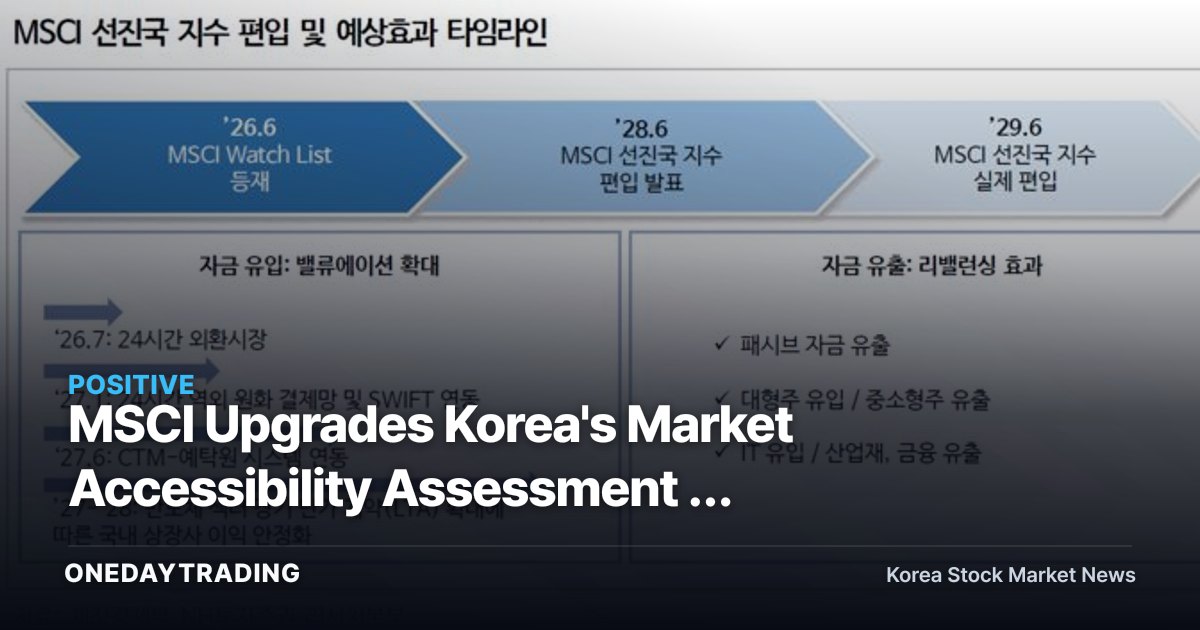
Among the 18 detailed market-accessibility criteria MSCI uses to evaluate Korea's stock market, it maintained its judgment that 5 areas — including foreign exchange market liberalization, settlement and clearing, and information access — still require improvement. At the same time, it raised its assessment of the criterion covering the availability of derivatives and investment instruments linked to Korean indices.
Based on these assessment results, MSCI will decide on June 24 (announcement in local time) whether to add Korea to the watchlist for inclusion in the Developed Markets Index. Watchlist designation is the step preceding actual inclusion, and typically even after designation it involves more than a year of additional review and confirmation of institutional improvements.
The reason the headline asks whether this is a positive catalyst or a negative catalyst is clear. Inclusion in developed markets raises the standing of Korea's stock market, but Korea is currently a heavily weighted component of the Emerging Markets (EM) Index, so it carries a two-sided dynamic in which some outflows from EM-tracking funds and new inflows into DM cross over each other.
Background and Context
Korea has attempted to be upgraded to developed-market status several times since 2008, but issues such as foreign exchange market accessibility, the short selling system, and the lack of English-language disclosures have held it back. With the government recently pushing to extend foreign exchange market trading hours and to abolish the foreign investor registration system, some of the key obstacles have been partly resolved, and this upgrade of the availability assessment is aligned with that trend.
Impact on the Market and Stocks
- Brokerage stocks: As foreign investor trading value and trading in derivatives and linked instruments rise, revenue from brokerage commissions and product management expands directly. Mirae Asset Securities, Samsung Securities, and Korea Investment Holdings are leading candidates to benefit first.
- Large-cap export and semiconductor stocks: Samsung Electronics and SK Hynix have a high foreign passive weighting, so new tracking funds could flow in upon DM inclusion; however, given their large weight in the EM Index, short-term supply-demand (order flow) could swing in both directions.
- Index and ETF management: The upgrade in the availability of MSCI Korea-linked instruments widens the room for designing passive ETFs and derivatives, stimulating related management demand.
- The KOSPI overall: If developed-market inclusion becomes reality, estimates of a fund reallocation on the order of tens of billions of dollars are being discussed, but this is a long-term scenario that comes after inclusion is confirmed.
Investor Checkpoints
- Confirm whether Korea is actually designated to the watchlist in MSCI's June 24 annual market classification announcement.
- Track the schedule and timing of follow-up government institutional improvements for the 5 criteria judged insufficient, including foreign exchange and settlement.
- Check supply-demand (order flow) signals through foreign net buying trends and the won-dollar exchange rate level before and after the announcement.
- Check brokerage stocks' dependence on foreign investor trading value and changes in commission revenue in next quarter's earnings.
Outlook
If institutional improvements continue and watchlist designation is confirmed, expectations of a passive-fund reallocation over the next one to two years could work favorably for the supply-demand (order flow) of brokerage stocks and key large caps. Conversely, if watchlist designation is again delayed or improvements to the 5 insufficient criteria are postponed, expectations could turn to disappointment and short-term volatility could increase. The timing gap between EM fund outflows and DM inflows is also a variable, so rather than inclusion itself, the pace of fund reallocation and the trajectory of the exchange rate are likely to be the key factors that determine actual profit and loss.
This article is content automatically summarized and analyzed based on the original news report. View the original (Maeil Business Newspaper, Securities)