
Key Takeaways
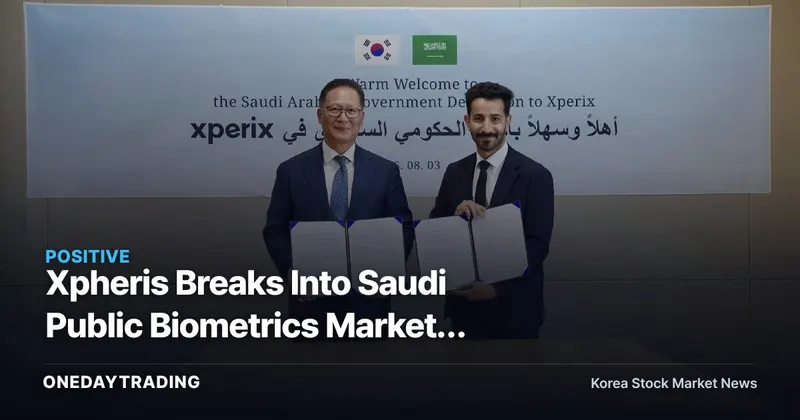
Biometrics specialist Xpheris has signed a strategic memorandum of understanding (MOU) with Alyamamah, a Saudi Arabian local company, and been named the only South Korean company to hold official partner status in Saudi Arabia's public-sector biometrics and electronic-document business. However, it's important to first note that this agreement is not a confirmed contract that will be booked as revenue — it is a stage at which one door toward revenue has opened.
What Happened
Xpheris announced it has signed a strategic MOU with Saudi local company Alyamamah to cooperate exclusively on Saudi Arabia's public-sector biometrics and electronic-document business. Among domestic biometrics companies, Xpheris is the only one selected as an official partner for this business. Public authentication systems that handle biometric data such as fingerprints and facial recognition tend to have stringent security-clearance and localization requirements, so foreign companies often opt for a consortium structure through a local partner rather than entering the market alone. Securing a local channel through Alyamamah means Xpheris has established a pathway to clear regulatory barriers.
That said, an MOU is different in nature from a legally binding supply contract. It is only an agreement in principle on the scope of business and mode of cooperation; the actual order volume and contract value must still be finalized through Saudi public institutions' procurement process. If the market reacts to this news, the magnitude of that reaction should reflect a reassessment of market-entry potential itself — not confirmed revenue.
Background and Context
Under its Vision 2030 national strategy, Saudi Arabia is rapidly expanding its e-government and digital identity infrastructure. The trend of adopting biometrics-based electronic-document systems for citizen identification, immigration control, and access to public services is not unique to Saudi Arabia — it aligns with the broader digital-transformation direction across oil-producing Middle Eastern nations. For South Korean biometrics companies, this opens up overseas public procurement markets that could help them move beyond the limits of the domestic market, but it also means exposure to the pace of government budget execution and local political and administrative variables.
Market and Stock (Ticker) Impact
- Xpheris: By securing status as South Korea's sole official partner, the company has built a reference case for entering the Middle East public procurement market. If a follow-on definitive contract is signed, it would provide grounds for expanding the company's share of overseas revenue.
- Domestic biometrics and electronic-document authentication solution industry: As successful cases of Middle East expansion by specific companies accumulate, this could serve as a positive reference point for confidence in overseas procurement markets across the industry as a whole.
- Small-cap KOSDAQ stocks (tickers) related to information security and public-sector systems integration: There is room for growing investor interest in the overseas public-procurement theme.
- Risk factors: Since MOUs carry the possibility of being cancelled or delayed, excessive expectations should be avoided across stocks (tickers) where contract uncertainty remains.
Investor Checkpoints
- Whether and when an actual supply contract (definitive contract) is signed following the MOU
- Disclosure of the specific order size and business scope from Saudi public institutions
- Alyamamah's business scope, its local procurement execution capability, and the stability of the consortium structure
- If a contract is finalized, the timing of revenue recognition and the quarter in which it is reflected in the order backlog
Outlook
The optimistic scenario is that this agreement leads to actual adoption in Saudi Arabia's national digital identity infrastructure project, which then serves as a reference for winning orders that spread to other Middle Eastern countries. Public procurement of biometrics systems tends to lead to long-term contracts once adopted, given the high cost of switching systems, so the ripple effect of an initial successful entry would not be small. Conversely, given the nature of Saudi public procurement procedures, it will take time before budget allocation and bidding are finalized, and the possibility that contract terms or the partner composition could change at the final stage cannot be ruled out. At this point, what will determine the real value of this story is not the agreement itself, but whether follow-on contract disclosures emerge within the next few months.
This article was automatically summarized and analyzed based on the original news source. View original (Maeil Business Newspaper, Securities)