
At a Glance
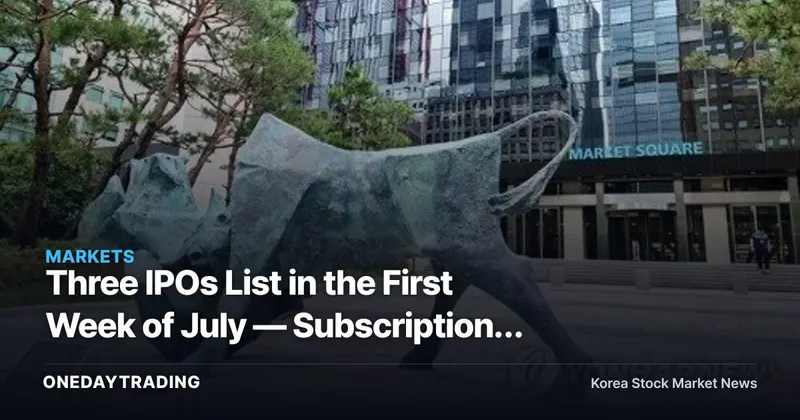
In the domestic equity market this week — bridging late June into early July — three new listings are scheduled alongside one IPO subscription and one institutional book-building. More significant than the performance of any individual stock (ticker) is the broader signal that the second-half IPO pipeline is beginning to fill again.
Why It Matters Now
The IPO calendar is more than a listing schedule — it is a thermometer for risk appetite. When new listings cluster and book-building demand ratios run high, it signals that both institutional investors and retail investors have the capacity to allocate capital toward growth stocks. Conversely, a rise in undersubscribed offerings or final pricing at the bottom of the range serves as a warning that liquidity is contracting.
A week like this one — where listings, subscriptions, and book-building all run concurrently — illustrates the velocity of IPO capital rotation. Whether profit-taking proceeds from newly listed stocks flow immediately into the next subscription, or shift to a wait-and-see posture, will determine the momentum of follow-on deals. July is particularly notable because it coincides with the Q2 earnings season, meaning peer-company share prices directly feed into valuation benchmarks for IPO candidates.
For underwriting securities firms, a recovery in IPO frequency translates directly into underwriting and placement fee income. Because higher listing volumes and larger offering sizes improve the earnings of securities firms' investment banking divisions, a warming IPO market is also relevant to investment decisions in brokerage stocks.
Frequently Asked Questions
- Why does book-building matter? The institutional demand ratio and the lock-up commitment rate determine the offering price and the supply-demand (order flow) dynamics in the early trading days after listing. A low lock-up commitment rate increases the volume of shares available for sale on the first day, amplifying price volatility.
- Does a high subscription demand ratio always mean good news? The higher the demand ratio, the smaller the pro-rata and equal allocation, meaning investors receive fewer shares. Overheating also carries the risk of a sharp drop (plunge) immediately after listing.
- Is it safe to buy on listing day? Stocks that open significantly above their offering price are prone to reversals as distributed shares hit the market. Investors should first check the lock-up release schedule and the proportion of freely tradable shares.
- Is now a good time to invest in IPOs? Rather than relying on the overall market mood, it is safer to evaluate each company's earnings visibility and the reasonableness of its offering price band independently.
Impact on Related Stocks and Sectors
- Underwriting securities firms IPO underwriting and placement fees flow directly into IB earnings, making a recovery in listing volumes favorable for major brokerages such as Mirae Asset Securities, NH Investment Securities, and Korea Investment Holdings.
- IPO funds and asset managers More new listings create more allocation opportunities, expanding the operational capacity of IPO-focused funds.
- KOSDAQ growth industry sector With the majority of new listings concentrated on KOSDAQ, the sector weighting within the index and supply-demand (order flow) dynamics are both affected.
- Existing listed peers When a newly listed company operates in the same industry sector, comparable valuations are recalibrated, rippling through the valuation multiples of existing stocks (tickers) in that space.
Key Investment Considerations
- Check whether the final offering price falls at the top or bottom of the band and review the institutional book-building demand ratio to assess whether the deal is overheated or undersubscribed.
- Compare the proportion of freely tradable shares on listing day against the institutional lock-up commitment rate to gauge early selling pressure.
- Equal-allocation subscriptions often result in a very small number of shares received; assess capital efficiency accordingly.
- Given the overlap with the Q2 earnings season, monitor how peer-company share price movements affect the fair-value assessment of IPO candidates.
Overall Outlook
The resumption of second-half IPO scheduling is a positive catalyst from the standpoints of recovering risk appetite and improving securities firms' IB earnings. That said, short-term volatility in newly listed stocks, supply-demand (order flow) pressure from lock-up expirations, and concerns about overpriced offerings remain variables that could trigger reversals at any time. Given the recurring pattern of strong subscription demand diverging from post-listing price performance, investors are better served by assessing each company's offering terms and supply-demand (order flow) structure independently rather than being swept along by market sentiment.
This content was automatically summarized and analyzed based on the original news article. View original article (Yonhap News — Securities)