
Key Takeaways
Greg Abel, the designated next CEO of Berkshire Hathaway, has obtained U.S. citizenship. While this may appear to be a routine personal matter, the timing — coming as the post-Buffett leadership transition draws near — gives Berkshire shareholders reason to read it as a signal of leadership continuity. That said, citizenship itself is not an event that directly drives earnings or share price.
What Happened
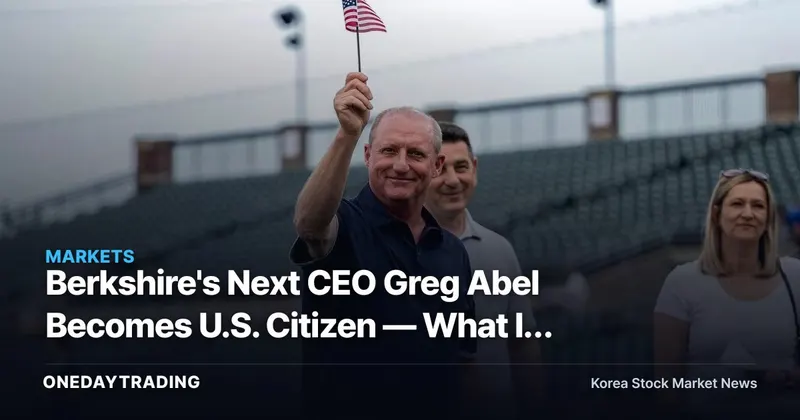
Born in Edmonton, Canada in 1962, Greg Abel has long resided in Iowa, and took his oath of U.S. citizenship at an annual naturalization ceremony hosted by the Iowa Cubs baseball club in Des Moines. Approximately 20 individuals from 16 countries participated in the event alongside him.
Abel serves as Vice Chairman overseeing Berkshire Hathaway's non-insurance operations, and is the individual Warren Buffett has publicly named as his successor. The fact that a Canadian-born executive obtained U.S. citizenship on the eve of assuming leadership of America's flagship conglomerate carries meaningful symbolic weight.
Background and Context
Berkshire Hathaway is a diversified conglomerate with vast operations spanning insurance, railroads, energy, manufacturing, and consumer goods, alongside a massive listed-equity portfolio. Among the risks the market has long monitored most closely is the question of post-Buffett succession — the so-called key-man risk. The clarification of the succession picture, now further reinforced by the successor's acquisition of U.S. citizenship, can be interpreted as reducing uncertainty on regulatory and governance fronts by one degree.
Market and Stock (Ticker) Impact
- Berkshire Hathaway: Formalizing the successor's personal credentials reduces potential friction in the leadership transition process. However, what ultimately drives the share price is insurance underwriting profit, operating cash flow, and portfolio mark-to-market gains and losses — not this event itself.
- Governance Premium: As key-man risk diminishes, the discount attributed to succession uncertainty narrows, which may support long-term investors' confidence in holding the stock.
- Core Berkshire Holdings: Whether the incoming leader maintains the current investment philosophy will influence future portfolio additions and reductions, giving indirect supply-demand (order flow) significance to stocks with large position sizes in Berkshire's portfolio.
Investor Checkpoints
- Official succession timeline: Monitor Buffett's announcements on the phased transfer of management authority and key messages at the next annual general meeting.
- Quarterly earnings: Track insurance underwriting profit, operating profit trends, and changes in cash and equivalents to assess management continuity.
- Portfolio changes: Review quarterly 13-F filings to see whether the investment posture is being maintained.
- Share buyback policy: Whether capital allocation priorities shift during the transition period is an important indicator to watch.
Outlook
On the optimistic side, a more firmly established successor could gradually allay market concerns about the single greatest uncertainty surrounding Berkshire — life after Buffett. On the other hand, how Abel performs on actual capital allocation and M&A decisions remains unproven territory. Until consistency and profitability in post-succession decision-making are demonstrated, it is more reasonable to view this citizenship news as a long-term variable that removes one layer of governance risk — rather than as a near-term share price catalyst.
This content was automatically summarized and analyzed based on the original news source. View original article (CNBC)