
At a Glance
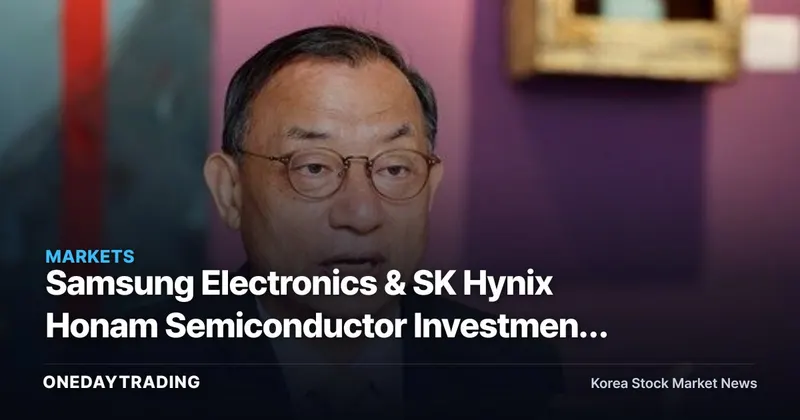
Former lawmaker Lee Jeong-hyeon's comments — arguing that scrutiny of Honam semiconductor investment is warranted but should not have a chilling effect — have thrust the question of regional investment by Samsung Electronics and SK Hynix back into the political arena. The crux of the matter is not an actual corporate investment decision but a divergence in political positions; this is a medium-to-long-term site selection and policy variable, not a near-term share price catalyst.
From an investor's perspective, what matters is not the remarks themselves but whether a non-capital-region semiconductor cluster remains a live policy agenda item.
Why It Matters Now
The center of gravity for domestic semiconductor investment sits firmly in the southern Gyeonggi mega-cluster. Samsung Electronics has concentrated its large-scale capital expenditure around Pyeongtaek and Yongin lines, while SK Hynix has focused on Yongin and Icheon — a structural pattern in which new fabs gravitate toward areas near the capital with established power, water, and workforce infrastructure. The Honam investment thesis is both a policy attempt to rebalance this concentration and a proposal that demands rigorous economic feasibility assessment — two sides of the same coin.
The political call for scrutiny amounts to a business viability review. For a semiconductor fab, the critical site requirements are a stable power supply, large-scale industrial water access, a supplier ecosystem, and proximity to a highly skilled talent pool. Without these, companies have weak organic incentives to invest, and a policy package — subsidies, tax incentives, infrastructure support — ultimately becomes the deciding variable.
Conversely, the cautionary view — that investment should not be chilled — draws on the rationale of balanced regional development and future site diversification. That rationale, however, is separate from corporate capital allocation logic, and investors must distinguish between political rhetoric and actual investment disclosures.
Frequently Asked Questions
- Has actual investment been confirmed by these remarks? No. These are simply position statements by political figures; neither Samsung Electronics nor SK Hynix has disclosed a specific investment plan or site decision.
- Why does semiconductor investment concentrate near the capital? Power and water infrastructure, a dense supplier base, and easier talent acquisition all lower the operational risk of new fabs in the greater Seoul region. Regional investment presupposes policy support to bridge that gap.
- Who benefits if a regional cluster moves forward? Direct beneficiaries include site development, power, and construction infrastructure companies; indirect beneficiaries include materials, components, and equipment (MCE) suppliers.
- Is there a near-term share price impact? At the stage of remarks, the impact is limited. A meaningful momentum catalyst would require an actual letter of investment intent or a confirmed site disclosure.
Related Stocks & Sector Implications
- Samsung Electronics Cited as one pillar of the Honam investment debate, but its current capital expenditure thrust is concentrated on the Pyeongtaek and Yongin lines, leaving the impact limited until an actual decision is made.
- SK Hynix Given its investment roadmap centered on the Yongin cluster, any new regional investment would be an incremental consideration; the extent of policy support is the key variable.
- Semiconductor MCE Sector Wherever a new fab is sited, equipment and materials orders follow, opening a benefit channel once a cluster is confirmed — though a site decision is a prerequisite.
- Construction & Infrastructure Site development and large-scale power and water facilities represent the most direct link.
- Regional Power & Utilities Fabs consume enormous amounts of electricity, necessitating investment in transmission and distribution infrastructure.
Investment Caveats
- There is a significant time lag and uncertainty between political statements and actual corporate investment disclosures. Chasing related stocks (tickers) based solely on position statements may represent an overinterpretation.
- For regional investment, the cost burden of infrastructure and talent is the crux of economic viability. A negative assessment could suspend the initiative entirely.
- With investment already concentrated in capital-region clusters, additional regional investment may rank lower in capital allocation priorities.
- Stocks (tickers) that have seen a sharp gain (surge) on theme-driven expectations may be exposed to volatility unsupported by fundamentals, warranting a valuation check.
Comprehensive Outlook
In an optimistic scenario, policy support and infrastructure buildout align to materialize a non-capital-region semiconductor hub, with benefits spreading to MCE, construction, and power sectors upon site confirmation. Conversely, if an economic feasibility review highlights the limitations of available sites, the debate risks stalling at the level of rhetoric. The checkpoints are clear: investment letters of intent or site-related disclosures from Samsung Electronics and SK Hynix; the government's schedule for announcing cluster and power infrastructure support policies; and whether the next capex guidance includes any mention of regional sites. Until those signals materialize, it is reasonable to treat this as a matter of political discussion rather than investable fact.
Samsung Electronics: Real-Time Data Snapshot
Samsung Electronics's most recent closing price is KRW 339,500 (-5.30% vs. the prior day). The composite signal incorporating foreign investor and institutional investor supply-demand (order flow) alongside news and momentum reads 🔴 Caution. Foreign investor, institutional investor, and momentum factors are all negative — caution is warranted at this time.
- ▼ Supply-Demand (Order Flow) Continuity — Foreign investors have been net sellers for 6 consecutive sessions (−2,014.2 billion won)
- ▼ Dual-Sided Selling — Foreign investors −2,014.2 billion won · Institutional investors −1,209.4 billion won, selling in tandem
- ▲ 52-Week Position — 89th percentile of the 52-week range — near all-time-high territory
- ▲ News Flow — Positive catalysts 32 vs. negative catalysts 19 — positive catalysts in the lead
Recent related news shows 32 positive catalysts and 19 negative catalysts — a favorable balance.
※ Price and foreign investor/institutional investor supply-demand (order flow) data are provided by Korea Investment & Securities (KIS) as of the time of publication.
This content is auto-summarized and analyzed based on the original news article. View original article (Yonhap News Industry)