
Summary
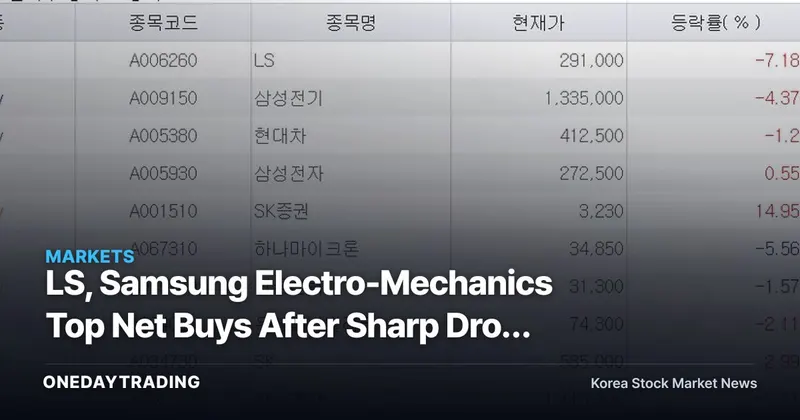
In early trading on the 21st, the top 1% of investors by trading returns loaded up on LS, Samsung Electro-Mechanics, and Hyundai Motor — stocks that have recently suffered sharp drops — as their top net buys. By contrast, SK Hynix, Samyang, GS Engineering & Construction, and OCI, which have continued a recent uptrend, topped the net-sell list. The key takeaway is that the top traders' positioning ran directly opposite to the broader market's trend-following behavior.
What Happened
According to the "Stock Market Elite" trading data compiled by Maeil Business Newspaper's securities desk on the 21st, LS ranked as the top net buy in early trading. Top traders appear to have bought the dip after LS's recent pullback, with Samsung Electro-Mechanics and Hyundai Motor also making the list of top net buys. What the three stocks have in common is that their share prices have recently fallen more sharply than the broader market — in other words, top traders hit the buy button in the zone of overextended declines.
On the other side is SK Hynix. Despite riding a rally on expectations for the semiconductor industry, it ranked as the No. 1 net sell in top traders' accounts. Samyang, GS Engineering & Construction, and OCI also made the list of top net sells, meaning selling emerged simultaneously across the chemicals, construction, and solar materials sectors.
Structural Background
The top 1% cohort tracked in this data represents accounts with the highest short-term returns, and their trading tends to be contrarian — reacting to the size of declines and rebounds rather than making directional bets. The buying in LS and Samsung Electro-Mechanics reads as a judgment that the pullback had gone too far, while the selling in SK Hynix looks more like profit-taking logic — cashing in short-term gains first. In short, this trading pattern is better explained as a reversion bet aimed at narrowing an already-existing price gap, rather than a reaction to any new catalyst.
Impact on Stocks and Sectors
- LS - A large holding company spanning cables, power equipment, and non-ferrous metals, whose business structure makes it prone to attracting bargain-hunting once a decline is seen as overextended. This is the backdrop for its recent sharp drop translating into the top spot among top traders' net buys.
- Samsung Electro-Mechanics - A components supplier of MLCCs and semiconductor substrates, whose share price swings sharply in line with downstream set and server demand. The larger the pullback, the more likely bargain-buying is to flow in.
- Hyundai Motor - The bellwether of the finished-vehicle sector, sensitive to the exchange rate and U.S. sales performance. Its appearance among the top net buys can be read as relative confidence in its earnings resilience.
- SK Hynix - A stock that has continued its uptrend on memory demand for AI servers, but appears to be seeing profit-taking after a short-term sharp gain. This looks more like a matter of trading timing than any deterioration in earnings fundamentals.
- GS Engineering & Construction, OCI - Construction and solar materials are exposed to the housing cycle and polysilicon price swings, respectively, making them sectors prone to profit-taking once a rebound rally has run its course.
Bull vs. Bear Scenarios
Bull scenario If the declines in LS and Samsung Electro-Mechanics reflected a simple supply-demand (order flow) adjustment rather than any deterioration in earnings, top traders' bargain-buying could be a leading signal of a rebound. In that case, buying could spread more broadly to other overextended, sharply-dropped stocks.
Bear scenario Conversely, if the selling in SK Hynix goes beyond simple profit-taking and reflects a growing perception that the semiconductor cycle has peaked, valuation concerns could come to the fore across the leading stocks that have driven the recent rally. Top-trader activity also has the limitation of being a lagging indicator, so whether this round of net buying and selling actually marks a trend reversal will need to be confirmed by order flow on the next trading day.
Action Points for Investors
- Check whether the declines in LS and Samsung Electro-Mechanics stem from company-specific earnings issues or a broader sector-wide correction, via their next earnings releases and order/supply contract disclosures.
- For SK Hynix, next quarter's memory pricing and HBM shipment guidance will determine whether this selling should be read as profit-taking or as a sign of a cooling industry cycle.
- For GS Engineering & Construction and OCI, track housing pre-sale results and polysilicon spot price trends, respectively, to gauge whether the selling will persist.
- Since top-trader data is a single-day snapshot, gauge its reliability by whether the same direction continues for two to three trading days.
Frequently Asked Questions
Who exactly are the "top traders"?
"Stock Market Elite" is a regular feature compiled by Maeil Business Newspaper that tracks the trading activity of accounts in the top 1% by investment returns over a given period. It is not a stock recommendation, but a reference indicator showing the top net-buy and net-sell stocks among the highest-return accounts.
Why did they sell SK Hynix, which has been rallying?
It is interpreted as profit-taking following a short-term sharp gain. This data alone does not confirm any deterioration in earnings or industry conditions; that judgment requires looking at next quarter's memory prices and HBM shipment figures as well.
Is the buying after the sharp drops in LS and Samsung Electro-Mechanics a bargain-buy signal?
Net buying in top traders' accounts is only a reference indicator and cannot be treated as a definitive buy signal. Whether the decline was a simple supply-demand (order flow) adjustment without earnings deterioration needs to be confirmed through upcoming earnings and order disclosures.
LS: A Real-Time Data Snapshot
LS's most recent closing price is 291,000 won (-7.18% from the previous day), and the composite signal combining foreign/institutional order flow with news and momentum is 🔴 Caution. Foreign investors, institutional investors, and momentum are all negative, so caution is warranted right now.
- ▼ Double-sided selling — foreign investors sold a net 18.9 billion won and institutional investors sold a net 15.7 billion won
* Price and foreign/institutional order-flow data are provided by Korea Investment & Securities (KIS) and are as of the time of publication.
This article is automatically summarized and analyzed content based on the original news report. View original article (Maeil Business Newspaper Securities)