
Key Takeaways
The recurring summer damage from high water temperatures and red tides is not merely a natural-disaster headline — it is a structural variable that undermines the cost structure and supply stability of the domestic fisheries and aquaculture value chain. The Gyeongnam aquaculture industry's push for structural reform represents a near-term cost burden, but over the medium-to-long term it creates differentiated opportunities for land-based and smart aquaculture equipment companies, as well as for integrated fisheries firms capable of securing stable raw-material sourcing.
The critical dividing line is this: companies with heavy exposure to traditional cage aquaculture face direct mortality risk, while large-cap integrated fisheries stocks (tickers) with diversified raw-material sourcing and a higher share of processing and distribution have comparatively greater capacity to absorb shocks.
What Is Happening
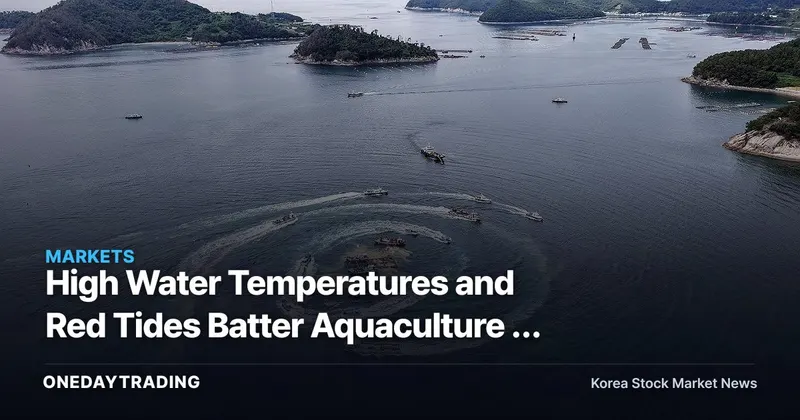
At coastal fish farms in Changwon and other parts of Gyeongnam, mass mortality events in cage-farmed fish — triggered by midsummer water temperature spikes and red tide outbreaks — are growing more frequent year after year. Fishermen no longer view this as an isolated incident but as a persistent risk, and they are pursuing structural reform: switching to species more tolerant of high water temperatures or overhauling their farming methods entirely.
Specific measures being discussed include transitioning to heat-tolerant species, shifting from cage systems to land-based recirculating aquaculture system (RAS) facilities, and reinforcing infrastructure for rapid response when red tides occur. These changes push up per-unit aquaculture costs, while simultaneously generating demand for related equipment, feed, and seed industries — a dual-sided dynamic.
Background and Context
The rising trend in sea surface temperatures around the Korean Peninsula is interpreted not as a one-off event but as a long-term structural shift driven by climate change. High-temperature advisories and red tide warnings during the summer months have already become an annual routine, and because farmed fish require a full rearing cycle to recover from a mortality event, supply disruptions translate readily into price volatility.
The central and local governments are running policies in parallel — both compensating for losses and incentivizing the shift in farming methods — meaning investment in land-based and smart aquaculture infrastructure is also aligned with policy-driven tailwinds.
Market and Stock (Ticker) Impact
- Large-cap integrated fisheries stocks (tickers) (Dongwon Industries · Sajo Industries): With operations diversified across offshore fishing, coastal fishing, processing, and distribution, direct exposure to localized coastal aquaculture mortality events is limited. Should aquaculture supply disruptions push seafood prices higher, a buffer effect is expected on the value of their inventory and raw-material holdings.
- Processing- and distribution-focused fisheries stocks (tickers) (CJ Seafood · Hansung Enterprise): Rising raw-material prices represent a near-term cost burden, but the ability to defend profitability will depend on pricing power and product portfolio mix.
- Land-based and smart aquaculture equipment: Growing demand for RAS facilities and water temperature/quality control systems opens a new demand channel for related equipment and environmental companies.
- Feed and seed segment: Species conversion and farming-method changes will reshape the demand structure for specialized feed and seed, affecting the revenue mix of companies in this space.
- Small and mid-size cage aquaculture operators dependent on coastal waters: Directly exposed to mortality risk, this segment faces the most pronounced negative impact from rising costs and supply instability.
Investor Checkpoints
- Monitor the frequency and severity of summer high-temperature advisories and red tide warnings via meteorological and oceanographic authority announcements to gauge the scale of potential damage.
- Compare raw-material purchase prices and processing-segment margin trends in major fisheries companies' quarterly earnings to assess pricing power.
- Track the schedule and budget scale of government support and subsidy policies related to land-based and smart aquaculture.
- Use seafood wholesale price indices and farm-gate price trends for key species to verify whether supply disruptions are actually being reflected in market prices.
Outlook
In the optimistic scenario, structural reform leads to stable supply and premium aquaculture products, allowing structural demand to accumulate in integrated fisheries stocks (tickers) and aquaculture equipment industry sectors. On the other hand, species conversion and capital investment in new facilities take both time and money — the clear near-term risk is that rising costs and mortality losses will pressure profitability. Since fisheries stocks (tickers) carry both earnings volatility and valuation risk simultaneously, a measured approach is warranted: monitor supply and price trends driven by climate variables on a quarterly basis.
Dongwon Industries — A Real-Time Data Snapshot
Dongwon Industries most recent closing price was ₩30,950 (–0.16% vs. the prior session). The signal indicator — which aggregates foreign investors and institutional investors supply-demand (order flow) alongside news and momentum — reads 🟡 Neutral / Wait-and-See. Positive and negative signals are offsetting each other; this is a period for observation.
- ▼ Trend Alignment — Short- and medium-term downward alignment (day: –0.2% · 1 week: –5.4% · 1 month: –13.3%)
- ▼ 52-Week Position — Near 52-week low, 4% above trough
※ Price and foreign investors/institutional investors supply-demand (order flow) data are provided by Korea Investment & Securities (KIS) and are current as of the time of publication.
This content was automatically summarized and analyzed based on the original news article. View original article (Yonhap News — Industry)