
Key Takeaways
For SK Hynix (000660) investors, the private dinner between President Lee Jae-myung and SK Group Chairman Chey Tae-won signals both the pace of semiconductor investment and the potential for policy coordination.
A semiconductor mega-investment is not simply about expanding factories — it is a long-term capex cycle that requires power supply, water resources, permits, tax policy, and external supply chains to align simultaneously. Seen through Yoon Jae-ho's lens, the real story here isn't the dinner itself but how far the government and big conglomerates can jointly resolve these bottlenecks.
What Happened
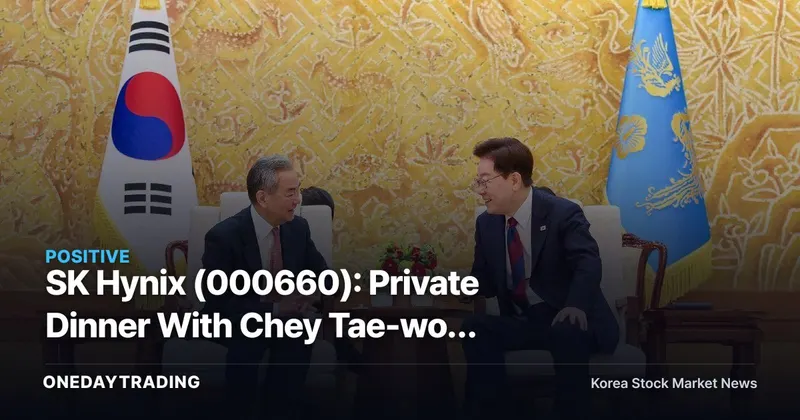
According to a Maeil Business Newspaper corporate report, President Lee Jae-myung held a private dinner with SK Group Chairman Chey Tae-won to discuss a semiconductor mega-investment, among other topics. The report said President Lee has stepped up close communication with the heads of the four major conglomerates, and that meetings are also scheduled with Samsung Electronics (005930) Chairman Lee Jae-yong, LG Group Chairman Koo Kwang-mo, and Hyundai Motor Group Chairman Chung Eui-sun to discuss U.S. investment plans and other issues.
The primary message investors should take away is that domestic semiconductor investment is being elevated once again from a corporate-only project to a national-competitiveness project. Capex at SK Hynix (000660) and Samsung Electronics (005930) sets off a sequential chain — equipment orders, materials demand, construction, and power infrastructure. The meetings between the president and conglomerate chairmen are being read as a policy signal that could pull that sequence forward.
The same report noted that President Lee received Chinese Foreign Minister Wang Yi and assessed that South Korea-China relations are on a path to full restoration. The semiconductor supply chain sits squarely between U.S. technology controls and Chinese end-demand — which is exactly why U.S. investment and the restoration of South Korea-China relations were mentioned in the same breath.
Background and Context
Semiconductors don't move on nanometer process nodes or HBM stack counts alone. Scaling up HBM and advanced DRAM output requires EUV equipment, back-end packaging, high-purity materials, and power supply to all advance at the same pace. If any single stage lags, the investment announcement stays a number on paper and shipments slip to the following quarter.
For SK Hynix (000660), the significance of policy coordination is more direct. With AI server demand now at the center of the memory cycle, a mega-investment is fundamentally about securing supply capacity for HBM and high-value-added DRAM. If the government reduces bottlenecks in permitting, power supply, tax policy, and external negotiations, the present value of the capacity expansion rises. Conversely, if meetings keep happening without concrete support measures following through, the expectations already priced into the stock's valuation will cool faster than earnings estimates can catch up.
Impact on the Market and Stocks
- SK Hynix (000660): The semiconductor mega-investment discussion between Chairman Chey Tae-won and the president raises expectations for HBM, advanced DRAM, and back-end packaging investment. That said, capex spending raises depreciation expenses first, so customer orders and yields need to be confirmed alongside it before the payoff shows up as margin improvement.
- Samsung Electronics (005930): The planned meeting with Chairman Lee Jae-yong could lead to discussions on memory and foundry investment. Because Samsung must manage the balance between its U.S. investment plans and its China business alongside the technology race itself, the value of policy coordination is especially high.
- LG: The planned meeting with Chairman Koo Kwang-mo could expand into an investment agenda covering batteries, automotive components, displays, and materials. If U.S. investment discussions become concrete, subsidies, local production requirements, and customer contract terms will turn into variables that move earnings.
- Hyundai Motor (005380): The planned meeting with Chairman Chung Eui-sun could lead to discussions on U.S. production, electric vehicles, and battery supply chains. Changes to tariff and subsidy structures would alter automakers' regional margins.
- Semiconductor equipment and materials stocks: If the mega-investment translates into actual orders, equipment, cleanroom, and materials companies will move first. Share prices typically react ahead of official disclosures, however, so order backlogs and delivery guidance need to be checked alongside the price action.
Investor Checkpoints
- First, watch for follow-up announcements from the presidential office or the individual conglomerates to see whether semiconductor investment amounts, sites, timelines, and tax support are laid out in concrete figures.
- Second, watch whether SK Hynix (000660) and Samsung Electronics (005930) raise their guidance on HBM shipments, yields, customer orders, and capex at their next quarterly earnings calls.
- Third, U.S. investment discussions should be read together with subsidy eligibility conditions, local production requirements, and restrictions on bringing equipment into China.
- Fourth, comments about restoring South Korea-China relations are better read first as a signal of easing supply-chain risk rather than as a sign of recovering Chinese demand.
Outlook
The bullish scenario is straightforward: if the government eases infrastructure and tax bottlenecks, and SK Hynix (000660) and Samsung Electronics (005930) ramp up shipments of high-value-added products in line with AI memory demand, the semiconductor mega-investment will spread outward into equipment orders and materials demand. In that case, the market would be pricing in an upgrade to underlying earnings power rather than a simple cyclical recovery.
The risks are not small, either. Pursuing U.S. investment and restoring relations with China at the same time is difficult. If U.S. semiconductor controls tighten further, the recovery in Chinese demand will be limited, and large-scale capex will hit the income statement first through the depreciation burden. The next things to watch are the investment timelines and government support measures that emerge after each conglomerate chairman's meeting, along with quarterly capex guidance from SK Hynix (000660) and Samsung Electronics (005930).
Frequently Asked Questions
Why does this matter for SK Hynix's (000660) share price?
It matters for SK Hynix's (000660) share price because the mega-investment discussion feeds directly into expectations for expanded HBM and advanced DRAM supply capacity. For the stock to keep reacting, though, the actual investment timeline and customer orders need to be confirmed in hard numbers after the private meeting.
What does a "semiconductor mega-investment" mean?
A semiconductor mega-investment refers to capital expenditure executed over a long period that bundles together large-scale factories, equipment, power, water, and back-end infrastructure. For companies like SK Hynix (000660) and Samsung Electronics (005930), it's a near-term cost burden, but once yields and shipments catch up, it becomes the foundation for mid-to-long-term earnings.
Which stands to benefit more — Samsung Electronics or SK Hynix?
In this Maeil Business Newspaper report, the party who actually met with the president was SK Group Chairman Chey Tae-won, so the near-term read leans more toward SK Hynix (000660). That said, a meeting with Samsung Electronics (005930) Chairman Lee Jae-yong is also reported to be scheduled, so if the follow-up agenda takes concrete shape around foundry and memory investment, policy-driven expectations could attach to Samsung Electronics as well.
SK Hynix (000660) by the Numbers: Real-Time Data
SK Hynix's (000660) most recent closing price was 1,691,000 won (+12.73% from the previous session), and the composite signal combining foreign and institutional order flow with news and momentum reads 🟢 Buy-leaning. Foreign investor flow, news, and momentum are all positive, making this a stock worth watching.
- ▲ News flow — 10 positive catalysts vs. 2 negative catalysts — positive catalysts dominate
Recent related news skews favorable, with 10 positive catalysts versus 2 negative catalysts.
※ Price and foreign/institutional order-flow data are provided by Korea Investment & Securities (KIS) and reflect figures as of publication time.
This article was automatically summarized and analyzed based on the original news report. View original (Maeil Business Newspaper, Corporate)