
At a Glance
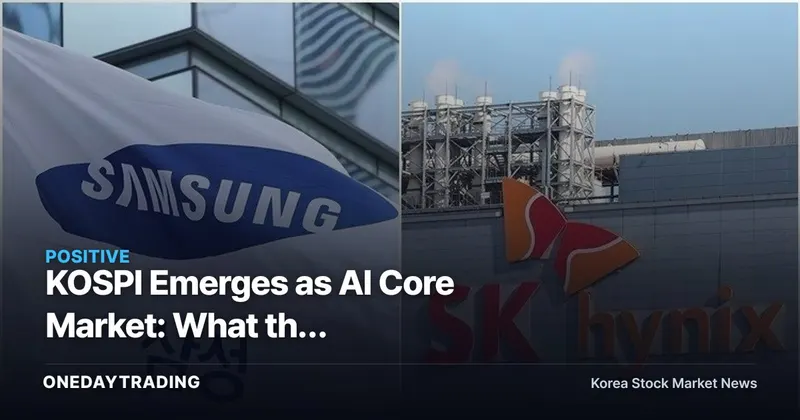
As the KOSPI has seen repeated sharp drops and sharp gains after touching the 9,000 level, international media is pointing to the Korean stock market as a central stage in the AI cycle. The key phenomenon is the convergence in which U.S.-listed Micron's share price tracks the movement of Samsung Electronics and SK Hynix. This suggests that the Korean market is no longer a peripheral market, but is being read as a leading indicator for gauging global AI memory demand.
Why This Matters Now
The bottleneck in expanding AI data center investment is not compute chips alone — it is the supply of high-bandwidth memory (HBM) and DRAM. Because South Korea's Samsung Electronics and SK Hynix effectively control global supply in the HBM and server DRAM markets, the two companies' share prices serve as a real-time barometer reflecting the intensity of AI memory demand. The fact that Micron moves in tandem with these stocks means investors are trading the entire memory industry cycle as a single theme, rather than on individual company earnings.
The key point here is the direction of causality. If Korean stocks (tickers) move first and U.S. stocks follow, one can interpret the KOSPI's price action as having a leading quality — reflecting global memory prices and demand expectations ahead of other markets. International media reports that Japanese investors reference the KOSPI when formulating their trading strategies also stem from this context. At the same time, this convergence is a double-edged sword. It raises concern that a sharp drop originating in Korea could transmit shocks to global ETFs holding memory and AI theme positions.
The sharp swings around the 9,000 level are a manifestation of the volatility this structure produces. The stronger the crowding effect — where foreign investors and institutional investors simultaneously buy and sell the same theme — the more structurally pronounced the volatility becomes: rapid rises on positive catalysts and steep declines on profit-taking.
Frequently Asked Questions
- Why does Micron follow Korean stocks (tickers)? All three companies are the top-three memory players with revenue concentrated in DRAM and HBM, exposed to the same industry cycle and pricing dynamics, which leads investors to trade them as a group.
- What is the basis for calling KOSPI an AI core market? Two Korean companies dominate the supply of AI-critical memory such as HBM, so KOSPI price action is perceived as a leading signal for global AI memory demand.
- Why does a Korea-originating sharp drop translate into ETF concerns? Korean memory stocks carry significant weight in semiconductor and AI theme ETFs, meaning a KOSPI correction could spread into concurrent selling by global passive funds.
- How long will the volatility last? Crowding-driven swings are likely to continue through at least the quarterly earnings season, when AI memory demand forecasts, DRAM spot prices, and big tech data center investment plans will be confirmed.
Related Stocks (Tickers) and Sector Impact
- SK Hynix As the leader in the HBM market, it stands to benefit most directly from AI memory demand — but for the same reason, it is a high-beta stock (ticker) that could see amplified drawdowns during theme corrections.
- Samsung Electronics Given its business structure spanning memory, foundry, and finished products, the pace of its HBM competitiveness recovery will determine the strength of its price convergence.
- Micron Exposed to the same memory cycle, it serves as the U.S.-side comparative benchmark that moves alongside Korean stocks (tickers).
- Hanmi Semiconductor and other HBM back-end process equipment makers Their revenue is tied to Samsung's and SK Hynix's HBM capacity expansion investment, making them downstream beneficiaries of the capital expenditure cycle.
- Semiconductor and AI theme ETFs With high exposure to memory stocks, they become the direct conduit absorbing KOSPI volatility.
Key Risks to Watch
- Convergence synchronizes declines as well as gains. Rather than watching a single stock (ticker), investors should also monitor DRAM spot prices and HBM demand forecasts together.
- The sharp swings near the 9,000 level are largely driven by supply-demand (order flow) crowding rather than fundamental improvement, making it difficult to treat short-term surges as a sustained trend.
- If signs of slowing AI investment or falling memory prices emerge, the convergence structure could operate in reverse, amplifying the depth of any decline.
- Investors should assess whether current valuations have already priced in a significant portion of the expected industry recovery.
Overall Outlook
In the bull scenario, continued AI data center investment keeps HBM and server DRAM demand robust, the KOSPI solidifies its position as a leading market in the global AI memory cycle, and inflows from foreign investors persist. Conversely, if big tech begins to moderate its capital expenditure pace or memory price corrections become visible, the same convergence structure would turn into a transmission channel for downward pressure, with ETF-driven concurrent selling amplifying volatility. Key checkpoints to watch include the next quarterly earnings from the top-three memory companies and their HBM guidance, DRAM spot price trends, and the capital expenditure announcement schedules of major big tech firms.
SK Hynix — Real-Time Data Snapshot
SK Hynix's most recent closing price is KRW 2,673,000 (−8.36% day-over-day), and its signal light — a composite of foreign investor and institutional investors supply-demand (order flow) and news momentum — reads 🔴 Caution. Foreign investors, institutional investors, and momentum are all negative, warranting caution at this time.
- ▼ Supply-Demand (Order Flow) Continuity — Foreign investors: 6 consecutive sessions of net selling (−2,315.0 billion won)
- ▼ Dual-Side Selling — Foreign investors −2,315.0 billion won · Institutional investors −2,834.3 billion won selling in tandem
- ▲ 52-Week Position — 89% of 52-week range — near all-time high territory
- ▲ News Flow — Positive catalysts 24 vs. negative catalysts 16 — positive catalyst majority
Recent related news stands at 24 positive catalyst items and 16 negative catalyst items, reflecting a favorable tone.
※ Price and foreign investor/institutional investors supply-demand (order flow) data are provided by Korea Investment & Securities (KIS) and reflect conditions as of the time of publication.
This content was automatically summarized and analyzed based on the original news article. View original article (Maeil Business News Korea — Securities)