
Government Bond Prices Shift After Donald Trump’s Remarks
Government bond yields fell across all maturities on November 3, 2026, after President Donald Trump’s position on Iran was reported. The key point for investors is not simply that yields declined. The yield curve flattened as foreign buying focused on 10-year government bond futures, while long- and ultra-long-term government bonds rallied more strongly.
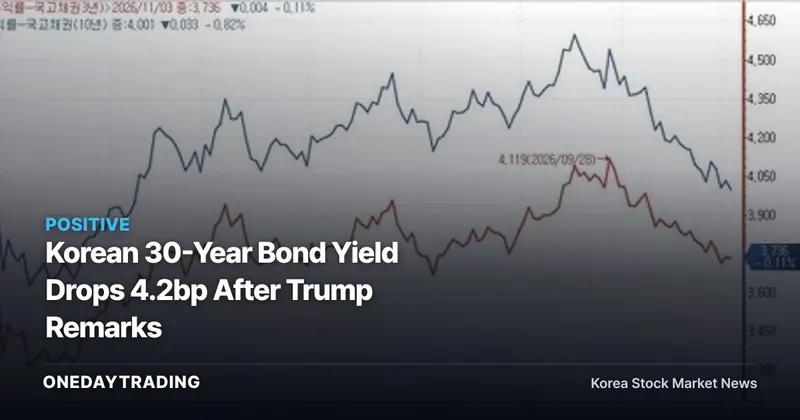
At the November 3, 2026 market close, data compiled by Yonhap News showed that the 10-year government bond yield stood at 4.001% per annum, down 3.3bp from the previous session. According to the same source, the 30-year government bond yield fell 4.2bp to 4.089% per annum, while the 50-year yield declined 4.0bp to 4.115% per annum. Moves at the long end were larger than those at the short end.
Foreign Investor Order Flow Favored 10-Year Futures
Government bond futures are instruments based on future government bond prices. Rising futures prices signal bond-market strength and correspond with falling yields. The 3-year government bond futures contract closed 7 ticks higher at 103.46 points, while the 10-year contract gained 43 ticks to 108.11 points.
According to Yonhap News, foreign investors sold a net 133 3-year government bond futures contracts on November 3, 2026, while buying a net 8,146 10-year contracts. These figures indicate supply-demand (order flow) concentrated at the long end rather than uniform buying across all maturities. However, the data did not reveal the specific reasons for the foreign buying.
Falling Long-Term Yields Flatten the Yield Curve
The 2-year government bond yield closed at 3.701% per annum, down 1.8bp from the previous session, while the 3-year yield declined 0.4bp to 3.736% per annum. The 5-year yield fell 2.2bp to 3.870% per annum. By comparison, yields on maturities of 10 years or longer dropped by between 3.3bp and 4.2bp.
Yield-curve flattening occurs when long-term yields fall more than short-term yields, narrowing the spread between maturities. The 30-year yield posted the session’s largest decline at 4.2bp, followed by the 50-year and 20-year yields at 4.0bp and 3.5bp, respectively. The market has already priced in the relative strength of long-term government bonds, but whether that trend will continue remains uncertain.
WTI Near $97 Moves Alongside U.S. Long-Term Yields
President Donald Trump said he did not plan to resume military strikes against Iran after the midterm elections. In Asian trading, West Texas Intermediate (WTI) futures fluctuated around $97 per barrel, while the U.S. 10-year government bond yield fell 1.6bp.
“Bonds strengthened as falling oil prices compounded the risk-off mood,” a bond portfolio manager at a securities firm told Yonhap News. The rally in Korean government bonds should be viewed in the context of not only foreign net buying of long-term government bond futures, but also simultaneous declines in oil prices and U.S. long-term yields.
30-Year Auction Adds No Supply Pressure
At the 30-year government bond auction, bids totaled 3.936 trillion won for 2 trillion won of bonds, and the accepted yield was set at 4.07%. The bond portfolio manager said the auction had been expected to perform well due to demand from insurers and proceeded as anticipated, limiting its market impact.
The confirmed information is limited to the offering amount, total bids, and accepted yield. The actual amount awarded to insurers cannot be determined from the publicly available data. There is therefore insufficient evidence to interpret the auction result as sustained demand from any particular investor group.
Conditions That Could Determine Bond Strength or Weakness
Under the bullish scenario, continued foreign net buying of 10-year government bond futures and persistently larger yield declines in long- and ultra-long-term bonds than in short-term maturities would keep the yield curve flattening. Key indicators would be the price of 10-year government bond futures, the scale of foreign net buying, and yields on 20-, 30-, and 50-year bonds.
Under the opposing scenario, a shift from foreign buying to net selling in 10-year government bond futures would remove one pillar supporting the rally in long-term bonds. The future direction of WTI futures and the U.S. 10-year government bond yield also remains uncertain, so one day of synchronized movement should not be treated as a lasting trend.
Numbers Investors Should Watch Next Session
- Monitor whether foreign net buying of 10-year government bond futures continues after reaching 8,146 contracts.
- Track the subsequent moves in 10-year government bond futures at 108.11 points and 3-year futures at 103.46 points separately.
- Compare how the 10-year government bond yield of 4.001% per annum, the 30-year yield of 4.089%, and the 50-year yield of 4.115% move next.
- Monitor both WTI futures around $97 per barrel and the direction of the U.S. 10-year government bond yield.
The trigger for the next decision is not any particular instrument, but supply-demand (order flow) in long-term futures and yield movements across maturities. The equation changes if foreign buying loses momentum, while continued relative declines in long-term yields would reinforce the flattening interpretation.
WTI Crude Oil MetricsAs of 2026-11-03
| Performance | 1 Week -2.07% 1 Month +9.39% |
|---|
Index, commodity, and exchange rate data are based on global markets and reflect values at the time of publication.
This article was automatically summarized and analyzed from the original news report. View the original article (Yonhap News)