
Three-Line Briefing
- The rally of 2,000 Samsung Electronics DX union members is a variable that amplifies concerns over management execution rather than cost issues in the smartphone, TV, and home appliance businesses.
- The DX (Device eXperience) division is the business pillar at Samsung Electronics responsible for finished products such as home appliances, TVs, and smartphones.
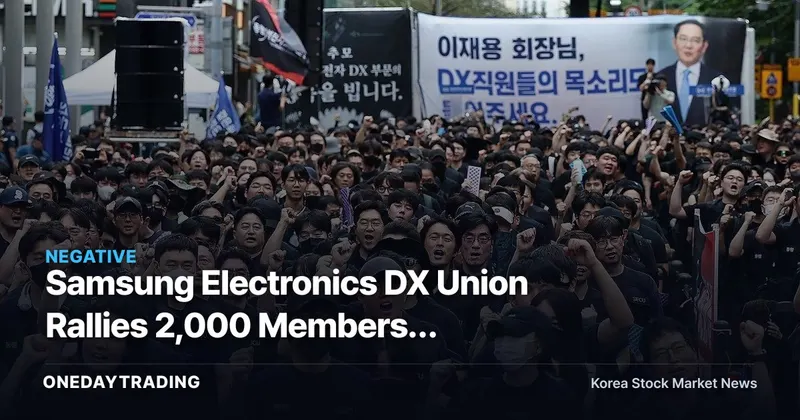
- According to Yonhap News industry reporting, this rally—led by a union centered on DX division employees—demanded accountability for management failures, making it an event where investors need to weigh both labor relations and product competitiveness together.
What's Changing
When Samsung Electronics investors read into this DX union rally, the first thing to look at isn't labor costs. The DX division isn't a business that can be explained in one stroke through wafer input and yield, unlike semiconductors. Smartphones move on new product cycles, TVs on premium demand, and home appliances on cost and distribution inventory all at once. A gathering of 2,000 people from this organization signals that frontline employees are beginning to take issue with management judgment and accountability, not simply compensation.
In finished-product businesses at tech companies, when the product roadmap wavers, the internal temperature of the organization shifts before the income statement does. Smartphones require alignment across component sourcing, software maturity, and channel marketing within a single quarter. For TVs and home appliances, when the premium mix weakens, revenue may hold steady but margins thin out. The union's demand for management accountability forces the market to ask where in this chain a bottleneck has emerged.
From a stock price perspective, this leans toward a short-term negative catalyst. Samsung Electronics' share price typically reacts more strongly to the semiconductor cycle and memory prices, but the DX division is the finished-product pillar that underpins brand trust and cash generation. At a stage when hopes for a semiconductor recovery are pushing up valuation, growing internal conflict in the finished-product business could slow the pace of multiple expansion. If the market has already priced in the semiconductor recovery, then DX execution risk is what remains under-reflected.
Numbers and Context
The key figure confirmed in this news is 2,000. According to Yonhap News industry reporting, a labor union centered on Samsung Electronics DX division employees gathered roughly 2,000 people and demanded accountability for management failures. A single figure alone cannot quantify the earnings impact. However, in a finished-product business, internal cohesion and decision-making speed are directly tied to launch schedules, quality response, and channel negotiations.
The DX division is also a downstream consumer of the semiconductor supply chain. If smartphone sales weaken, internal demand for mobile memory and display components cools. If price competition in TVs and home appliances intensifies, logistics costs, promotional spending, and inventory costs rise first. This issue is therefore both a labor-relations story and a story about set-product business competitiveness.
Stocks to Watch: Beneficiaries and Losers
- Samsung Electronics (005930): The direct subject of the DX union rally. Organizational stability and product execution in the smartphone, TV, and home appliance segments have become a checklist item for investors.
- LG Electronics: A direct rival to Samsung Electronics in home appliances and TVs. If decision-making within Samsung's DX division falters, the relative comparison in premium appliances and OLED TV competition could widen in LG's favor.
- Samsung Electro-Mechanics: Tied to smartphone component demand. The pace of new product launches and sales mix in the DX division could shift expectations for component shipments.
- Samsung SDI: Indirectly linked to battery demand for mobile devices and some electronics. If concerns over slowing finished-product sales emerge, more conservative discount rates could be applied across the component value chain as well.
Risk Check
- This report alone cannot confirm a strike, production disruption, or earnings damage. What's confirmed is a rally of roughly 2,000 people and a demand for management accountability.
- The central variable for Samsung Electronics' share price remains the semiconductor cycle. For the DX issue to override the memory price recovery, actual deterioration in sales or cost metrics would need to follow.
- Whether the union's demands narrow to wage negotiations or expand into calls for divisional management accountability makes a difference. The former is a cost variable; the latter is a governance and execution variable.
- If new smartphone sales, TV and appliance inventory, and marketing costs all deteriorate together, the market discount on the DX division's profit defensibility will widen.
Bottom Line
The rally of 2,000 Samsung Electronics DX union members is not, on its own, enough to derail expectations for a semiconductor recovery, but it meets the conditions to be priced in as a negative catalyst that lowers the execution premium of the smartphone, TV, and home appliance businesses.
FAQ
Is the Samsung Electronics DX union rally a negative catalyst for the stock (ticker)?
The Samsung Electronics DX union rally carries strong negative-catalyst characteristics in the short term. According to Yonhap News industry reporting, roughly 2,000 people gathered to demand accountability for management failures, so investors may view decision-making and organizational stability in the finished-product business—rather than cost—as a discount factor.
What does Samsung Electronics' DX division handle?
Samsung Electronics' DX (Device eXperience) division handles consumer finished-product businesses such as home appliances, TVs, and smartphones. Unlike semiconductors, this division's earnings are driven by product launch cycles, brand competitiveness, distribution channels, and inventory management.
What should Samsung Electronics investors watch?
Samsung Electronics investors should monitor next quarter's smartphone sales trends, TV and appliance inventory, marketing costs, and whether the union's demands escalate further. For the DX issue to spread into actual earnings, indicators such as delayed product launches or a deteriorating sales mix would need to be confirmed.
Samsung Electronics: A Real-Time Data Snapshot
The most recent closing price for Samsung Electronics (005930) was 281,500 won (+3.87% vs. the prior day), and the signal combining foreign investors/institutional investors order flow with news and momentum reads 🟢 Buy-leaning. Foreign investors, institutional investors, news flow, and momentum are all positive, making this a stock (ticker) worth watching.
- ▲ Dual buying — Foreign investors +431.7 billion won · institutional investors +368.2 billion won in combined net buying
- ▲ Trend alignment — Short- and medium-term uptrend alignment (intraday +3.9% · 1-week +10.2% · 1-month +8.7%)
- ▲ News flow — 13 positive catalysts vs. 2 negative catalysts — positive catalysts dominate
Recent related news skews favorable, with 13 positive catalysts versus 2 negative catalysts.
※ Price and foreign/institutional order-flow data are provided by Korea Investment & Securities (KIS) and are as of the time of publication.
This article was automatically summarized and analyzed based on the original news report. View original (Yonhap News Industry)