
Summary
Yoon Jae-ho, OneDayTrading Editorial Board
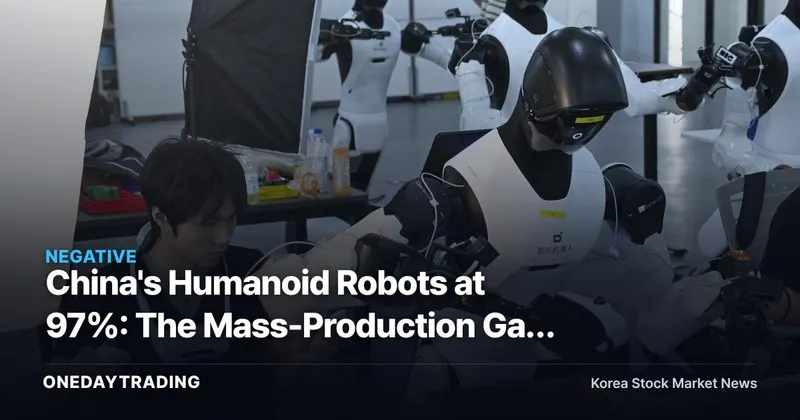
Humanoid robots are no longer confined to the language of lab demonstrations. The fact that Chinese manufacturers captured more than 97% of global shipments in the first half of this year poses a more uncomfortable question for Korean robot stock (ticker)s than any technology gap: it's not about who built the smarter robot, but who first brought costs and the supply chain down to mass-production levels.
What Happened
According to Yonhap News, Chinese companies accounted for more than 97% of global humanoid robot shipments in the first half of this year. Chinese firms such as AgiBot, Unitree, and UBTech dominated the market by volume, while Tesla's Optimus in the U.S. remains at a pre-mass-production stage. The first round of the humanoid robot market was decided not by software vision but by the pace of hardware shipments.
The investment implication of this figure goes beyond a simple narrative of China's robotics rise. The robotics value chain breaks down into motors, reducers, sensors, controllers, batteries, AI compute modules, and final assembly. China shipping 97% doesn't just mean faster final assembly — it means the country has already built a closed loop in low-cost component sourcing and the accumulation of repeat-production data. Shipment volume translates directly into failure data, and failure data is the raw material for lowering costs in the next generation.
What Korean investors should watch is not the technological prowess of humanoid platform companies like Rainbow Robotics itself, but the speed of their transition to mass production. A company strong in research platforms and a company with a mass-shipment system look entirely different on the income statement. What customers demand isn't demo videos — it's delivery schedules, maintenance, and stable component sourcing.
Structural Background
Humanoid robots resemble semiconductors in this respect. Even a well-designed chip won't make money if yields are low. For robots, shipments only scale when joint-actuator yield, battery safety, sensor calibration, and control-software stability all align at once. Behind Chinese manufacturers' more-than-97% share in the first half lies a manufacturing ecosystem that drives down finished-product prices, combined with government-led demand creation.
Korea, by contrast, has high utilization of industrial robots but still a thin ecosystem for finished humanoid products. This gap is a burden on theme stock valuations. As the robot narrative grows, the market attaches a premium to technology stock (ticker)s with no revenue, but as Chinese shipment data accumulates, the benchmark for comparison shifts from research achievements to unit sales and cost ratios.
Stock (Ticker) and Industry Sector Impact
- Rainbow Robotics: As Korea's leading humanoid stock (ticker), it is the most direct point of comparison. Its technology premium may hold, but as Chinese manufacturers accelerate mass production, investors are likely to scrutinize delivery volumes and the timing of its commercial transition more strictly.
- Robotis: With its actuator modules and robot platform capabilities, it could benefit from expectations around localizing humanoid components. However, if low-cost Chinese modules spread widely, its pricing power will be put to the test.
- SPG: Reducer and motor-related component stock (ticker)s are in a position where orders could materialize ahead of finished products. The key question is how quickly high-precision robotics components can replace existing industrial revenue.
- Hyundai Motor: It holds a robotics strategy through Boston Dynamics, but the investment logic for an automaker is different. Rather than near-term earnings, what matters is confirmed productivity gains from field applications in logistics, manufacturing, and mobility.
- Samsung Electronics (005930): Robotics represents a long-term option on demand for AI chips and edge devices. Rather than assuming a direct benefit from the finished-product shipment race, it should be viewed through the lens of sensors, memory, and on-device AI adoption trends.
Bullish vs. Bearish Scenarios
The bullish scenario is one where expanding Chinese shipment volumes are read as validation of overall market demand. As finished-product prices fall, adoption barriers come down for factories, logistics, security, and research institutions. In that case, Korean component makers could gain a neutral-supplier position, serving both the Chinese and U.S. supply chains.
The bearish scenario is more realistic. A 97% share suggests Chinese manufacturers could set the early standard. If standard components and software interfaces become locked into Chinese specifications, later-entrant finished-product makers will fall behind simultaneously on price, delivery, and ecosystem. If Korean robot stock (ticker)s have already priced in a physical-AI premium, the trigger for the next correction could be a lack of new orders.
Investor Action Points
- Starting next quarter, investors should distinguish in domestic robot stock (ticker) disclosures between R&D partnerships versus actual mass-production supply contracts, repeat deliveries, and real customer deployment sites.
- For reducer, actuator, and motor makers, watch the share of robotics-related revenue versus the margin gap with existing industrial revenue. Being included in the robotics theme alone does not raise earnings estimates.
- Track the pricing policies of China's AgiBot, Unitree, and UBTech and whether they expand overseas sales. If low-cost models proliferate, the upside on multiples for Korean finished-product stock (ticker)s will be capped.
- For government robotics support programs, the purchase volume from pilot demonstration projects matters more than the size of subsidies. Robots improve through field hours, not research papers.
Rainbow Robotics: Real-Time Data Snapshot
Rainbow Robotics's most recent closing price was 489,000 won (+5.16% from the previous day), and its composite signal — based on foreign/institutional order flow and news/momentum — is 🟢 Buy-leaning. Foreign investors, institutional investors, and momentum are all positive, making it worth watching.
- ▲ Dual buying — Foreign investors +17.1 billion won and institutional investors +4.3 billion won in combined net buying
- ▲ Trend alignment — Short- and medium-term uptrend aligned (+5.2% today · +6.7% over 1 week · +13.5% over 1 month)
Recent related news skews negative, with 0 positive catalysts and 1 negative catalyst.
※ Price and foreign/institutional order-flow data are provided by Korea Investment & Securities (KIS) and are as of the time of publication.
This article is automatically summarized and analyzed content based on the original news report. View Original (Yonhap News, Securities)