
3-line briefing
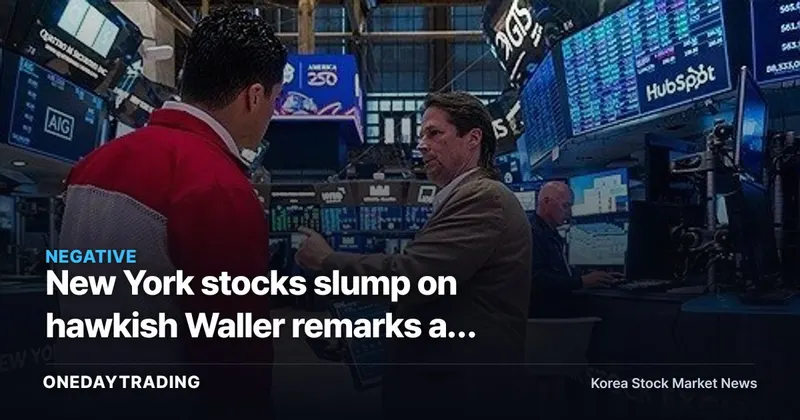
- What shook New York stocks was not Waller’s remarks themselves, but the market’s renewed pricing of the September rate path. The 2-year yield and the dollar reacted first, and Nasdaq and semiconductors absorbed the shock.
- At the close on the 28th, the Dow was down 0.02%, the S&P 500 fell 0.25%, and the Nasdaq slipped 0.52%. The Philadelphia Semiconductor Index dropped 3.5%, showing that rate-sensitive industry sectors were the first to lose footing.
- For Korean investors, the key is the won and foreign investors’ supply-demand (order flow). If the U.S. 2-year yield rises to 4.29% and the dollar strengthens, the pressure on KOSPI will first show up in semiconductors and growth stocks’ multiples rather than the index itself.
What changes
The essence of the New York stock move, the hawkish Waller remarks, and the Nasdaq decline is the direction of the discount rate, not the Fed’s messaging itself. When Waller said there is still more to do if inflation has not fallen sufficiently to 2%, the market raised again the odds of a 25bp hike at the September 15-16 meeting. Stocks reacted not to the earnings outlook, but to higher rates that reduce the value of future cash flows.
When rates rise, stocks that are weighted toward profits far in the future come under pressure first. Semiconductors, AI, software, and internet names build higher multiples as the growth story stretches out, but in a rising-rate environment those multiples are the first to compress. By contrast, banks and sectors that benefit from dollar strength tend to hold up relatively better. The same pattern carries over directly to the Korean market. When won weakness and higher U.S. short-term rates overlap, foreign investors look at the exchange rate before earnings.
This statement landed more sensitively because the market had already been partly pricing in a more dovish Fed message. Since Waller judged financial conditions as not yet restrictive enough, the stock market once again started reading rates and the dollar as leading indicators ahead of earnings. Even strong earnings cannot protect a share price immediately if the discount rate moves higher. Marvell Technology’s more than 10% drop despite reporting earnings and guidance is a case in point.
Numbers and context
The 28th close in New York showed the Dow Jones at 53,559.99, the S&P 500 at 7,711.76, and the Nasdaq at 26,402.42. On the surface, that looks like a modest correction, but the market moved much more sharply underneath. The 2-year government bond yield jumped to 4.29%, hitting a one-month high, while the dollar index also climbed to the 99.5 level, pushing up the discount rate on risk assets.
What matters here is what is already priced in and what still remains. Current stock prices have begun to reflect a significant portion of the chance of a September rate hike, but if the next inflation data comes in hot again or the 2-year yield holds above 4.3%, tech multiples could face a longer compression cycle. On the other hand, if inflation cools and the dollar rolls over, this decline may end as only a mid-cycle re-pricing of rates.
Winners and losers
- Marvell Technology: Even if earnings are not bad, the long-term growth story for AI semiconductors gets discounted more heavily in a rising-rate environment.
- NVIDIA: A flagship AI name, but also a high-beta stock (ticker) whose valuation tends to wobble first as rates and the dollar rise.
- SK hynix, Samsung Electronics (005930): The pullback in U.S. tech stocks does not immediately mean weaker revenue, but it does pressure the valuation multiples of Korean semiconductors.
- KB Financial Group, Shinhan Financial Group: Relatively defensive in a U.S. rate-hike and stronger-dollar environment. That said, domestic rates and loan growth need to support the move for the effect to hold.
- Hyundai Motor, Kia: A weaker won helps export profitability, but if global demand also slows, the exchange-rate tailwind alone is not enough.
Risk check
- If inflation data before the September Fed meeting comes in strong again, the 2-year yield and the dollar could rise further.
- Conversely, if inflation cools, the shock from hawkish remarks could fade into a short-term event.
- Semiconductor stocks are more sensitive to valuation than earnings, so even a small rise in rates can increase price volatility.
- If KRW/USD moves back into the mid-1,300 won range or higher, foreign investors’ supply-demand (order flow) is more likely to tilt toward profit-taking.
Bottom line
This New York stock decline is about rate re-pricing, not weak earnings. The September Fed meeting, U.S. CPI, and whether the 2-year yield settles above 4.3% are likely to decide the next quarter’s leading stocks.
Frequently asked questions
Why do hawkish Waller remarks hurt the Nasdaq more?
The Nasdaq is home to many companies whose value comes more from future earnings than current earnings. When rates rise, the present value of cash flows far in the future is discounted more heavily, so growth stocks tend to wobble before value stocks.
Why should the 2-year yield be watched first?
The 2-year note is the most sensitive to the Fed’s next move. When the probability of a September rate hike rises, the short end moves before longer maturities, and that signal is immediately reflected in tech stocks and the dollar.
What should Korean investors check?
They should watch the KRW/USD exchange rate, the U.S. 2-year yield, and foreign investors’ supply-demand (order flow) in major domestic semiconductor names together. If all three worsen at the same time, KOSPI is more likely to come under index-level pressure than to see simple industry sector rotation.
This article is automatically summarized and analyzed based on the original news report. Read the original article (Yonhap News securities)