
3-line briefing
- What CJ Logistics and Hanjin need to read first here is not a labor issue but a cost issue. As the court has not excluded two-person delivery operations from industrial accident protection, safety management costs and insurance premiums in logistics could become fixed recurring expenses.
- In the courier industry, margins can differ even on the same volume depending on staffing and liability structure. If freight rates do not follow quickly, operating profit margins will come under pressure first.
- Investors should watch the scope of the ruling’s spillover, next quarter’s SG&A, and disclosures on safety investment rather than shipment volume.
What changes
The signal this ruling sends to investors is simple. Courier and logistics are no longer an industry sector that can be explained by demand recovery alone. If industrial accident protection extends even to two-person delivery operations, companies must recalculate legal costs that had been hidden between delivery rates and labor costs.
Industrial accident protection is a mechanism that compensates work-related injuries. If the court views the operating model itself, namely two-person crews, as within the protected scope, the issue is no longer whether an accident occurred but which work design creates greater liability. From that point on, courier companies must treat partner management, safety training, backup labor and insurance premiums as one cost bundle.
The market has already priced in some of the impact from parcel volumes and freight-rate negotiations. But it has not fully reflected the broader effect of expanding safety liability. If the scope of industrial accident protection is widened across two-person delivery operations, cost pressure may not end at one point and could continue structurally.
Reading the numbers and context
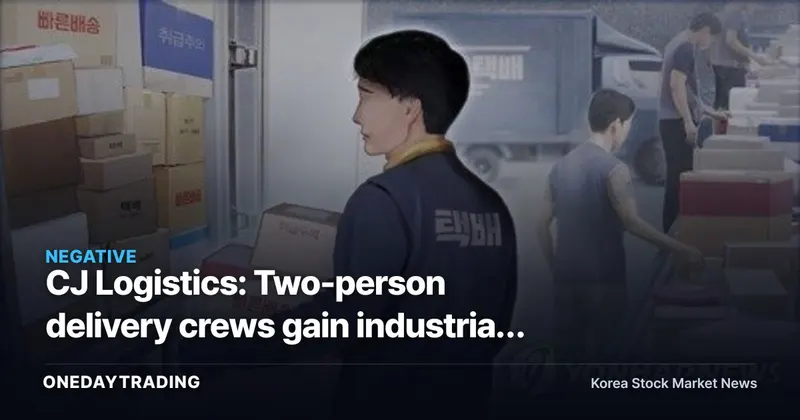
The key number is two-person crews. A structure in which two people handle one delivery together reduces per-person throughput while spreading risk. But if the court does not place that structure outside industrial accident protection, the company can no longer look only at volume. It must also look at insurance premiums, safety training expenses, backup labor costs and partner management costs together.
The fact that the case began with a heatstroke death during work also carries weight. Courier work is an industry sector where accident risk varies by season and time of day, so if safety investment is delayed, the cost reappears every quarter. In other words, this is not an industry where profitability automatically recovers just because freight volumes rebound.
Beneficiaries and losers
- CJ Logistics: With a high courier exposure, safety management costs and insurance premiums feed directly into operating profit margins. The more outsourced and in-house labor are mixed, the easier it is for management costs to rise.
- Hanjin: If the same safety standards spread across the logistics network, both labor deployment and partner costs will rise. The longer freight-rate negotiations take, the greater the margin burden.
- Hyundai Glovis: Even with relatively limited direct courier exposure, it is hard to avoid a broad rise in logistics safety standards. If the industry’s average cost rises, the comparison base changes too.
- Courier and last-mile logistics stocks (tickers) overall: Businesses with many two-person crew operations or similar work patterns will see insurance premiums and backup labor costs reflected more quickly.
Risk check
- If the ruling is limited to this individual case, the cost shock may be contained.
- If it cannot be passed through to freight rates, safety costs will weigh directly on SG&A.
- Companies that have already invested heavily in safety will see less impact, while laggards will feel a larger difference.
- If follow-up precedents or administrative interpretations continue, the impact range will widen further.
Bottom line
This ruling is not a positive catalyst for courier demand but a redistribution of logistics costs and responsibility. The next checkpoint is how much safety management costs rise in the next quarter’s earnings and whether the judgment expands to similar work patterns.
Frequently asked questions
Why would two-person delivery crews also be covered by industrial accident protection?
The court appears to have looked at actual risk and work structure rather than the form of the job. If it is difficult to exclude protection based solely on the fact that the work was done by a two-person crew, the industrial accident judgment shifts toward broader work design.
How does this get reflected in courier company earnings?
Safety management costs, insurance premiums, training expenses and backup labor costs rise first. If they cannot be offset by higher freight rates, the burden goes straight to operating profit margins.
What should investors check?
Look at how much SG&A and safety-related costs rise in the next earnings release, and whether more rulings follow for similar work. If the legal interpretation stops expanding, the impact will be limited; if it continues, the valuation discount on logistics stocks (tickers) could widen.
CJ Logistics key metricsAs of 2026-08-31
| Return over period | 1 week +1.77% 1 month +5.66% |
|---|---|
| supply-demand (order flow) | foreign investors +KRW 700 million net buy institutional investors +KRW 400 million net buy |
| Recent news tone | positive catalyst 1 · negative catalyst 1 |
Price and supply-demand data are real-time values from Korea Investment & Securities (KIS), and the supply-demand and news-tone tally is calculated by OnedayTrading.
Supply-demand & momentum reading🟢 Buy bias
Foreign investors and institutional investors are positive, so it is worth watching.
- ▲coordinated buyingForeign investors +KRW 700 million, institutional investors +KRW 400 million buying together
- ▼52-week positionnear the 52-week low at 6%
Upcoming dates to watch
- 09.10Futures and options expirationMediumQuadruple witching - watch for volatility and supply-demand (order flow) distortions
- 09.16FOMC policy rate decisionHighU.S. Federal Reserve policy announcement - direction of rates and the dollar
- 10.08Index options expirationLowKOSPI 200 options expiration
- 10.22Bank of Korea Monetary Policy BoardHighbenchmark interest rate decision meeting
This article is an automatically summarized and analyzed piece based on the original news report. View original (Yonhap News - Industry)