
What KODEX200’s Return Reveals
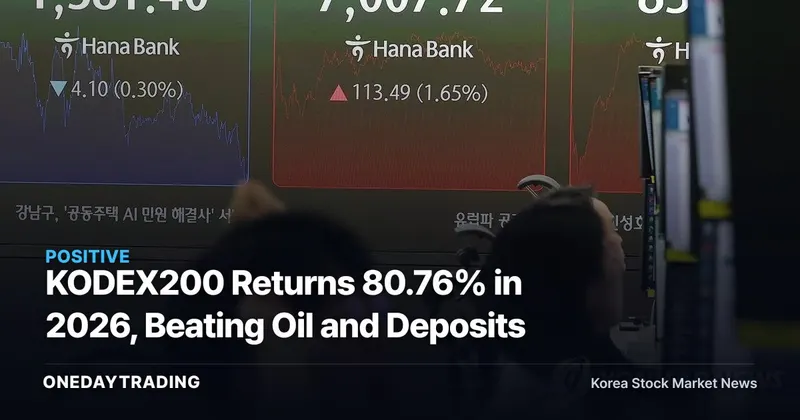
KODEX200’s 80.76% return signifies more than a simple ranking. According to Daishin Securities data reported by Yonhap News, the KOSPI 200-tracking asset outperformed deposits, crude oil, overseas equities, gold, Bitcoin and bonds from January 2 to September 20, 2026. The strongest signal for Korean investors this year was not a broad rally across asset classes, but the concentration of gains in a product tracking Korea’s benchmark stock index.
KODEX200 is an ETF designed to track movements in the KOSPI 200. The fact that a product reflecting the direction of an index, rather than the performance of an individual stock (ticker), topped the return rankings highlights the relative strength of Korean equities. What remains uncertain is whether that advantage will continue.
The Numbers That Reshaped the Return Rankings
- KODEX200 rose from 60,460 won on January 2, 2026, to 109,285 won on September 20, delivering an 80.76% return over the period.
- Front-month West Texas Intermediate crude oil futures in New York climbed from $57.41 to $96.08 per barrel over the same period, ranking second with a 67.36% return.
- The 272 Korean active equity funds with at least 10 billion won in assets under management posted an average return of 58.07% over the same period.
On the surface, the period may appear to have been a broad rally across risk assets. A closer look, however, reveals a clear performance gap. The SPY ETF, which tracks the U.S. Standard & Poor’s (S&P) 500 Index, gained 11.08% over the same period. The Korean index-tracking ETF outperformed both the average Korean active equity fund and the U.S. index-tracking ETF.
The Gap Between Deposits at 1.99% and KODEX200 at 80.76%
One-year term deposits at Korea’s five largest banks generated a 1.99% return from January 1 to September 20, 2026. This figure was calculated on a daily basis over 262 days using the 2.77% average annual base rate offered on the reference date by NH NongHyup, KB Kookmin, Shinhan, Hana and Woori Bank. KODEX200’s return was 40.6 times the deposit return.
While this comparison illustrates the difference in returns, it does not make the risks equivalent. KODEX200 tracks movements in the KOSPI 200, whereas the term-deposit return was calculated using base interest rates. The 40.6-fold difference should therefore be understood as a performance gap between investment options with different risk profiles over the period, not as a like-for-like comparison.
Gold, Bitcoin, Bonds and Exchange Rates Moved the Other Way
Over the same period, Korea’s retail gold price fell from 883,000 won to 860,000 won per 3.75g, a return of -2.60%. Bitcoin dropped from approximately $89,953 to $80,793, producing a return of -10.18%. Based on this year’s results alone, gold and Bitcoin failed to provide diversification against KODEX200’s rise.
The Korea Investors Service Composite Bond Index also declined from 279.70 to 269.15, a return of -3.77%. The won-dollar exchange rate fell -4.59%, from 1,466.70 won to 1,380.30 won per dollar, while the won-yen exchange rate declined -4.16%, from 922.70 won to 884.33 won per 100 yen. Performance during the period was shaped not only by asset selection but also by exchange rate movements when returns were measured in won.
Beneficiaries and Relative Underperformers
- KODEX200 and KOSPI 200: They recorded the highest return over the comparison period at 80.76%, confirming the relative strength of Korean index-tracking products.
- West Texas Intermediate crude oil (WTI): It ranked among the top-performing assets with a 67.36% gain but fell short of KODEX200.
- Korean active equity funds: The average return across 272 funds was 58.07%. The data did not provide individual fund results, making it impossible to assess differences between products.
- SPY ETF: It gained 11.08%, but underperformed Korean equity-related investments over the same period.
- Gold, Bitcoin, bonds and exchange rates: Korea’s retail gold price, Bitcoin, the Korea Investors Service Composite Bond Index, the won-dollar exchange rate and the won-yen exchange rate all declined.
Countervailing Factors After the Rally
- It has not been confirmed whether fees and taxes were reflected in each asset’s return calculation. There is therefore no basis for concluding that investors’ actual net returns matched the reported figures.
- A complete list of all investment options covered by the survey was not disclosed, so the rankings should be interpreted only within the scope of the included comparison group.
- If KODEX200’s performance reverses, the assumption that this year’s relative advantage will continue would no longer hold. Past returns and future expected returns must be considered separately.
- Daishin Securities analyst Lee Kyung-min projected a KOSPI range of 6,000 to 9,300 points for the fourth quarter of 2026. The width of that range itself shows that the KOSPI’s future level remains uncertain.
Oil Prices and Bond Yields Are the Next Indicators to Watch
Lee Kyung-min said, “Uncertainty surrounding global monetary policy has passed its peak, and with a more peaceful atmosphere emerging between the United States and Iran ahead of the U.S. midterm elections in early November, oil prices and bond yields are expected to stabilize at lower levels.” The next key test is not KODEX200’s past ranking, but whether this forecast materializes. The strength of Korean index-tracking ETFs has been established, but a shift in the direction of oil prices and bond yields would alter both the projected KOSPI range and the relative performance of each asset.
KOSPI Index MetricsAs of 2026-09-27
| Performance | 1 Week +5.40% 1 Month +5.02% |
|---|
Index, commodity and exchange rate data are based on global markets and reflect values at the time of publication.
This article was automatically summarized and analyzed based on the original news report. View Original Article (Yonhap News — Securities)