
At a Glance
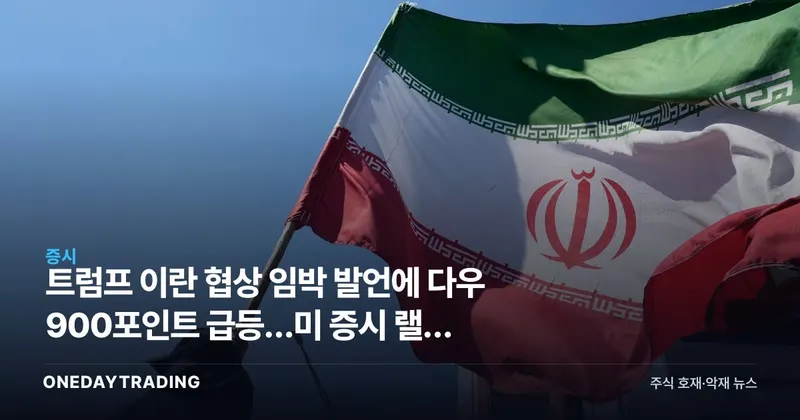
U.S. equities rebounded sharply after President Donald Trump suggested that a deal with Iran was drawing closer. The Dow surged roughly 900 points, with the Nasdaq and S&P 500 rallying alongside it. The move is read as a sign that hopes for easing Middle East geopolitical risk fueled renewed appetite for risk assets.
Why It Matters Now
One of the key variables weighing on global equities recently has been Middle East tensions. When conflict escalates, international oil prices spike, which in turn drives inflation higher and raises corporate costs — a burden on risk assets. As a result, a single signal pointing to a possible deal was enough to trigger a swift relief rally.
Notably, this rebound goes beyond a mere technical bounce; it reflects expectations that oil prices could settle as the geopolitical premium unwinds. Stable oil prices could also work favorably for the Federal Reserve's rate path, which is why the growth- and tech-heavy Nasdaq responded more sensitively.
That said, investors should keep in mind that rallies built on leaders' remarks tend to be highly volatile. If expectations run ahead without a confirmed agreement document or a concrete implementation timeline, the risk of a pullback grows just as quickly should the talks stall.
Frequently Asked Questions
- Why did the Dow surge? Expectations of progress in talks with Iran were interpreted as easing Middle East risk, drawing in buying interest.
- What happens to oil prices? If the geopolitical premium unwinds, international oil prices could come under downward pressure.
- Is this good for Korean equities? A recovery in risk appetite is favorable for KOSPI export stocks, but falling oil prices could weigh on refining stocks.
- Will the rally last? Until an actual agreement is confirmed, the rally remains heavily dependent on remarks, so investors should be mindful of volatility.
Affected Stocks and Sectors
- Semiconductors and large-cap exporters Samsung Electronics, SK Hynix and others benefit from favorable foreign-investor order flow amid a recovery in risk appetite and strength across global equities.
- Airline stocks Carriers such as Korean Air stand to see improved profitability expectations as easing oil prices reduce their fuel-cost burden.
- Refining stocks S-Oil, SK Innovation and others could face a negative impact on refining margins and inventory valuations if oil prices fall.
- Chemicals and transportation Chemicals, which carry a high share of crude-based costs, along with shipping and logistics, could benefit from stable oil prices.
Points to Watch When Investing
- Rallies based on leaders' remarks can reverse quickly if a deal falls through, so caution is warranted before chasing the move higher.
- Because refining and airline stocks see their fortunes diverge in opposite directions depending on the direction of oil prices, a differentiated, sector-by-sector approach is needed.
- Investors should also monitor how the exchange rate and U.S. interest-rate trends simultaneously affect foreign-investor order flow.
- In phases of heightened short-term volatility, staggered entries and risk management are key.
Overall Outlook
In the optimistic scenario, the Iran talks lead to an actual agreement, oil prices stabilize, and the recovery in risk appetite spreads to global equities and KOSPI export stocks. Calmer oil prices ease inflation and rate pressures, providing additional momentum for tech stocks. Conversely, if the talks stall or the remarks are walked back, geopolitical risk could resurface and much of this rally could be unwound. Ultimately, the key lies not in expectations but in whether an actual agreement makes progress; rather than betting on one side, investors would do well to adopt a balanced strategy that keeps both scenarios open.
This article is auto-summarized and analyzed content based on the original news report. View original (Yahoo Finance)