
Summary
What this story really signals isn't a simple disaster response. As the heatwave and drought drag on, water shifts from a public good to a cost variable — and that cost flows down into agricultural prices, regional manufacturing output, and local government budgets.
From Kang Si-hyun's perspective, the market has already priced in the summer heatwave headlines. What it hasn't fully priced in yet is the second-order impact of water shortages on inflation and production costs.
What Happened
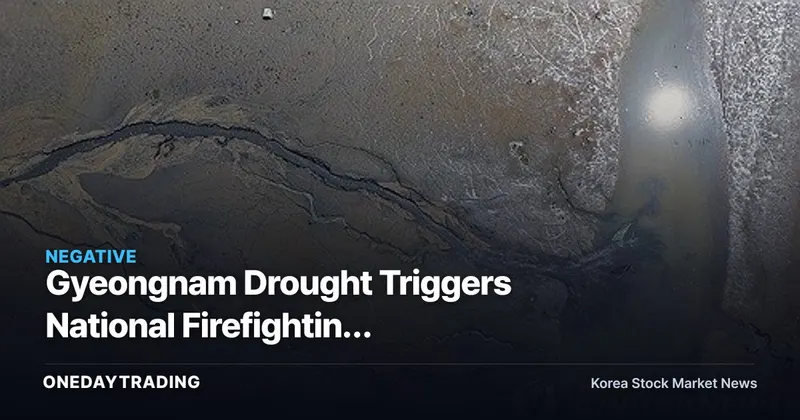
According to Yonhap News's industry desk, the government has issued a national firefighting mobilization order to support water supply in Gyeongnam Province, which is experiencing water shortages due to the heatwave and drought. This marks an escalation from a regional response to one involving firefighting resources deployed from across the country.
What matters to investors isn't the image of fire trucks hauling water. It's that the supply-demand (order flow) balance for water has been shaken enough to require mobilizing administrative resources for residential water supply. Drought first hits agricultural output, which then squeezes food costs and dining-out inflation. The heatwave, meanwhile, pushes up power demand, raising both cooling costs and logistics costs at the same time.
Gyeongnam is a region where shipbuilding, machinery, auto parts, and port logistics overlap. This report alone doesn't confirm production disruptions at any specific plant. Still, as residential water supply becomes the priority, investors should watch for potential knock-on effects on industrial water allocation, outdoor working hours, and productivity at ports and construction sites.
Structural Backdrop
The read-through on inflation starts with interest rates. If the heatwave and drought push up agricultural prices, the downward path for consumer inflation slows. A slower deceleration in inflation weakens rate-cut expectations, which in turn revives the relative appeal of sectors with solid cash flow over growth stocks that carry higher discount rates.
That said, not every heatwave headline is automatically a negative catalyst for equities. Markets price in a degree of seasonality already. The key variable is duration. If this remains a temporary water-supply support measure, it stays contained to local administrative costs. But if the drought drags on and spreads into agricultural prices and on-site industrial costs, earnings estimates — not valuations — will be the first thing to get revised.
Stock (Ticker) and Sector Impact
- Food & Beverage: Companies with a high share of agricultural raw materials will feel the cost pressure first. Revenue can hold up if price pass-through is possible, but margin recovery will be slower amid weaker consumer spending.
- Retail: Greater volatility in fresh food prices could drive traffic to large discount stores and online grocery channels. On the other hand, inventory write-offs and cold-chain logistics costs will weigh on earnings.
- Power & Energy: The heatwave is driving up cooling demand. If power peaks recur, generation fuel costs and grid strain become variables the market will watch closely.
- Construction & Machinery: Outdoor processes and on-site work in Gyeongnam are sensitive to heat-related work restrictions and water constraints. Whether project schedules slip will be the key driver of cost recognition.
- Water/Sewage & Environmental Infrastructure: This is more a medium-to-long-term budget issue than a near-term earnings one. Repeated droughts strengthen the case for local governments to invest in pipe network maintenance and water storage/treatment facilities.
Bullish vs. Bearish Scenarios
In the bullish scenario, the damage stays contained to the residential water-support stage. Short-term costs are incurred, but if production disruption and inflation pass-through remain limited, the market absorbs this as disaster-response news and shifts its focus back to interest rates, exchange rates, and corporate earnings.
In the bearish scenario, the heatwave and drought simultaneously hit agricultural prices, power supply-demand (order flow), and regional productivity. If inflation proves stickier than expected, rate-cut expectations retreat, and earnings estimates could wobble for consumer goods makers and small-to-mid-sized manufacturers unable to pass rising costs through to prices.
Investor Action Points
- Watch the direction of fresh food and dining-out prices in the next CPI release — the first signal is whether the heatwave has spread into actual prices.
- Check disclosures and earnings commentary from Gyeongnam-based manufacturers regarding plant operations, delivery schedules, and logistics delays.
- Monitor power peak and reserve margin data together — if the heatwave strains both water supply and power costs at once, cost pressure will intensify.
- Focus less on whether rainfall eases the situation and more on whether water restrictions spread into industrial sites. That's the variable the market has under-priced.
This article was automatically summarized and analyzed based on the original news report. View original (Yonhap News Industry)