
At a Glance
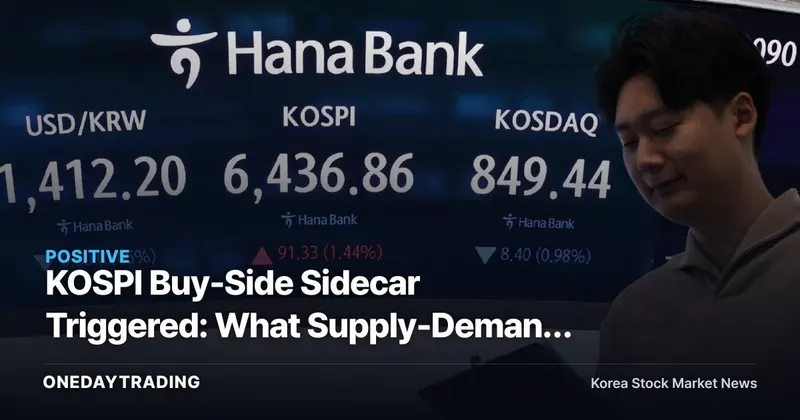
It wasn't KOSPI that rose first — futures lifted the market's risk appetite ahead of it. The fact that a temporary suspension of program buy orders, i.e., a buy-side sidecar, was triggered on the KOSPI market at 11:57 a.m. on the 12th following a sharp gain (surge) in the KOSPI 200 futures index means less "the market is bullish" and more that the speed of supply-demand (order flow) outran price discovery.
For Korean investors, two questions matter most. First, has passive buying pressure centered on large-cap stocks (tickers) intensified? Second, is this rally a valuation expansion that interest rates and the exchange rate can support, or merely the unwind of a short-term futures bet?
Why It Matters Now
A sidecar is a mechanism that briefly cools the shock of program trading when the market moves too fast. The fact that today's trigger came at 11:57 a.m. — not right at the open — suggests this wasn't a simple opening gap-up, but rather that the force of futures prices pushing up the cash market built through the mid-morning session. When KOSPI 200 futures post a sharp gain (surge), program buying flows first into large index-weight stocks (tickers) such as Samsung Electronics (005930), SK Hynix (000660), Hyundai Motor (005380), and KB Financial Group (105560).
What this really reflects is the relationship between interest rates and multiples. When rates fall — or the likelihood of a cut rises — the discount rate applied to equities drops, and the market can assign a higher price-to-earnings ratio to the same level of earnings. Conversely, if rate-cut expectations are already fully priced in, the sidecar becomes a sign of overheating rather than the start of a new trend. What the market bought today wasn't confirmed corporate earnings but the possibility of liquidity.
The interpretation therefore differs by industry sector. Large export-oriented stocks (tickers) like semiconductors and autos, where foreign investors and passive funds tend to flow in all at once, are the first beneficiaries of the index's rise. Financial stocks (tickers) face pressure on net interest margins if rate-cut expectations run too far, but when risk appetite revives, their shareholder-return policies and undervaluation appeal come into focus as well. The wild card is the exchange rate. If the won-dollar exchange rate turns volatile again, foreign investor flows can reverse direction within a single day.
Frequently Asked Questions
- Is a buy-side sidecar always a positive catalyst? In the short term, it's a positive catalyst for supply-demand (order flow). But it also means prices moved fast enough to require throttling program buying, so if cash-market trading value and foreign net buying don't follow through afterward, the upward momentum could fade.
- Why do KOSPI 200 futures matter? Futures are where institutional investors' and foreign investors' directional bets get reflected first. When futures post a sharp gain (surge), arbitrage trading and passive buying can flow through into large-cap stocks (tickers) in the cash market.
- Should investors watch the index rather than individual stocks (tickers)? The first reaction is at the index level. After that, investors should pick industry sectors where earnings outlooks are rising in tandem. A futures-driven rally alone doesn't change earnings.
- What indicators should be checked next? Watch, as of the market close, foreign net buying in the cash market, the scale of net program buying, the won-dollar exchange rate, and whether trading value is rising in KOSPI 200 large-cap stocks (tickers).
Related Stocks (Tickers) and Sector Impact
- Samsung Electronics (005930). A flagship large-cap stock with heavy weighting in the KOSPI 200. It's among the first to be affected when program buying and foreign passive fund inflows come in.
- SK Hynix (000660). The semiconductor sector has high sensitivity to the index, and AI memory expectations remain in place. That said, it's worth checking whether the share price has run ahead of the pace of earnings improvement.
- Hyundai Motor (005380). During periods of won weakness, expectations build around export profitability, but if exchange-rate volatility increases, the persistence of foreign fund inflows could waver.
- KB Financial Group (105560). When risk appetite strengthens, capital can rotate into undervalued financial stocks (tickers). But excessive rate-cut expectations weigh on bank margins.
- KOSPI 200 large-cap stocks (tickers). The direct channel for this event is program buying flowing from futures into the cash market. Large-cap stocks (tickers) tend to react before small- and mid-cap names.
Points to Watch for Investors
- The sidecar trigger itself shouldn't be read as confirmation of a trend. Cash-market supply-demand (order flow) needs to be confirmed after the close.
- If rate-cut expectations are already priced in, further gains will require upward earnings revisions.
- If the won-dollar exchange rate rebounds sharply, foreign buying could weaken on concerns about FX translation losses.
- Stocks (tickers) that rose on program buying could see quick profit-taking in the next trading session.
Overall Outlook
This buy-side sidecar signals a revival of risk appetite in Korea's equity market. The bullish scenario is clear: if strength in KOSPI 200 futures translates into foreign net buying in the cash market, and earnings outlooks for large-cap semiconductor and auto stocks (tickers) provide support at the same time, the index could enter a multiple re-rating phase.
But there are variables the market hasn't yet priced in. If rate-cut expectations retreat or the won-dollar exchange rate spikes back up, today's program buying will end up as volatility rather than a trend. The next triggers to watch are closing supply-demand (order flow), the exchange-rate level, and shifts in rate expectations around the next Monetary Policy Board meeting. What matters is the character of the money, not the speed of the index.
This article is automatically summarized and analyzed content based on the original news report. View Original (Maeil Business Newspaper, Securities)