
Three-Line Briefing
- The key takeaway for Samsung Electronics investors is not that bonuses will immediately decline. Rather, the significance lies in the narrower scope for future bargaining over demands tied to operating profit.
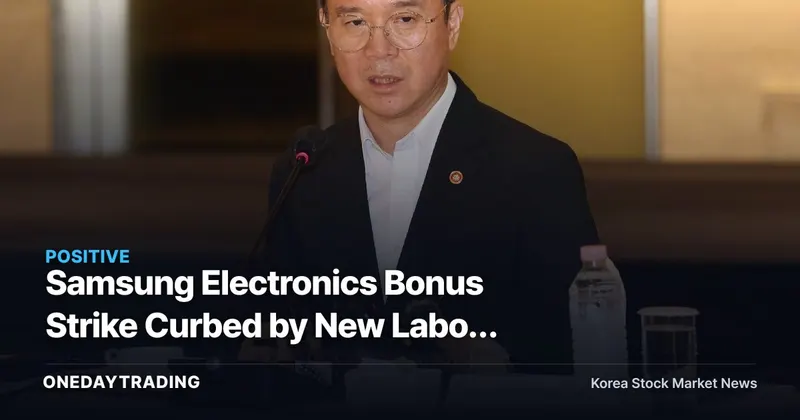
- In an interview reported by Maeil Business Newspaper on September 8, Employment and Labor Minister Kim Young-hoon said that, under the new enforcement guidelines, the Samsung Electronics union’s May strike demanding bonuses equal to “N% of operating profit” would be deemed illegal.
- The guidelines are not expected to apply retroactively to existing collective bargaining agreements. More important than any immediate earnings impact are the structure of demands in the next negotiations and rulings by the relevant authorities.
What Is Changing
A new benchmark has emerged in the Samsung Electronics bonus dispute. The Yellow Envelope Act enforcement guidelines announced by the Ministry of Employment and Labor on September 3 state that demands for performance bonuses linked to corporate profit are unlikely to qualify as mandatory bargaining subjects. Mandatory bargaining subjects are employment-related matters over which an employer generally cannot refuse to negotiate without just cause.
The guidelines do not challenge all performance bonuses. They specifically address demands to allocate a fixed percentage of operating profit before taxes and other items are reflected. The ministry said such demands could infringe on the rights and interests of third parties, including the government and shareholders, while excessively restricting corporate management decisions and their execution.
The real implication is not the end of labor-management negotiations, but a shift in the issues under discussion. If demands based on a fixed percentage of operating profit fall outside the scope of bargaining, unions may instead propose higher base pay, enhanced benefits, or other forms of compensation. The company’s total compensation cost will ultimately be determined through those subsequent negotiations.
The Numbers and Context
The only figure cited in this case is “N%,” not a specific payout rate. No basis was provided for calculating bonus payments, reductions in labor costs, or improvements in operating profit. Treating the announcement as an immediate reason to raise Samsung Electronics’ earnings estimates would therefore run ahead of the facts.
The distinction between what has and has not been established is clear. The government has confirmed its interpretation limiting the scope of mandatory bargaining. By contrast, the legality of any individual labor dispute will depend on the specific demands, procedures, and future rulings by the relevant authorities. Minister Kim also said the law cannot be applied uniformly and that precedents must accumulate.
What markets may price in first is the possibility of lower uncertainty surrounding future negotiations. What remains difficult to price is the actual total compensation bill and the cost of disputes. If fixed-percentage bonus demands decline in the next round of collective bargaining and subsequent rulings follow the guidelines, the policy signal could develop into a more stable framework for negotiations.
Potential Beneficiaries and Losers
- Samsung Electronics: The company was cited as a direct example under the new guidelines. If bonuses linked to operating profit are firmly excluded from mandatory bargaining, that could reduce some uncertainty surrounding future negotiating issues and financial planning. However, there is no evidence that existing payment arrangements or actual labor costs have changed.
- Semiconductor industry sector: The source did not confirm the collective bargaining agreements or bonus formulas of other companies. Rather than extrapolating the Samsung Electronics case into lower costs across the industry sector, investors should first determine whether similar profit-linked demands exist at each company.
Risk Check
- Administrative guidelines represent the government’s stated standards for applying the law. If authorities handling individual cases reach different interpretations, the investment case for greater predictability would weaken.
- Even if fixed-percentage bonus demands are restricted, cost pressures could shift to other categories if unions increase demands for base pay or other compensation.
- If disputes over the scope of bargaining continue, the duration of conflicts and the cost of labor-management relations will remain difficult to estimate in advance.
- Weaker foreign investment was a concern cited by Minister Kim in explaining the need for restrictions. The source provides no figures showing an actual improvement in foreign investor supply-demand (order flow) or Samsung Electronics’ valuation.
Bottom Line
The new guidelines are a favorable signal for clarifying the scope of Samsung Electronics’ future bonus negotiations. However, any share-price revaluation will require evidence of how the structure of demands and total compensation costs change in the next collective bargaining round.
Frequently Asked Questions
Is the Samsung Electronics union’s strike in May now illegal?
Minister Kim said it would be deemed illegal if the new guidelines were applied. However, the guidelines are not expected to apply retroactively to bonus arrangements already agreed upon by Samsung Electronics and its unions, while the legality of an individual dispute will depend on the specific facts and application procedures.
Are all bonus demands excluded as grounds for a strike?
No. Minister Kim said not all performance bonuses would be excluded from labor disputes. The guidelines focus on demands requiring a fixed percentage of operating profit to be allocated before taxes and other items are reflected.
What should investors watch to assess the impact on Samsung Electronics shares?
First, investors should see whether demands linked to operating profit are raised again in the next wage and collective bargaining negotiations. They should then track changes in total compensation and rulings by the relevant authorities to determine whether the policy signal has affected earnings and valuation.
Samsung Electronics Key MetricsAs of 2026-09-08
| Period Returns | 1 Week +6.70% 1 Month +20.56% |
|---|---|
| Trading Value · Trading Volume | 3.4153 trillion won · 12,415,265 shares |
| Supply-Demand (Order Flow) | Foreign Investors Net Buying of 871.1 Billion Won Institutional Investors Net Buying of 1.222 Trillion Won |
| Recent News Tone | 6 Positive Catalysts · 5 Negative Catalysts |
Price and supply-demand (order flow) data are real-time figures from Korea Investment & Securities (KIS), while supply-demand (order flow) and news-tone tallies are calculated independently by One Day Trading.
Supply-Demand (Order Flow) and Momentum Assessment🟢 Buying Advantage
Foreign investors, institutional investors, news, and momentum indicators are showing positive signals.
- ▲Dual BuyingForeign investors bought a net 871.1 billion won and institutional investors a net 1.222 trillion won
- ▲Trend AlignmentShort- and medium-term uptrends aligned (day +3.1% · 1 week +6.6% · 1 month +20.5%)
Upcoming Events to Watch
- 09.10Simultaneous Futures and Options ExpirationMediumQuadruple witching — watch for volatility and supply-demand (order flow) disruptions
- 09.16FOMC Policy Rate DecisionHighFederal Reserve monetary policy announcement — direction of interest rates and the dollar
- 10.08Index Options ExpirationLowKOSPI 200 options expiration
- 10.22Bank of Korea Monetary Policy BoardHighBenchmark interest rate decision meeting
This article was automatically summarized and analyzed based on the original news report. View Original Article (Maeil Business Newspaper — Companies)