
At a Glance
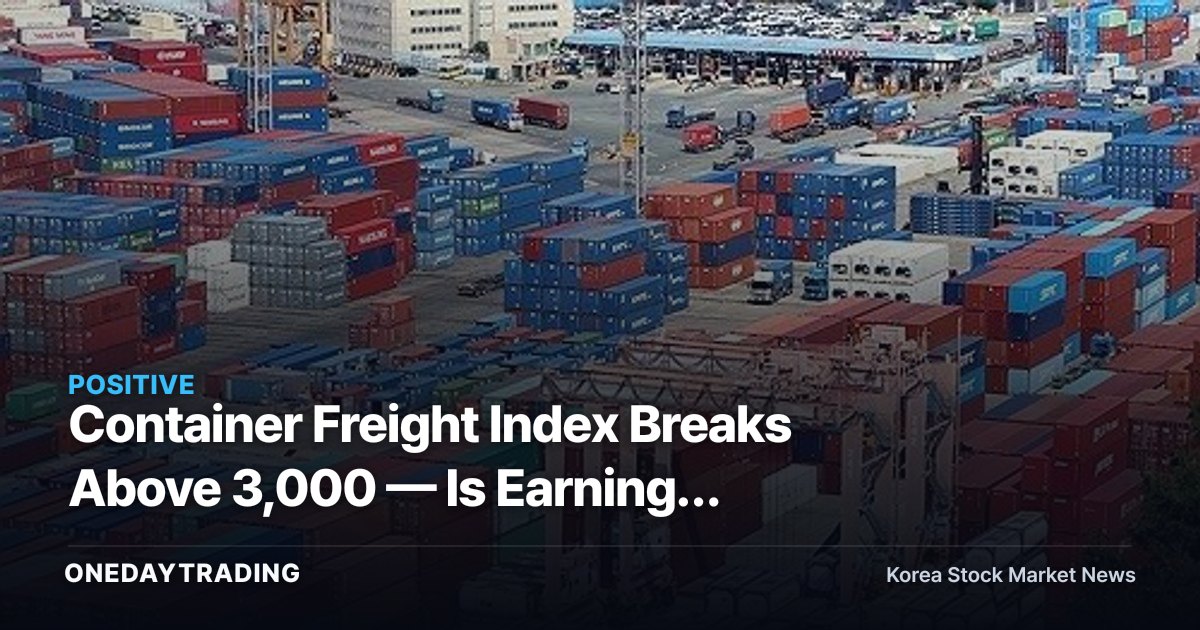
The container freight index has climbed back above the 3,000 level for the first time in one year and ten months. Even with the ceasefire agreement between the United States and Iran, the normalization of maritime logistics is unfolding with a time lag — meaning that in the near term, the shipping sector, which benefits from higher freight rates, and export sectors, which face a growing logistics cost burden, could move in opposite directions.
Why It Matters Now
The freight index breaking out of its trading range to reclaim the 3,000 level is more than a simple price fluctuation — it signals that supply-demand (order flow) for vessel capacity (cargo space) has tightened once again. Container carriers' revenue is closely tied to freight rates, and because fixed costs make up a large share of their cost structure, once rates climb above the breakeven point, most of any further rate increase flows straight through to profit. This means that even a modest step-up in freight rates can trigger substantial operating profit leverage.
What's underpinning freight rates is that route disruptions remain very much alive despite the ceasefire agreement. If uncertainty over passage through the Red Sea and the Suez Canal drags on, carriers reroute around the southern tip of Africa, which requires longer voyages and more vessels and fuel to carry the same amount of cargo. The net effect is a reduction in effective capacity supply, which keeps freight rates supported. Even once the geopolitical situation stabilizes, redeploying vessels and normalizing schedules takes anywhere from several weeks to several months — and that lag is the backdrop for the current strength in freight rates.
FAQ
- Why is a rise in freight rates a direct positive catalyst for shipping stocks? Because carriers' revenue is tied to freight rates and fixed costs make up a large share of their cost base, once rates clear the breakeven point, profit leverage becomes substantial.
- Why are rates rising even after the ceasefire agreement? Because the longer voyages from rerouting and delays in vessel redeployment continue to tie up effective capacity.
- Do all shipping stocks benefit equally? Carriers with heavy container exposure benefit directly, while bulk- and tanker-focused carriers see a more limited or different impact.
- What does this mean for exporters? Rising freight rates translate into higher logistics costs, becoming a cost factor that squeezes margins.
Related Stocks and Sector Impact
- HMM: As Korea's leading container carrier, HMM has the highest revenue sensitivity to freight rates, making it a prime candidate to directly benefit from the index's return above 3,000.
- Pan Ocean and Korea Line: Although bulk-shipping focused, they could see a knock-on effect from the improving mood in the shipping industry and expectations of a recovery in cargo demand.
- Shipping and logistics sector overall: Strong freight rates provide grounds for upward revisions to carriers' earnings estimates and stimulate investor sentiment toward the industry sector.
- Export manufacturers (electronics, automotive, chemicals): Rising container freight rates act as a logistics cost burden, potentially pulling these sectors in the opposite direction from shipping stocks.
- Refining and fuel-related names: A prolonged rerouting period increases demand for marine fuel, which could have a secondary effect on demand for bunker fuel and similar products.
Points to Watch for Investors
- If the strength in freight rates rests on the temporary factor of route disruption, a reversal could come quickly once the geopolitical situation stabilizes and schedules normalize.
- In a cycle where newbuild deliveries expand capacity supply, freight rates face the risk of being structurally pressured lower again.
- Because shipping stocks' earnings are highly volatile relative to freight rates, investors should check valuation risk during periods of a sharp gain (surge).
- Since rising freight rates represent a cost for exporters, the same news can have opposite effects depending on the industry sector of the stock (ticker) an investor holds.
Overall Outlook
As long as the extended rerouting and delayed vessel redeployment persist, freight rates could stay elevated, fueling expectations of improved quarterly earnings for container carriers. Conversely, if the Middle East situation stabilizes quickly and passage normalizes, the effective capacity that had been tied up could be released all at once, triggering a sharp pullback in rates. Key indicators to watch are the weekly freight index trend, whether Red Sea and Suez Canal transit resumes, and next quarter's carrier earnings and guidance. Rather than a single week's index rebound, whether the rate level holds for several weeks or more is the key to judging the trend's direction.
HMM in Real-Time Data
HMM's most recent closing price was KRW 20,450 (-7.47% versus the previous day), and the traffic-light signal combining foreign and institutional investor order flow with news and momentum reads 🔴 Caution. Caution is warranted right now, as foreign investors, institutional investors, and momentum are all negative.
- ▼ Dual selling — foreign investors sold a net −KRW 7.4 billion, institutional investors sold a net −KRW 4.4 billion
Recent related news skews favorable, with 1 positive catalyst and 0 negative catalysts.
※ Price and foreign/institutional investor order-flow data are provided by Korea Investment & Securities (KIS) and are current as of the time of publication.
This article is automatically summarized and analyzed content based on the original news report. View Original (Yonhap News Industry)