
Three-Line Briefing
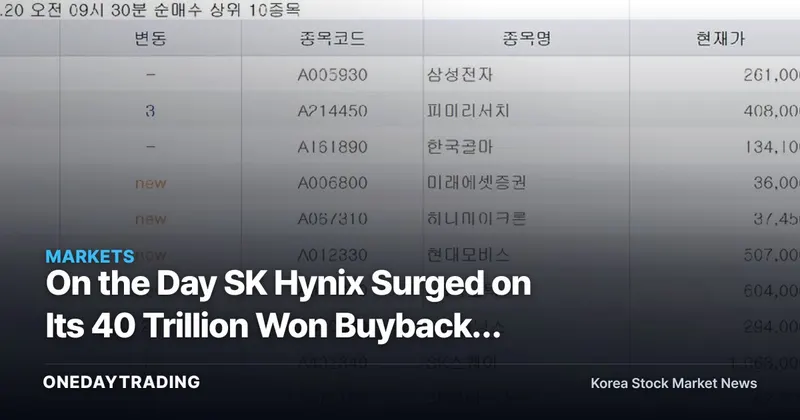
- In early trading on August 20, the top 1% of investors by returns were net buyers of Samsung Electronics (005930) above all else, while net selling SK Hynix (000660) — which surged on a 40 trillion won buyback plan — more than any other stock.
- This selling by smart money isn't a signal of an impending price decline; it reflects a judgment that the buyback announcement has already been priced in.
- Even within the same semiconductor cycle, when a valuation gap widens, top-tier traders sell the stock (ticker) that has already rallied and rotate into the relatively underperforming sector bellwether.
What's Changing
When SK Hynix rolled out a 40 trillion won share buyback, the market responded immediately with a sharp gain in the stock. Yet in this very surge, the biggest sellers were the top 1% of investors by returns. What they sold wasn't a bet against SK Hynix's fundamentals — it was a judgment that the buyback announcement had already been priced in ahead of time. Share buybacks lift per-share value by reducing shares outstanding, but most of that effect gets baked into the price the moment it's announced. For top-tier traders, the math favored locking in gains over betting on further upside once the catalyst had already played out.
Buying Samsung Electronics, on the other hand, reflects a shift in relative value within the same semiconductor cycle. While SK Hynix's valuation ran up first on the back of its HBM leadership and the buyback catalyst, Samsung Electronics still hadn't fully priced in expectations for a foundry and NAND recovery. The top-tier traders' moves look more like a rotation to close that gap. It's a signal that SK Hynix has gotten expensive — not a bearish call on the semiconductor cycle itself.
Whether this trend holds, though, is a separate question. The top-tier trading data is just a snapshot from early trading, so the direction could reverse within the same day, and a buyback's real price-support effect tends to show up more clearly once the actual purchases are executed. Short-term volatility could widen in the gap between the announcement and its execution.
Numbers in Context
40 trillion won is a substantial sum even relative to SK Hynix's market capitalization. A buyback plan of this scale sends a clear message to the market: the company views its own stock as undervalued. But the stronger the signal, the more immediate the market's reaction — and that very immediacy became the top-tier traders' cue to take profits. If the market priced in the entire catalyst within a single day, what's left to drive the stock is earnings and supply-demand (order flow), not a repeat of the same catalyst. The flow of capital into Samsung Electronics reflects the flip side of the same logic — a bet that there's still a catalyst not yet fully priced in.
Winners and Losers
- Samsung Electronics (005930): Smart money net buying concentrated on the stock while expectations for a foundry and NAND recovery remain only partially priced in. The stock is being re-rated as the next beneficiary of the improving semiconductor cycle.
- SK Hynix (000660): With the buyback catalyst spent in a single day's surge, further upside now hinges on confirmation of fundamentals such as HBM earnings and yield rates.
- Semiconductor equipment and materials suppliers: Regardless of which bellwether capital favors, the broader cycle remains intact in this phase, so upstream supply-chain beneficiaries are relatively less affected.
Risk Check
- The top-tier trading data is just a snapshot from early trading and may differ from the supply-demand (order flow) picture at the market close.
- The stock's price-support strength will depend on the speed and scale at which the buyback announcement translates into actual purchases.
- If the capital shift into Samsung Electronics turns out to be simple sector rotation rather than a genuine valuation-gap correction, its durability could be short-lived.
- Should the global semiconductor cycle itself roll over, the rotation logic between the two stocks (tickers) would be undermined as well.
Bottom Line
The top-tier traders' selling isn't pessimism toward SK Hynix — it's profit-taking after the catalyst played out — while their buying of Samsung Electronics is a rotation toward the relatively underperforming stock within the same cycle. The next disclosures on buyback execution and Samsung Electronics' foundry and NAND earnings will be the test of whether this call was right.
SK Hynix by the Numbers: Real-Time Data
SK Hynix's most recent closing price was 1,692,000 won (+12.80% versus the prior day), and the composite signal combining foreign/institutional investor flows with news and momentum reads 🟡 Neutral / Wait-and-See. With positive and negative signals mixed, this is a period to watch closely.
- ▼ Double-sided selling — Foreign investors −1,817.6 billion won · Institutional investors −471.8 billion won, sold in tandem
- ▲ News flow — 9 positive catalysts vs. 1 negative catalyst — positive catalysts dominate
Recent related news skews favorable, with 9 positive catalysts versus 1 negative catalyst.
※ Price and foreign/institutional investor flow data are provided by Korea Investment & Securities (KIS) and reflect figures as of publication.
This article was automatically summarized and analyzed based on the original news report. View original (Maeil Business Newspaper - Securities)