
At a glance
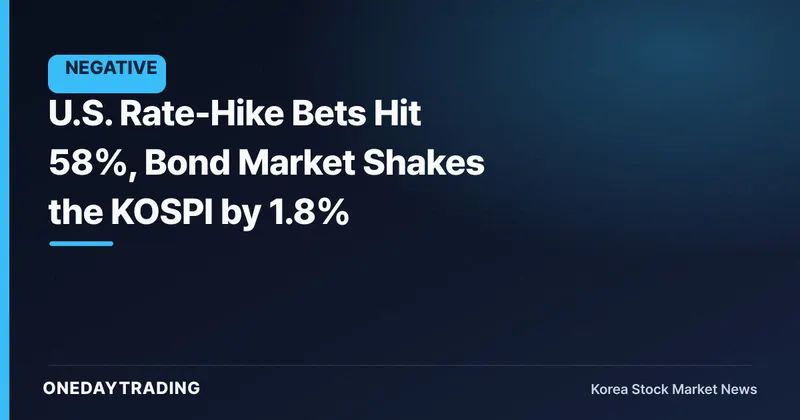
U.S. rate-hike bets on August 28, 2026 pushed bond yields higher, signaling that discount-rate pressure has returned to the Korean stock market. According to AP News, the U.S. 2-year Treasury yield jumped from 4.22% to 4.35% right after Fed Chair Kevin Warsh’s Jackson Hole remarks, not Jerome Powell’s.
What this really says is not that the stock market simply fell. What the market had already priced in was hawkish Fed language; what it has not fully priced in yet is the probability that, if that language turns into an actual rate hike, growth-stock multiples will be pushed lower again.
Why it matters now
Based on CME Group data, the market-implied odds of a Fed rate hike rose from 35% a day earlier to nearly 58% on August 28. Short-term rates reflect expectations for the benchmark interest rate most directly. While the 2-year yield rose 13 bp, the 10-year moved from 4.67% to 4.72%, and the 30-year from 5.19% to 5.21%. In other words, the short end was more sensitive than the long end.
This structure leaves banks with expectations for net interest margin gains, but it is a burden for sectors such as semiconductors and internet stocks, where far-future earnings are valued in present terms. The Nasdaq fell 0.5%, and the S&P 500 slipped 0.3%. The KOSPI’s 1.8% decline on the same day should be read not as simple follow-through weakness from overseas, but as the result of higher dollar rates lifting foreign investors’ required return on Korean assets.
Jackson Hole is a venue where a single remark is traded as a policy signal. Warsh emphasized that short-term rates are the Fed’s key tool and said financial conditions do not appear tight enough. The market translated that sentence not as a delay in rate cuts, but as a possible additional hike.
Key points
- Warning from short-term rates: The U.S. 2-year yield at 4.35% is a price signal that the benchmark interest-rate path has reopened to the upside. Stock multiples cannot escape this yield when it comes to discounting.
- Equity weakness is still shallow: The S&P 500’s 0.3% drop, the Dow Jones’s decline of less than 0.1%, and the Nasdaq’s 0.5% fall point more to repricing than to shock. The real issue comes when the next jobs and inflation data confirm the same direction.
- AI-stock narrative check: Marvell Technology beat expectations slightly on earnings and revenue and raised its outlook for its AI business, yet the stock fell 10.6%. With the stock already up 184% year to date, a lot of good news was already priced in.
- Consumer stocks reacted selectively: Gap rose 13.5% after stronger-than-expected quarterly profit and a leadership change at Old Navy. Even in a higher-rate environment, an earnings surprise can move an individual stock.
Impact on related stocks and sectors
- KB Financial Group and Shinhan Financial Group: Higher short-term rates support expectations for wider net interest margins. However, if a slowdown in the economy feeds into credit costs, that rate benefit can be offset in quarterly profit and loss.
- Samsung Electronics (005930) and SK hynix: The burden comes less from AI chip demand itself than from the path through which higher U.S. rates raise the discount rate on growth stocks. Marvell’s decline showed that even with strong AI revenue, valuation can be pressured first.
- Naver and Kakao: Platform stocks are priced on both long-term growth and ad-market expectations. The rise in the U.S. 2-year yield lowers the ceiling for PER recovery.
- Korean Air and CJ CheilJedang: If higher dollar rates lead to a weaker won, foreign-currency debt and raw-material import costs become a burden. The key question is whether the exchange rate rises alongside rates.
- S-Oil and SK Innovation: For these names, oil prices and refining margins matter more than long-term rate moves. Still, if recession concerns grow, the demand outlook for energy can weaken first.
Investment takeaways
- Until the next Fed meeting, watch whether the U.S. 2-year yield stays above 4.35%. If that level holds, a rebound in growth stocks will likely need a signal of rate relief before earnings do.
- If the U.S. 10-year yield approaches 5%, foreign investors’ supply-demand (order flow) in Korean stocks could swing again alongside the exchange rate. A KOSPI rebound will have better quality only if both rates and the won-dollar pair stabilize at the same time.
- AI semiconductors are no longer in a phase where only revenue guidance matters. As Marvell showed, even when earnings beat expectations, stocks that have already run up can still correct.
- Bank stocks are too late to buy on the rate-hike story alone. You also need to watch the lag between high rates and damage to consumer and property-backed credit quality.
Overall outlook
The bullish scenario is clear. If the Fed reinforces its commitment to containing inflation and brings down long-term inflation expectations, the rise in long-term yields should remain limited, and the stock market could once again price policy credibility as a premium. The fact that long-term yields rose less than short-term yields on this day still leaves that possibility open.
The trigger for the opposite scenario is the next inflation and jobs data. If inflation stays sticky and employment holds up, the market will push that 58% probability further toward an actual hike path. At that point, it is not that the KOSPI falls; rather, the yield and currency compensation foreign investors demand for won assets rises. The next checkpoints are U.S. CPI and labor data due before the Fed’s September meeting, along with the first resistance level for the won-dollar exchange rate.
Frequently asked questions
Why does the probability of a U.S. rate hike matter for Korean stocks?
When the probability of a U.S. rate hike rose from 35% to nearly 58% on August 28, 2026, the U.S. 2-year Treasury yield climbed to 4.35%. Because Korean stocks rely heavily on foreign investors, higher dollar rates quickly translate into a higher required return for won-denominated equities.
Which stocks are hurt by a rise in the U.S. 2-year Treasury yield?
A rise in the U.S. 2-year Treasury yield weighs first on growth stocks such as semiconductors, internet, and biotech, where a large share of value lies in future earnings. Even if Samsung Electronics (005930) and SK hynix still have strong AI demand, higher discount rates can slow the pace of valuation re-rating.
Are bank stocks always a winner in a rising-rate environment?
Higher rates can raise net interest margin expectations for KB Financial Group and Shinhan Financial Group. But if high rates increase borrowers’ repayment burden, credit costs follow, so bank stocks need to be viewed together with rate direction and delinquency trends.
KB Financial Group in real time
KB Financial Group recently closed at 171,600 won (+2.08% from the previous day), and its traffic-light signal, combining foreign investors/institutional investors supply-demand (order flow) with news and momentum, is 🟡 neutral / watch. Positive and negative signals are mixed, so this is a wait-and-see zone.
- ▲ Trend alignment — Short- and medium-term upside alignment (day +2.1% · 1 week +7.2% · 1 month +3.9%)
- ▼ News flow — positive catalyst 4 vs negative catalyst 9 — negative catalyst in the lead
Recent related news is negative, with 4 positive catalyst items and 9 negative catalyst items.
※ Price and foreign investors/institutional investors supply-demand (order flow) data are provided by Korea Investment & Securities (KIS) and are based on the time of publication.
This article is automatically summarized and analyzed based on the original news report. View original (AP News)