
At a Glance
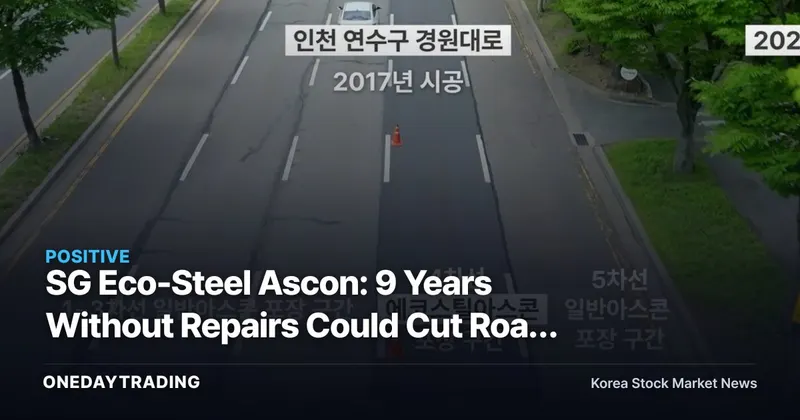
SG’s Eco-Steel Ascon recorded zero repair work for nine years after a 2017 test paving on Incheon’s Gyeongwondaero. The key point for investors is not product promotion, but the performance data showing that road maintenance costs could be reduced.
For asphalt concrete, the life-cycle costs of repeated repairs and traffic controls are more important to project owners than the price at the time of construction. If long-term durability is recognized in public procurement standards and actual bidding competition, SG’s product mix and order quality could change.
Why It Matters Now
The test results SG released on the 3rd are long-term service data from an actual road, Incheon’s Gyeongwondaero. The fact that it lasted nine years without repaving is more directly relevant to buyers’ decisions than laboratory strength tests or short-term site photos.
Eco-Steel Ascon is an eco-friendly, high-durability asphalt paving material. If road project owners calculate not only initial construction costs but also repair cycles and traffic disruption, products with lower total costs could gain an advantage even if their unit prices are somewhat higher.
However, the test section’s traffic volume, climate, and load conditions are not identical to those of every road nationwide. For success on one section to translate directly into overall revenue, repeated validation on roads in other regions and of different grades, along with adoption in procurement standards, will be necessary.
Key Issues
- What Nine Years Without Repairs Means
A record of zero repair work over nine years since 2017 demonstrates the product’s potential to extend service life. Its commercial value will be established only when project owners can convert this into maintenance-budget savings. - Environmental Credentials and Procurement Competition
Eco-friendly paving materials fit the public-procurement trend emphasizing carbon reduction and resource efficiency. Yet they must also pass environmental certifications, quality standards, and regional aggregate-sourcing requirements before leading to actual orders. - Initial Price and Life-Cycle Cost
If the initial purchase price is higher than competing products, adoption in the private market may be slow. Conversely, as data accumulates showing longer repair intervals, procurement could shift from a lowest-price focus toward total-cost considerations. - Reproducibility of Validation
The results from a single section of Gyeongwondaero are not enough to conclude that yield or margins will improve. Additional data must be disclosed, separating road-specific service conditions from construction quality.
Impact on Related Stocks and Sectors
- SG
If Eco-Steel Ascon is adopted in the public road repair and repaving market, the share of higher-value product revenue could rise. The key indicators to monitor are product-level order disclosures and gross margin. - Ascon and Construction Materials Industry Sector
As durability-focused procurement expands, conventional asphalt concrete companies could face greater price-competition pressure. Companies with eco-friendly, high-performance products, meanwhile, will gain an edge from the speed of securing certifications and reference projects. - Road Maintenance Market
Longer repair intervals could reduce construction volumes in the short term, but demand for new paving materials and performance-based contracts could grow over the long term. How project owners budget will determine the direction of revenue. - Related Steel Byproduct Recycling Fields
As the use of recycled materials expands in product inputs and processes, raw-material sourcing and environmental-regulation responses will become more important. If raw-material prices rise, the eco-friendly premium may be offset by margin pressure.
Investment Considerations
- At the next earnings release, investors should check whether Eco-Steel Ascon’s revenue share and operating profit margin have actually improved.
- Investors should review additional test results outside Incheon and cases where local governments and public agencies have applied the product in procurement. Continued references would improve the quality of SG’s order pipeline.
- Ascon demand is affected by road budgets and construction conditions. If public procurement declines, revenue recognition could be delayed regardless of product performance.
- If the test section had more favorable conditions than ordinary roads, repair intervals could shorten during nationwide expansion. If additional data falls short of expectations, the valuation premium could contract quickly.
Overall Outlook
SG’s announcement shows more than a single product’s longevity record: it suggests that the criteria for buying asphalt concrete could change. If public procurement incorporates the nine-year, repair-free data into design and purchasing standards, and performance holds at other sites, SG could secure higher prices and more stable orders than conventional asphalt concrete.
The opposite scenario is also clear. If durability is not replicated at additional sites or the burden of the initial price becomes prominent, this record will remain marketing material. The stock price is more likely to respond to the speed at which order value, capacity utilization, and product mix flow through to earnings than to the product news itself.
The next checkpoints are SG’s follow-up order disclosures and whether the product is applied in public road projects from 2026 onward. If the nine-year record becomes a repeatable standard, growth rates could change; otherwise, the market will turn its attention back to the asphalt concrete industry cycle and cost variables.
Frequently Asked Questions
What is Eco-Steel Ascon?
It is an eco-friendly, high-durability asphalt paving material developed by SG. The key point of this announcement is that the section test-paved on Incheon’s Gyeongwondaero in 2017 remained without repair work for nine years.
Will nine years without repairs immediately show up in SG’s earnings?
Not automatically. Product adoption by public agencies, additional field validation, actual orders, and revenue recognition must follow before product performance translates into profit.
What indicators should investors monitor?
Investors should review product-level revenue share, gross margin, new public-sector orders, and capacity utilization together. If follow-up field data exceeds the existing record, it could signal faster adoption.
SG Key MetricsAs of 2026-09-03
| Period returns | 1 week -16.34% 1 month -10.16% |
|---|---|
| Trading value · Trading volume | 66.06 million won · 60,390 shares |
| Supply-demand (order flow) | Foreign investors +600 million won net buying Institutional investors No notable trading |
| Recent news tone | Positive catalyst 0 · Negative catalyst 1 |
Price and supply-demand data are real-time values from Korea Investment & Securities (KIS); supply-demand and news-tone figures are calculated internally by One Day Trading.
Supply-Demand · Momentum Assessment🟡 Neutral · Watch
Positive and negative signals are mixed, indicating a period to watch.
- ▼52-week positionNear the 52-week bottom, 2%
Upcoming Dates to Watch
- 09.10Simultaneous futures and options expirationModerateQuadruple witching — watch for volatility and supply-demand disruption
- 09.16FOMC policy-rate decisionHighU.S. Federal Reserve monetary-policy announcement — direction of rates and the dollar
- 10.08Index options expirationLowKOSPI200 options expiration
- 10.22Bank of Korea Monetary Policy BoardHighBenchmark interest rate decision meeting
This article is automatically summarized and analyzed based on the original news report. View original (Maeil Business Newspaper Securities)
。