
At a Glance
Yoon Jae-ho, OneDayTrading Editorial Board What Nvidia has reclaimed is more than just the title of largest company by market capitalization. The market is now assigning a higher growth premium to AI computing infrastructure than to finished smartphone products.
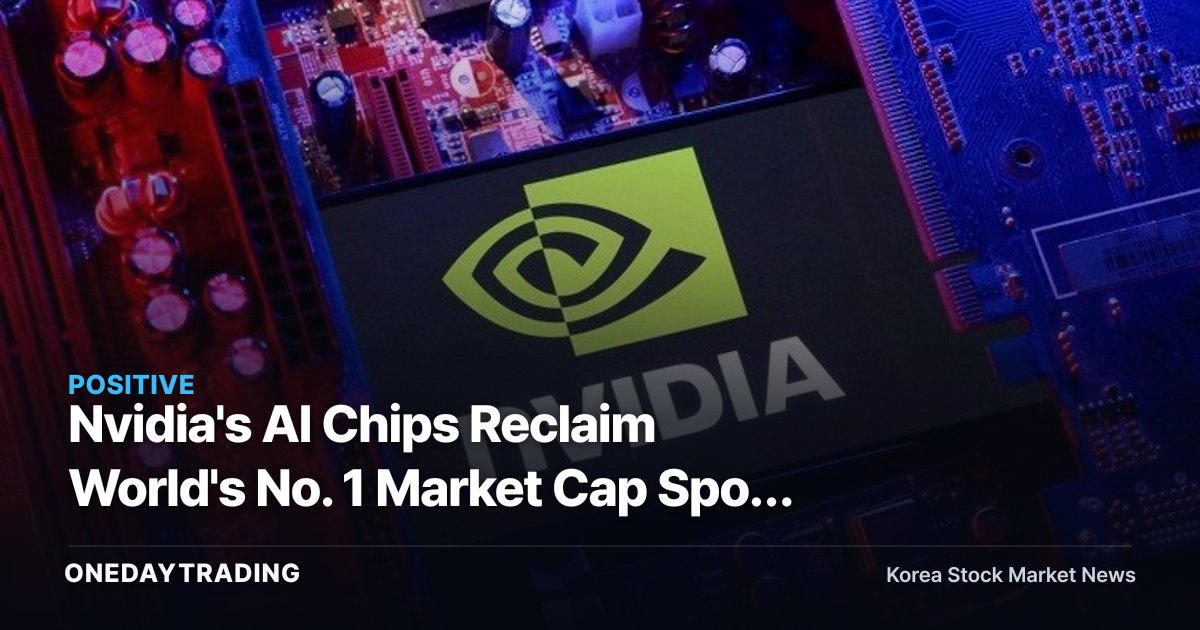
In U.S. trading on the 31st (local time), Nvidia reclaimed the global No. 1 spot in market capitalization that it had lost to Apple, doing so in just four days. For Korean investors, this news is not simply about Nvidia's single stock (ticker) — it's a question of relative valuation across HBM, foundries, AI servers, and Apple-related component makers.
Why It Matters Now
A changing of the guard among tech stocks usually looks like a mere ornament of a liquidity-driven rally. This time is different. The structure in which Nvidia rose as Apple's stock wavered reveals a gap in speed between the consumer device cycle and the data center investment cycle. iPhone replacement cycles are lengthening, and monetization of AI features is still slow. Nvidia, by contrast, sits in a position where demand for AI model training and inference translates directly into GPU orders.
Breaking the supply chain into stages makes the investment implications clearer. AI chip demand starts with Nvidia, the GPU designer, and flows down through HBM memory, advanced packaging, foundries, and server assembly. The first channel through which Nvidia's return to the No. 1 market cap spot reaches the Korean market is expectations around high-bandwidth memory (HBM) at SK Hynix and Samsung Electronics (005930). What matters more than a simple rebound in memory prices is customer qualification, transitions to newer memory generations, and yield stability.
Conversely, Apple's weakness is uncomfortable for domestic IT component stocks. Companies embedded in Apple's value chain are sensitive to shipment volumes, component pricing, and inventory adjustments. What matters more than the mere fact that Apple lost the top market cap spot is the signal that the market is giving Apple a low score on the pace of its AI transition. Even if iPhone sales remain solid, component stocks will see limited multiple expansion unless they capture a sufficient AI premium.
Frequently Asked Questions
- Is Nvidia's return to the No. 1 market cap spot an immediate positive catalyst for Korean semiconductors? The direction is positive. However, it only becomes an earnings-boosting catalyst once GPU demand translates into actual HBM orders and pricing.
- Is Apple's weakness a negative catalyst for domestic component stocks? It's a burden in the short term. Apple-related component stocks are tied more closely to smartphone shipments and inventory cycles than to AI servers.
- What indicators should be checked first in the AI chip rally? Nvidia's next-quarter data center revenue, orders from major customers, and the status of HBM supplier qualifications.
- Can a buy decision be made on the market cap news alone? That's difficult. The stock price may already reflect substantial growth expectations, so earnings figures and valuation must be examined together.
Related Stocks and Sector Impact
- Nvidia. As the leading AI chipmaker, it is the direct party behind the return to the No. 1 market cap spot. The market has valued the durability of GPU demand more highly than the Apple ecosystem.
- SK Hynix. HBM expectations are central to its position in the AI GPU supply chain. Earnings sensitivity increases as high-value-added memory demand for Nvidia is sustained.
- Samsung Electronics (005930). Whether it can restore its HBM competitiveness is the key question. For the Nvidia rally to directly translate into a re-rating of Samsung Electronics, customer qualification and yield improvement are needed.
- Apple. The party that ceded the No. 1 market cap spot. It remains to be seen whether the real-world value of its AI features and iPhone replacement demand can rebuild its stock price premium.
- TSMC. It serves as the intermediate gateway for demand in advanced process nodes and packaging. Expanding Nvidia volumes affect foundry utilization rates and advanced packaging bottlenecks.
Points to Watch for Investors
- The No. 1 market cap ranking is a lagging indicator. It is often confirmed only after the market has already priced in AI growth prospects.
- For HBM, yield matters more than demand. Even with rapid capacity expansion, margin contribution is delayed if the product fails to meet the quality customers require.
- Apple's value chain should be assessed separately. Nvidia's strength does not imply a recovery in smartphone component demand.
- The concentration in U.S. tech stocks moves in tandem with the exchange rate. During periods of won weakness, the performance of dollar-denominated assets may look overstated to domestic investors.
Overall Outlook
Nvidia reclaiming the No. 1 market cap spot in just four days shows that the AI chip cycle remains at the center of the market. The optimistic scenario is straightforward: if data center investment and GPU orders hold up and HBM suppliers maintain yields, large-cap Korean semiconductor stocks will enter another round of upward earnings estimate revisions.
The risk lies in the same place. If the narrative runs ahead of actual shipments, share prices can be shaken by even minor delays. The next checkpoints to watch are Nvidia's quarterly data center revenue, the pace at which Apple monetizes its AI features, and the progress of HBM customer qualification at Korean memory makers. More important than holding the title of No. 1 is which line the orders actually flow down to.
This article is automatically summarized and analyzed content based on the original news report. View Original (Maeil Business Newspaper - Securities)