
Key Takeaways
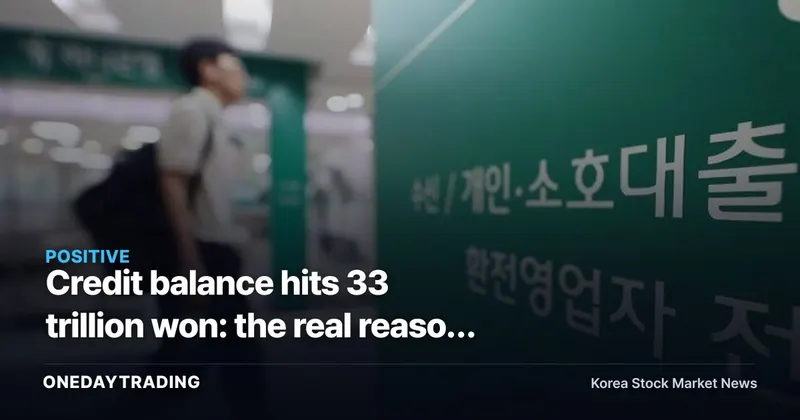
The rise in credit trading loans to 33 trillion won, up for nine straight trading days, shows that retail investors are leaning more heavily into KOSDAQ high-beta stocks than KOSPI large caps. Based on Maeil Business Newspaper securities coverage, balances in the main market have fallen while KOSDAQ balances have increased, a mix that shows the stock market has entered a phase more sensitive to supply-demand (order flow) and expectations than to earnings.
This trend is a short-term positive catalyst for brokerage stocks and leading KOSDAQ growth names, but leverage is the first to break when rates and volatility rise. Because credit trading loans involve borrowing from securities firms to buy stocks, the upside is amplified when the index rises, but if the direction turns, forced-selling pressure builds quickly.
What Happened
The shift of funds out of KOSPI and into KOSDAQ is not just a simple change in market preference. Large-cap stocks have already priced in a good part of earnings, exchange rates, and interest rates, while KOSDAQ names tend to have smaller market caps and higher multiples, so the same amount of money creates much larger price swings.
Credit balances at 33 trillion won signal that retail investors are not trading only with cash but are adding leverage to their bets. This move should therefore be read as a style issue rather than a sector issue. When money flows into volatile stocks instead of stocks with confirmed profits, the market is pricing expected returns more richly than realized returns.
Background and Context
In a high-rate environment, KOSDAQ stocks with high multiples are at a disadvantage. That is because a higher discount rate weakens the pull of future earnings into present value. By contrast, when rate-cut expectations stay alive or government bond yields ease, that expectation is reflected in stock prices first, and the names that move fastest are speculative names rather than large-value stocks.
This flow also suggests that the expectation has not yet fully hardened. Credit buying concentrated in KOSDAQ can have strong spillover effects in a market with thin liquidity, but if the economy slows or an event disappoints, the unwind can be just as fast. Once the index slips and credit balances start falling together, a bull market can turn into a defensive market overnight.
Impact on the Market and Stocks
- Kiwoom Securities, Mirae Asset Securities, and NH Investment & Securities can see both interest income and brokerage income supported when trading value and credit exposure balances rise together. But if the index wobbles, a reduction in credit balances usually appears first and can reverse expectations for net profit.
- Ecopro BM, Alteogen, and HLB, as representative KOSDAQ growth stocks, are influenced first by improved supply-demand (order flow) rather than improved earnings. Even with the same inflow, the smaller the market cap, the stronger the price momentum.
- For KOSPI large caps such as Samsung Electronics and Hyundai Motor, the burden is less a direct negative catalyst than weakening relative strength. If money rotates back into KOSDAQ, the index may hold up, but the market’s feel weakens.
- The other-side risk is forced selling. When volatility rises, stocks bought on credit are more likely to face forced liquidation before stop-losses, so declines can accelerate faster than gains.
What Investors Should Watch
- Watch whether credit trading loans continue to rise above 33 trillion won next week. If the figure stalls, that may signal fading risk appetite as well.
- Check KOSDAQ trading value together with KOSDAQ relative performance versus KOSPI. If balances rise but trading value does not follow, the supply-demand effect will be short-lived.
- Watch how much interest income and brokerage revenue increase in brokerage earnings reports. Growth in credit balances is reflected first in brokerage results.
- If the Bank of Korea Monetary Policy Board, U.S. CPI, and the KRW/USD level all swing together, KOSDAQ’s momentum can fade quickly. Leverage is most sensitive to rates and exchange rates.
Outlook
If credit balances keep rising, KOSDAQ relative strength and earnings expectations for brokerage stocks could strengthen further. In particular, when trading value reacts before earnings do, brokerage names such as Kiwoom Securities, Mirae Asset Securities, and NH Investment & Securities tend to be highly sensitive.
On the other hand, if rate-cut expectations weaken, leverage demand will cool first. If KOSDAQ enters a correction, shrinking credit balances will weigh on supply-demand (order flow) once again, so the current strength should be viewed as a game of conditions rather than probabilities.
Frequently Asked Questions
Why is 33 trillion won in credit trading loans important?
Credit trading loans are the total amount borrowed from securities firms to buy stocks. Thirty-three trillion won means leverage has built up significantly in the market, and the fact that it has increased for nine straight trading days makes the direction even clearer.
Which stocks benefit when borrowed money floods into KOSDAQ?
Incoming funds usually go first into stocks with active trading and high volatility. That is why leading KOSDAQ growth names and theme stocks with smaller market caps benefit more from supply-demand (order flow), but if earnings do not catch up, the correction can be just as fast as the rise.
Does a rise in credit balances always help stock prices?
No. Credit acts as an amplifier in a rising market, but in a falling market it turns into forced-liquidation pressure. Even if balances increase, it is only favorable when the index and rates are holding up together; once volatility rises, the same money becomes a burden.
Kiwoom Securities Key MetricsAs of 2026-09-01
| Period Return | 1 week +3.74% 1 month +7.35% |
|---|---|
| Supply-demand (order flow) | Foreign investors +6.2 billion won net buying (19 straight days) Institutional investors −6.3 billion won net selling |
| Recent News Tone | Positive catalyst 2 · Negative catalyst 1 |
Price and supply-demand data are real-time values from Korea Investment & Securities (KIS), and the supply-demand and news-tone counts are calculated by OneDayTrading.
Supply-Demand and Momentum Assessment🟢 Buy-side bias
Foreign investors and news flow are positive, so it is worth paying attention.
- ▲Supply-demand continuityForeign investors net buying for 19 straight days (+6.2 billion won)
- ▲News flowPositive catalyst 2 vs Negative catalyst 1 — positive catalysts dominate
Upcoming Dates to Watch
- 09.10Futures and options simultaneous expiryMediumQuadruple witching — watch for volatility and supply-demand (order flow) distortions
- 09.16FOMC policy rate decisionHighFed policy announcement — direction of rates and the dollar
- 10.08Index options expiry dayLowKOSPI200 options expiry
- 10.22Bank of Korea Monetary Policy BoardHighBenchmark interest rate decision meeting
This article is automatically summarized and analyzed based on the original news report. View original (Maeil Business Newspaper Securities)