
Three-Line Briefing
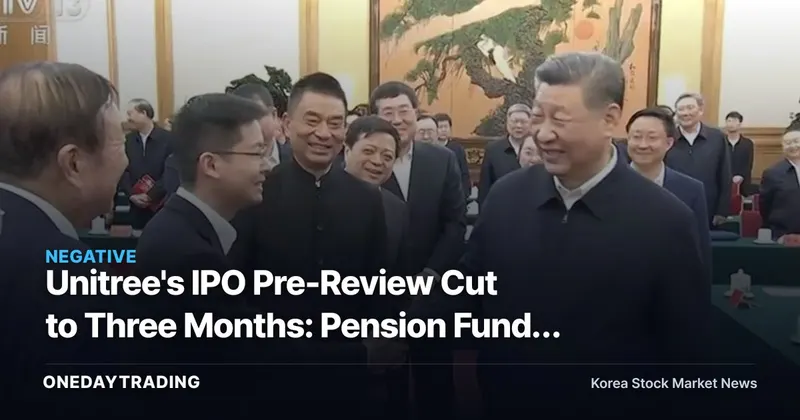
- Unitree cleared its IPO pre-review in just three months, becoming Shanghai's first listed humanoid robotics company
- Pension funds and state-owned enterprises joined as IPO strategic investors, meaning state capital is directly underpinning the valuation
- Founder Wang Xingxing has stated that his ultimate goal isn't robot sales but artificial general intelligence (AGI)
What's Changing
The humanoid robot value chain can be broken into three layers: the actuation system (actuators, reducers/gearboxes), force/torque sensors, and the control software layered on top. Until now, the market has mostly focused on actuation-system costs. But the core of this story isn't hardware — it's the speed of capital raising. IPO reviews in China typically take more than six months, so a three-month cut is unusual, and the fact that pension funds and state-owned enterprises followed up with strategic investment means the state has effectively absorbed part of the company's valuation risk.
Why does this matter? Humanoid robotics is still an area where mass production has not yet been fully validated, so private capital alone leaves significant valuation anxiety. When state capital comes in as a strategic investor, it provides the financial runway to withstand this period of uncertainty, allowing orders for actuation systems and sensors to keep expanding. In other words, what this news actually moves isn't Unitree's own stock price — it's the continuity of orders across the entire component supply chain built on top of it.
Numbers and Context
The fact that Wang Xingxing has set his sights on AGI beyond robotics should also be read with an investor's skepticism. When a hardware company expands its narrative into software and AI, it's often an attempt to have its valuation multiple judged against AI-platform peers rather than hardware-sector peers. What actually needs to be verified isn't the narrative but where the post-IPO proceeds get deployed first — expanding actuation-system capacity or ramping up finished-unit shipments.
Winners and Losers
- Rainbow Robotics — Korea's leading humanoid robot developer, exposed to relative pressure from a price-competition and mass-production speed race as China accelerates with state capital behind it
- Doosan Robotics — as it expands from collaborative robots into humanoids, low-cost supply from China could disrupt pricing structures across the Asian robotics market
- Samsung Electronics (005930) — as the largest shareholder of Rainbow Robotics, it holds a strategic stake in the humanoid business, so a rival's expanded capital strength affects the calculus around that equity stake's value
- SBB Tech — as a supplier of reducers and other robot actuation-system components, it's worth examining whether it stands to benefit indirectly from expanding global reducer demand if Unitree's IPO proceeds translate into actual capacity expansion
- Robostar — in the process of expanding its industrial and service robot lineup, it falls within the reach of the competition over humanoid component standardization
Risk Check
- Clearing the IPO pre-review is not the same as actually listing or deploying capital — the scale of orders can only be gauged once the actual offering price and capital raised are finalized
- A valuation propped up by state capital rests on policy will rather than earnings, so it could swing sharply if the policy tone changes
- The stated AGI goal is still at the narrative stage, not yet backed by a concrete roadmap or revenue model
- Whether Chinese robotics firms' low-price offensive actually translates into overseas orders needs to be separately confirmed
Bottom Line
Unitree's speed race, backed by state capital, has the potential to lift global demand for humanoid components, but it could just as easily pass the pressure of price competition straight back onto Korean robotics stocks — so until the actual offering price and where the raised capital gets deployed are confirmed, both optimism and caution are warranted.
Rainbow Robotics: A Real-Time Data Snapshot
Rainbow Robotics's most recent closing price was 490,000 won (0.00% vs. the previous day), and the composite signal — combining foreign and institutional investor order flow with news and momentum — reads 🟡 Neutral / Wait-and-see. With positive and negative signals mixed, this is a stock to watch.
Recent related news skews negative, with 0 positive-catalyst articles and 2 negative-catalyst articles.
※ Price and foreign/institutional investor order-flow data are provided by Korea Investment & Securities (KIS) and reflect figures as of publication time.
This article is automatically summarized and analyzed content based on the original news report. View original (Maeil Business Newspaper Securities)