
At a Glance
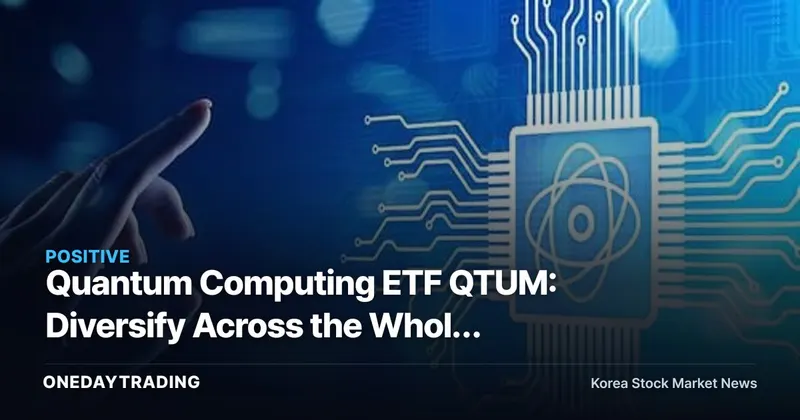
Quantum computing is still an early-stage industry years away from commercialization, so the price swings of individual stocks (tickers) are extreme. In this kind of environment, an ETF that bundles the entire theme at a low fee is gaining attention as an alternative to betting on one specific stock. The Defiance Quantum ETF (QTUM) covered in this article carries an expense ratio of around 0.40% and holds a broad basket of companies tied to quantum and high-performance computing.
Why It Matters Now
The quantum-computing theme drew investor interest in 2024–2025 as the share prices of pure-play quantum companies such as IonQ, Rigetti, and D-Wave swung several-fold over short periods. The problem is that most of these companies still have small revenue and are running losses, so a single piece of news — a technological advance or a government contract win — can send their shares into a sharp gain (surge) or sharp drop (plunge). Concentrating on a single stock carries a high risk that losses pile up if the company falls behind in the technology race or carries out a paid-in capital increase to raise funds.
The ETF approach diversifies away this single-stock risk. QTUM holds not only pure-play quantum startups but also large-cap tech names that pursue quantum research alongside their core business, such as IBM, Google (Alphabet), Microsoft, and Nvidia. In other words, even if quantum commercialization arrives later than expected, big-tech names with already solid earnings provide a floor. The trade-off is that the explosive upside available from investing directly in pure-play quantum stocks gets diluted. The 0.40% fee is not excessive for a thematic ETF, but the cumulative cost over a long holding period should be factored in.
Frequently Asked Questions
- Why an ETF instead of individual stocks: Quantum companies are still pre-profitability, so the technology and funding risk of any single stock can be fatal — the approach is to hold a basket and reduce volatility.
- Is the 0.40% fee expensive: It is higher than a standard index ETF, but it is considered about average for a niche thematic product.
- Does it hold only pure-play quantum stocks: No. It also includes large caps engaged in quantum research, such as IBM, Google, and Nvidia, to cushion volatility.
- Is now the time to enter the quantum theme: The commercialization timeline is uncertain and valuations are stretched, so phased entry and position sizing are key.
Impact on Related Stocks and Sectors
- IonQ, Rigetti, D-Wave: As the flagship pure-play quantum names, they benefit directly from money flowing into the theme, but their losses and capital-raising risks make them the most volatile.
- IBM, Google, Microsoft: Large caps with quantum hardware and cloud research; backed by an earnings base, they have relatively higher defensive strength during a theme-wide pullback.
- Nvidia: There is an indirect path to benefit through hybrid quantum-classical computing platforms and GPU demand.
- Korean quantum-related stocks: Quantum-encryption communications businesses such as SK Telecom and KT, and optical and telecom component stocks such as Woriro and Coweaver, may move in sympathy with the theme, but their actual contribution to quantum-computing revenue is limited.
- Korea's domestic ETF market: Growing interest in overseas quantum-theme ETFs could give domestic asset managers an incentive to launch similar thematic products.
Points to Watch When Investing
- Quantum computing is in a phase where share prices are driven by expectations rather than actual revenue, so valuation pressure and sharp-drop (plunge) risk are ever-present.
- Even as an ETF, many of its holdings are high-volatility loss-making stocks, so the diversification effect has limits.
- The 0.40% fee erodes returns when it accumulates over the long term, so the holding period and expected return should be calculated together.
- Exchange rate movements (the won-dollar level) directly affect the won-denominated returns of overseas ETFs.
Overall Outlook
The bullish scenario is one where progress on big tech's quantum roadmaps and an expansion of government research projects leads to a re-rating across the entire theme. In that case, a diversified ETF can ride the trend steadily, even if it does not surge as much as individual stocks. Conversely, if delayed commercialization, a worsening interest-rate environment, and funding pressure on pure-play quantum stocks all coincide, there is a risk the entire theme corrects together. As indicators to check, a realistic approach is to monitor the quarterly earnings of major companies, qubit technology announcements, government and defense-sector contract disclosures, and the won-dollar exchange rate together.
This article is content automatically summarized and analyzed based on the original news report. View Original (Yahoo Finance)