
Key Takeaways
The silk industry of Jinju in South Gyeongsang Province, which accounts for 80% of Korea's domestic silk production, is expanding its applications into cultural content and advanced, bio-based materials as traditional demand for hanbok linings declines. This is less a short-term earnings issue for any single listed company than a snapshot of a structural industry shift in which traditional natural fibers are migrating into the high-value specialty-materials arena.
From an investment standpoint, the key is not Jinju silk itself but the economic viability that natural protein fibers can secure in the medical, beauty, and functional-materials markets. Only when demand shifts from apparel toward industrial and healthcare uses will meaningful new revenue streams emerge for the materials companies involved.
What Happened
Jinju is regarded as one of the world's five great silk-producing regions and has long been a specialized hub responsible for roughly 80% of Korea's domestic silk production. However, as the frequency of hanbok wear declines and demand for lining silk shrinks structurally, the existing business model—dependent on a single use—has hit its limits.
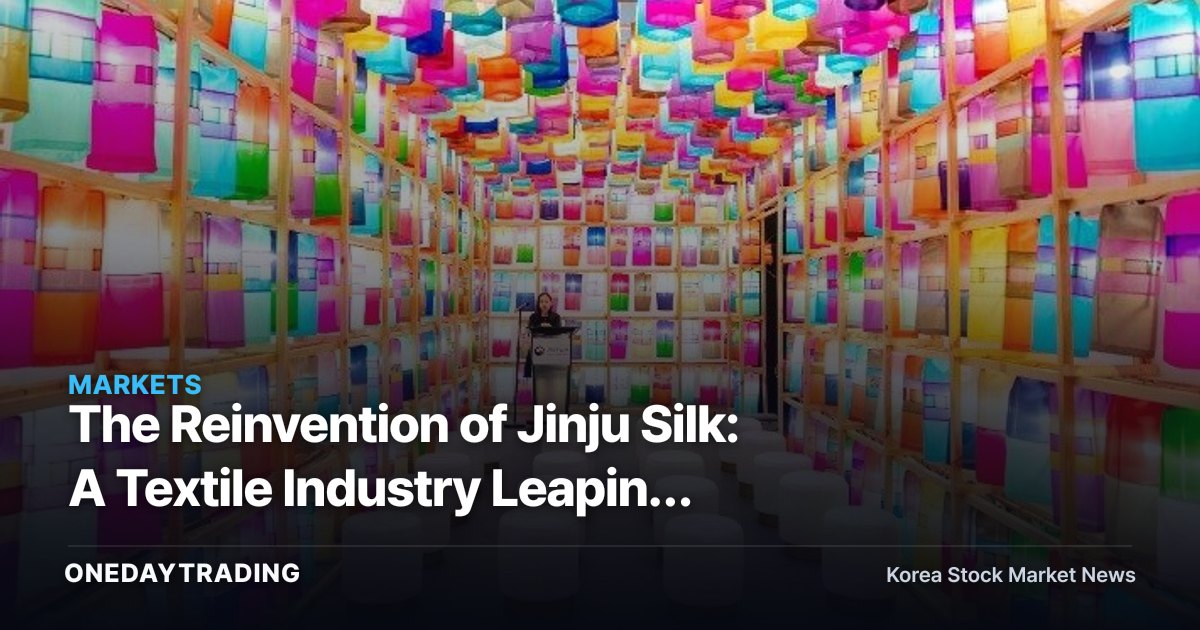
In response, the regional silk industry is seeking to add value through cultural content such as traditional textiles and crafts, while simultaneously expanding into medical, beauty, and functional materials that leverage the biocompatibility of silk proteins (fibroin and sericin). Silk proteins extracted from silkworm cocoons have long been cited as having potential applications in surgical sutures, cosmetic ingredients, and bio-materials.
That said, this is a transition still in progress, and it does not mean that a traditional weaving-based industry will translate directly into a mass-production system for advanced materials. Turning silk into materials involves separate hurdles: refining technology, certification, and securing buyers.
Background and Context
The textile industry has long been classified as a sunset industry, squeezed by low-cost imports and synthetic fibers, but it has recently been reassessed in high-value areas such as industrial and medical specialty fibers and eco-friendly natural materials. Natural protein fibers offer the differentiators of biodegradability and biocompatibility, targeting niche markets that synthetic materials struggle to fill.
Impact on the Market and Stocks
- Specialty and industrial textile-materials companies: This aligns with the trend of shifting portfolios from general-purpose apparel fibers to medical and functional materials. As the commercialization of natural protein materials advances, there is room to increase the share of high-value products.
- Cosmetics and beauty-ingredient sector: Silk proteins have been used as moisturizing, skin-friendly ingredients. If preference for naturally derived ingredients strengthens, this could become an area of interest from an ingredient-diversification perspective.
- Bio-materials and healthcare: Medical applications such as surgical sutures and tissue-engineering scaffolds face high certification and clinical hurdles, making them closer to a long-term R&D theme than a short-term earnings driver.
- Regional tourism and cultural content: Turning silk into a cultural asset carries more weight in terms of ripple effects on the local economy and tourism than as a direct benefit to listed companies.
Investor Checkpoints
- Check whether the share of high-value product revenue—medical, functional, and the like—is actually rising in the quarterly earnings of specialty-fiber and materials companies.
- Track whether concrete commercialization disclosures emerge for natural protein materials, such as large-scale supply contracts, medical-device certifications, and cosmetic-ingredient registrations.
- Review the budgets and support-policy timelines of central and local governments for fostering advanced fiber and materials industries.
- Examine whether natural materials secure competitiveness against synthetic materials in unit cost and mass-production viability, looking closely at the cost structure.
Outlook
In the optimistic scenario, traditional natural fibers establish themselves as high-value medical, beauty, and industrial materials—as in the case of Jinju silk—and secure new sources of demand in tandem with eco-friendly and biodegradable trends. In that case, an improving product mix can be expected for specialty-fiber and natural-materials companies.
On the other hand, the risks are clear. Turning silk into materials must clear high entry barriers—refining technology, certification, and securing stable buyers—and the unit-cost and productivity limitations inherent to natural materials could prove a stumbling block in competition with synthetic materials. Moreover, this issue is closer to a signal of structural industry change than direct earnings momentum for any specific listed company, so the basis for tying it directly to individual stock decisions is limited.
This article is content automatically summarized and analyzed based on the original news report. View original (Yonhap News, Industry)