
3-Point Briefing
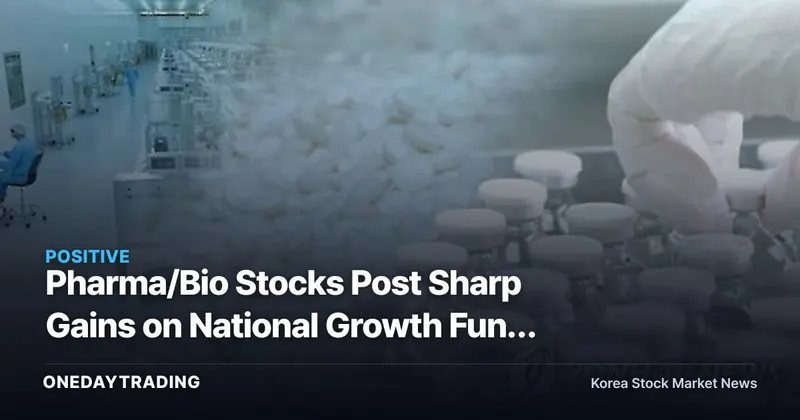
- During intraday trading on June 29, pharma/bio stocks posted sharp gains (surges) across the board, pulling the KOSDAQ index higher.
- Expectations that the National Growth Fund would include the bio/healthcare sector acted as a direct buy-side supply-demand (order flow) catalyst.
- Whether the fund's actual deployment scale and sector allocation weights are officially confirmed will be the watershed moment determining this rally's sustainability.
What Changes
The National Growth Fund is a policy-driven fund designed to channel long-term capital into domestic innovation industries through a public-private partnership structure. As the pharma/bio sector has been mentioned as a primary investment target, market participants are framing the move not as a simple theme rotation, but as a structural inflow of policy-driven supply-demand (order flow). When policy capital flows into a specific sector, institutional investors' supply-demand (order flow) in those stocks improves, partially unwinding valuation discount pressures.
In particular, the deterioration in market sentiment toward the bio sector — accumulated over years of repeated clinical failures and delayed technology licensing deals — has combined with policy benefit expectations to trigger buy-the-dip sentiment. Given that pharma/bio stocks account for a significant share of KOSDAQ's market capitalization, capital inflows into the sector translate directly into upward pressure on the broader index, making this more than a single-stock story.
By the Numbers and Context
Pharma/bio stocks command a significant share of KOSDAQ's market capitalization, meaning that price moves in large-cap biotech names are immediately reflected in the index. Should the National Growth Fund actually deploy capital into this sector, it could be interpreted beyond near-term supply-demand (order flow) improvement — as a signal for institutional investors to rebalance their portfolios. However, since the fund's specific deployment size and sector-level allocation weights have not yet been officially confirmed, it would be premature to quantify the magnitude of the benefit.
Winners and Losers
- Samsung Biologics: Strong earnings visibility backed by a global CDMO order base makes it likely to pass policy fund screening criteria. Its stable revenue structure is why it is frequently cited as the top candidate for growth fund inclusion.
- Celltrion: A high share of overseas biosimilar revenue provides earnings resilience even in a weak-won environment, and as a flagship biotech stock following its KOSPI inclusion, index-tracking buying interest is expected to continue.
- Hanmi Pharmaceutical: With ongoing expectations for licensing deals on its GLP-1-class obesity/diabetes pipeline, the addition of policy-driven supply-demand (order flow) would layer momentum on top of existing catalysts. Expanding global demand for obesity treatments continues to underpin its earnings base.
- HLB: Global clinical trial results for its liver cancer drug rivoceranib remain the dominant price driver, and since pipeline events rather than policy supply-demand (order flow) hold the controlling influence, this stock carries the highest volatility.
- Yuhan Corporation: As its non-small cell lung cancer drug Lazertinib expands global revenue, potential inclusion in the growth fund's portfolio is being discussed, and its stable dividend base meets the eligibility criteria for long-term fund investment.
Risk Checklist
- If the National Growth Fund's bio allocation falls short of market expectations, prices that rose on supply-demand (order flow) anticipation could reverse quickly. The pattern of disappointment selling following pre-pricing of expectations is a recurring dynamic in policy-driven theme stocks.
- With global interest rates still elevated, valuation discount pressures persist for biotech stocks that are heavily reliant on future cash flows.
- Pipeline events such as Phase 3 trial failures or receipt of an FDA Complete Response Letter (CRL) can cause a sharp drop (plunge) in individual stocks over a short period, meaning stock-specific risks persist regardless of favorable sector-wide supply-demand (order flow) conditions.
- If fund deployment is delayed, profit-taking selling could emerge as momentum fades; the next key checkpoints are the fund manager's official sector announcement and the timing of disclosed actual purchases.
Bottom Line
Expectations of National Growth Fund benefits for pharma/bio are providing structural rebound justification for a KOSDAQ biotech sector that has endured a prolonged slump; however, until the fund's actual deployment scale is disclosed and individual pipeline clinical event outcomes are confirmed, investors must navigate the swing risk between hope and disappointment.
Samsung Biologics — Real-Time Data Snapshot
Samsung Biologics's most recent closing price is ₩1,400,000 (+4.24% vs. the prior day); the composite signal incorporating foreign investors and institutional investors supply-demand (order flow), news, and momentum is 🟢 Buy-Leaning. Foreign investor flows and momentum are positive, making this stock worth monitoring.
- ▲ Supply-Demand (Order Flow) Continuity — foreign investors net buyers for 4 consecutive sessions (+600 million won)
- ▲ Trend Alignment — short- and medium-term upward alignment (day: +4.2% · 1 week: +8.1% · 1 month: +2.0%)
Recent related news is mixed: 1 positive catalyst and 1 negative catalyst.
※ Price and foreign investor/institutional investor supply-demand (order flow) data are provided by Korea Investment & Securities (KIS) and are current as of the time of publication.
This article is auto-summarized and analyzed content based on the original news source. View Original (Yonhap News Finance)