
Summary
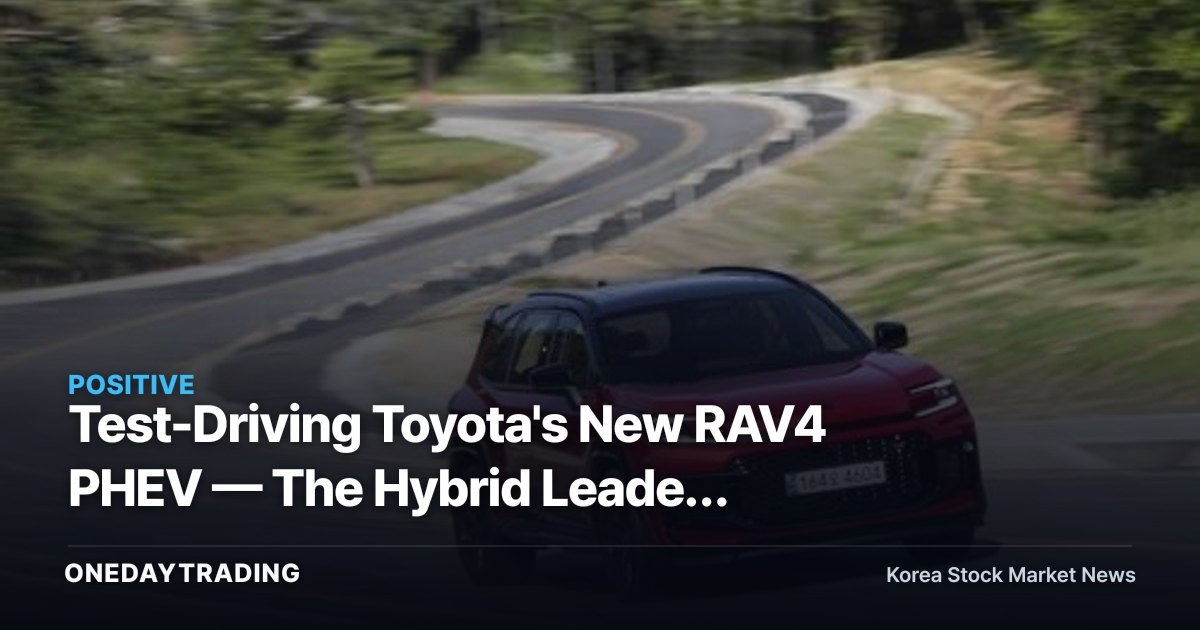
Toyota has unveiled a new version of its best-selling SUV, the RAV4, leading with the driving performance of its PHEV (plug-in hybrid) powertrain. With demand for pure electric vehicles slowing, this is a concrete example of Toyota's strategy to shift its center of gravity toward hybrids and PHEVs — carrying direct implications for the eco-friendly-vehicle competition that Hyundai Motor and Kia are pursuing in the same market, as well as for Korea's parts and battery supply chains.
How It Unfolded
First introduced in 1994, the RAV4 is the model that established the urban compact-SUV category in an SUV market that had been centered on off-road vehicles. The key to this new version is that it preserves that heritage while raising the driving refinement of the PHEV powertrain. Its ability to move seamlessly between short-range, everyday driving in electric mode and longer-range driving where the engine engages takes direct aim at consumers who want to ease the burden of charging infrastructure while pursuing fuel efficiency and quietness at the same time.
What stands out is that Toyota is using hybrids and PHEVs — rather than pure EVs — as a realistic bridge in its electrification transition. With global EV sales growth slowing and resistance over price and charging infrastructure coming to the fore, this can be read as a move to defend profitability by leveraging hybrid technology assets already proven through cumulative sales.
Structural Background
The electrification market is being reshaped from a single EV-only structure into a multi-layered one in which hybrids, PHEVs, and EVs coexist. Because PHEVs carry a smaller battery than pure EVs, they entail lower cost burdens and lower dependence on key minerals — yet their demand for electrified components such as motors, inverters, and small battery packs is greater than that of internal-combustion vehicles. In other words, an expanding PHEV share is a variable that affects both automaker profitability and the parts supply chain at the same time.
Impact on Stocks and Industry Sectors
- Toyota: By extending its proven hybrid system to PHEVs, Toyota secures a lineup capable of defending margins even amid an EV slowdown. That said, whether the new-model effect actually translates into higher sales must be confirmed through quarterly delivery figures.
- Hyundai Motor and Kia: Direct competitors in the same compact-SUV and eco-friendly segment. Toyota's PHEV push is a source of pressure on pricing and product competitiveness, but since both companies are also rapidly expanding their hybrid lineups, they could benefit alongside Toyota if overall demand grows.
- Battery cells and materials (LG Energy Solution, Samsung SDI, etc.): Although PHEVs use small batteries, volume-based demand will expand as more models adopt them. However, because the per-cell capacity is smaller than for EVs, the contribution to top-line growth is limited.
- Electrification components (motors, inverters, thermal management): Since the component count rises relative to internal-combustion vehicles, there is a structural path to benefit for Korean electrical-equipment and parts makers.
Bull vs. Bear Scenarios
Bull case: If the EV slowdown leads to a re-rating of PHEV and hybrid demand, the utilization rates and profitability across automakers with proven technology and the electrified-parts supply chain could improve.
Bear case: If PHEV subsidies and tax benefits are scaled back in some markets, or if the inconvenience of charging and maintenance comes to the fore, there is a risk this proves to be merely transitional demand. If automaker valuations already reflect eco-friendly expectations, favorable reviews of a single new model alone may provide only limited upside momentum for share prices.
Investor Action Points
- Check the trends in the quarterly eco-friendly-vehicle (HEV+PHEV) sales mix and average selling price (ASP) for Toyota, Hyundai Motor, and Kia at their earnings releases.
- Review the schedule and direction of changes to PHEV subsidy and tax policies in major markets (U.S. and Europe).
- Monitor PHEV-related order disclosures and changes in utilization rates at Korean battery and electrical-equipment parts makers.
- Since exchange-rate levels such as the yen/dollar are a variable in Japanese automakers' price competitiveness, use them as a reference when making relative comparisons with Korean export stocks.
This article is auto-summarized and analyzed content based on an original news report. View original (Yonhap News, Industry)