
Summary
The controversy over ExxonMobil trades is not simply a political ethics story. It raises the question of how much of the Iran war premium had already been priced into energy-stock multiples. According to financial disclosure documents reported by CBS News on August 27, 2026, President Trump’s investment account continued buying and selling shares of oil and natural gas companies through the second quarter of 2026.
Iran war risk lifts the earnings outlook for refining and exploration-and-production companies through oil prices. The issue is that after the market has already priced a war premium into share prices, opposite triggers such as a ceasefire, political investigations, and increased supply are all open at the same time.
What Happened
The key issue is not whether Trump personally instructed the trades. What matters for investors is the structure: while the president’s policy decisions directly affect global oil prices and energy-company profits, a personal account held and traded stocks such as ExxonMobil, Chevron, and ConocoPhillips.
CBS News reported that President Trump’s investment account made roughly 3,600 stock and securities trades in the first quarter of 2026, with transaction values ranging from $212 million to $695 million. Because U.S. Office of Government Ethics disclosures report transaction values as ranges rather than exact single figures, what the market should focus on is not precise gains and losses but the size of the trading and exposure to policy-sensitive industry sectors.
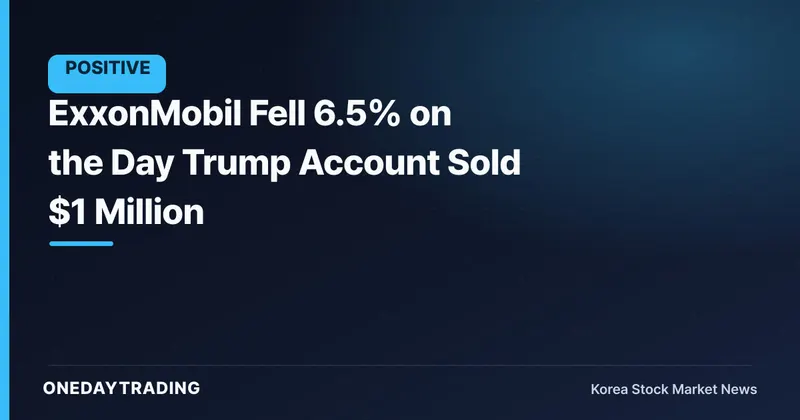
The most notable date is April 7, 2026. According to CBS News, Trump’s investment account sold $500,000 to $1 million worth of ExxonMobil shares that day. ExxonMobil closed at $163.91 on April 7 and opened at $153.52 on April 8. The decline was 6.5%. The timing, with the sale taking place on the day a ceasefire announcement was made, is at the center of the controversy.
Structural Background
A geopolitical oil-price premium occurs when the possibility of Middle East supply disruptions is reflected in crude futures prices and refining margins. The longer the Iran war continues, the more the market first prices in risks to crude shipping routes, marine insurance costs, and demand for inventory buildup, then recalculates the cash flows of integrated oil majors such as ExxonMobil and Chevron.
The Democratic members of the Joint Economic Committee estimated that the value of President Trump’s oil and gas holdings increased from a range of $13 million to $46 million in early 2026 to a range of $17 million to $61 million by mid-August. What those figures show is not portfolio weight, but sensitivity. When oil prices rise, energy stocks gain both stronger earnings expectations and greater dividend capacity, but if a ceasefire takes hold, the same multiples can quickly compress.
Stock and Industry Sector Impact
- ExxonMobil: With the disclosure of the $500,000 to $1 million sale on April 7, 2026, a governance discount emerged before the share-price impact itself. Still, high oil prices give its integrated structure, spanning both exploration and production as well as refining, stronger cash-flow resilience.
- Chevron: If the war premium persists, upstream profits are supported. Conversely, if the White House politically pressures major oil-company profits, expectations for share buybacks and dividend payouts could weaken.
- ConocoPhillips: Companies with greater exploration-and-production exposure than refining exposure have more direct sensitivity to oil prices. While Iran risk remains embedded in crude prices, earnings estimates are supported, but if a ceasefire coincides with rising crude inventories, the correction could also be larger.
- Korean refiners: S-Oil and SK Innovation move with the direction of global oil prices and refining margins. Rising crude prices can generate inventory valuation gains, but if the exchange rate and shipping costs rise at the same time, quarterly margins may improve less than expected.
Bullish vs. Bearish Scenarios
The bullish scenario is straightforward. If the Iran war drags on and the risk of crude supply disruptions remains, it will be difficult for second-half 2026 earnings estimates for energy companies to fall. In that case, the market treats ExxonMobil and Chevron less like cyclical stocks and more like geopolitical hedge assets.
There are two triggers for the bearish scenario. First, if a ceasefire leads to real supply stabilization, the oil-price premium comes out first, followed by lower energy-stock multiples. Second, if the controversy over presidential stock holdings expands into a congressional investigation or legislation restricting trading, the governance premium for U.S. megacaps, rather than just the sector itself, comes under pressure.
Investor Action Points
- In ExxonMobil and Chevron’s third-quarter 2026 earnings, investors should separately check realized upstream oil prices and refining margins. Even if higher oil prices flow into revenue, costs and taxes can erode earnings.
- Additional financial disclosures from the U.S. Office of Government Ethics are useful for checking the gap between trade dates and policy events. Trades above $1,000 must be reported, but investors should allow for potential reporting delays.
- If WTI rises on war headlines but energy stocks fail to follow, it is a signal that the market is already assigning more weight to the possibility of a ceasefire than to the geopolitical premium.
- Korean investors looking at S-Oil and SK Innovation should track the won-dollar exchange rate and refining margins alongside oil prices. If a weaker won increases crude import costs, the share-price response can be muted.
Frequently Asked Questions
Why are Trump’s energy-stock trades controversial?
The controversy over Trump’s energy-stock trades stems from a conflict-of-interest issue: presidential decisions on war and diplomacy can affect global oil prices and oil-company profits. The White House has said an independent third-party manager oversees the portfolio, but the fact that it is not a blind trust has intensified the debate.
Why did ExxonMobil shares fall 6.5% on April 8?
According to CBS News, ExxonMobil shares closed at $163.91 on April 7, 2026, and opened at $153.52 on April 8. After the ceasefire announcement came on the evening of April 7, part of the war premium was reversed. The later disclosure that Trump’s account sold $500,000 to $1 million worth of shares on the same day drew investor attention to the timeline.
How does the Iran war affect Korean refiners?
The Iran war affects Korean refiners’ inventory valuation gains and losses as well as refining margins through global oil prices and maritime shipping costs. S-Oil and SK Innovation can benefit from inventory valuation gains in the early stages of an oil-price increase, but if crude import costs and exchange rate burdens rise, improvement in operating profit will be limited.
This article was automatically summarized and analyzed based on the original news report. View original article (CBS News)