
Three-Line Briefing
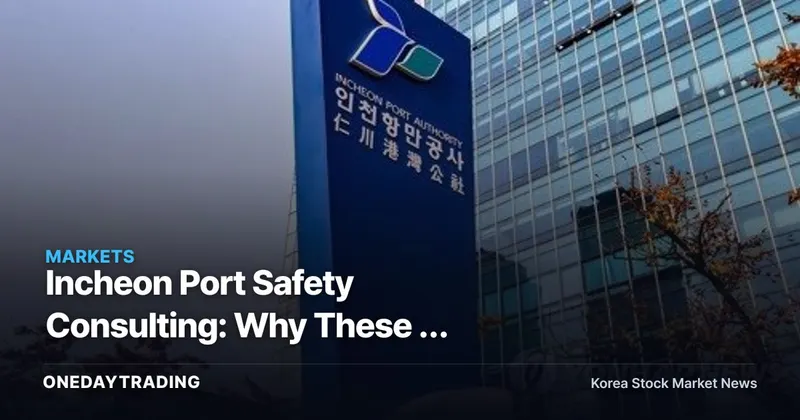
- The Incheon Port Authority (IPA) is recruiting companies to participate in a safety consulting support program aimed at preventing industrial accidents at Incheon Port.
- The target group is five partner companies with fewer than 50 employees — the weakest link in port operations: small-scale worksites.
- This is not news that will immediately move listed-company earnings, but for the shipping and port logistics value chain, the risk-management signal matters more than the cost involved.
What's Changing
When a port accident occurs, time is disrupted before logistics costs are. The Incheon Port Authority's decision to provide safety consulting support to five partner companies with fewer than 50 employees may look like a minor welfare initiative for small worksites. From an investor's perspective, however, it is a measure to reduce bottleneck risk in port operations. Vessels need to berth on schedule, and cargo needs to be moved out on schedule. When this flow breaks down, demurrage, cargo-handling delays, and insurance/compensation costs squeeze profitability before freight rates do.
The core of this program lies not in its scale but in its target. Partner companies with fewer than 50 employees have thinner dedicated safety personnel and systems investment than large prime contractors or public enterprises. Ports are worksites where cargo handling, transport, storage, and equipment operations are all interlinked. Accident probability doesn't show up directly on an individual company's financial statements, but when an accident does occur, it affects the operating rate and reliability of the entire port. Put simply: port profitability is determined not by order backlog but by throughput, throughput by operating rate, and operating rate ultimately by worksite downtime.
Incheon Port serves as the gateway for logistics in the greater Seoul metropolitan area. Where container, bulk, and hinterland cargo volumes converge, safety management is not a cost line item but a safeguard against the downside of handling capacity. If the consulting program goes beyond a checklist exercise and actually identifies real hazards, revises work procedures, equipment movement paths, protective-gear use, and emergency response systems, it becomes an indirect positive catalyst for port operators and logistics companies. If it remains a formality, however, there is no meaningful change for the market to price in.
Numbers in Context
Two figures are confirmed in this announcement: fewer than 50 employees, and five companies. This is not a large-budget program or major infrastructure investment, so interpreting it as a market-moving catalyst would be overstating its significance. Still, port safety policy affects corporate value in a way distinct from cargo-volume cycles. Even if cargo volume rises, if accidents halt operations, revenue recognition is delayed while fixed costs remain unchanged. Shipping and logistics stocks (tickers) are not an industry sector defined purely by the freight-rate cycle — port handling efficiency and operational stability also set the floor for earnings.
Another point of context involves partner companies. Management gaps are more likely to arise in subcontracted and partner work zones than in sections directly operated by the port authority. Consulting support is an initial step to close this gap. Investors should not view this news the way they would port automation or large-scale capacity expansion. Instead, it should be read as a signal of incremental improvement that lowers operational risk. Reliability in logistics infrastructure builds up as such small measures accumulate.
Stocks (Tickers) to Watch: Beneficiaries and Laggards
- Shipping and logistics industry sector overall: Greater handling stability at Incheon Port lowers the risk of delays in vessel berthing, cargo handling, and inland transport. That said, this program alone is not enough to revise earnings estimates.
- Port cargo-handling and transport partner companies: Worksites with fewer than 50 employees face a heavy cost burden in building out safety management systems. Consulting support eases some of the burden of regulatory compliance and work standardization.
- Industrial safety service providers: If public institutions expand safety consulting for small partner companies, demand could emerge for diagnostics, training, and manual development. With only five companies this time, the market size is limited.
- Cargo-owner companies: Fewer port accidents and work stoppages lower delivery-schedule risk. The benefit shows up more in inventory and shipping-schedule stability than in direct revenue.
Risk Check
- With support limited to just five companies, the short-term industry impact is small. Policy signals should be distinguished from earnings variables.
- If equipment upgrades or workforce training don't follow the consulting, the accident-prevention effect will be limited.
- If the cost burden on partner companies rises, some may struggle to sustain safety investment. It's worth confirming whether this support is a one-off or a recurring program.
- Shipping stocks (tickers) are more heavily influenced by freight rates, exchange rates, and oil prices. Safety consulting news alone provides weak grounds for an earlier investment decision.
Bottom Line
The Incheon Port Authority's safety consulting program for five partner companies with fewer than 50 employees is less a share-price catalyst than a small signal that reduces disruption risk in port logistics. What to watch next: the results of participant selection, follow-up improvement measures after consulting, and actual changes in Incheon Port's industrial accident and work-delay indicators.
This article was automatically summarized and analyzed based on the original news source. View original (Yonhap News, Industry)