
At a Glance
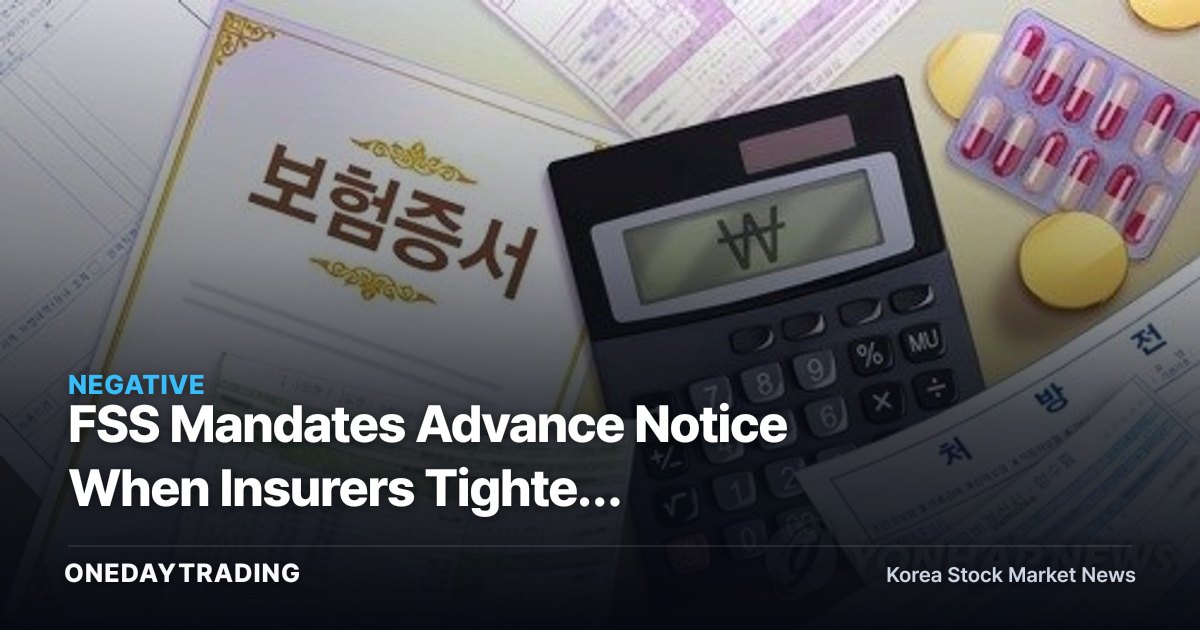
Starting on the 22nd, the Financial Supervisory Service (FSS) will require insurers to provide advance notice whenever they change their insurance-claim review criteria in a direction unfavorable to consumers. On the surface this is a measure to strengthen consumer protection, but for insurers it makes it harder to quietly tighten the review standards they have run internally — a change that directly affects loss ratios and compliance costs.
The crux is that it becomes harder for insurers to arbitrarily tighten their review of claim payouts. From an investment standpoint, this is an issue that calls for a fresh look at the claim payout rates (loss ratios) of listed property & casualty and life insurers, as well as the cost flows tied to complaints and disputes.
Why It Matters Now
An insurer's core profit comes from the structure of premiums received minus claims paid and operating expenses. Review criteria are therefore a sensitive variable that drives the loss ratio. Until now, some insurers have curbed payouts by gradually adjusting their interpretation of policy terms or internal payment guidelines, but once advance notice is mandatory, such changes are exposed to consumers and regulators first.
The impact could be especially large for products with high claim frequency and frequent disputes, such as indemnity health insurance. As the tightening of review standards becomes more transparent, consumers gain more room to respond in advance or to file objections, and as a result it becomes harder for insurers to unilaterally raise their payout-rejection rates. In the short term, this is a factor that narrows their room to maneuver in managing loss ratios.
That said, it should also be considered that the essence of the regulation is closer to adding a procedural obligation than imposing a new cost. Building notification systems and managing policy terms entail some cost, but the larger insurers that already have consumer-protection frameworks in place may face only limited marginal burden.
Frequently Asked Questions
- What is changing If an insurer changes its insurance-claim review criteria in a way unfavorable to consumers, it must provide advance notice of the change starting on the 22nd.
- Why does it affect insurance stocks Review criteria are a variable that determines the scale of claim payouts — that is, the loss ratio — and the loss ratio is directly tied to insurance underwriting profit.
- Does it apply equally to all insurers Property & casualty insurers with a large share of indemnity and health insurance, which see many claims and disputes, are relatively more sensitive.
- Will earnings be shaken significantly right away Given the strongly procedural nature of the regulation, the effect is more likely to emerge gradually through medium- to long-term loss-ratio trends and complaint metrics than as an immediate shock.
Impact on Related Stocks and Sectors
- Samsung Fire & Marine Insurance As a leading property & casualty stock with a large share of indemnity and long-term protection products, greater review transparency acts as a direct variable in loss-ratio management.
- DB Insurance and Hyundai Marine & Fire Insurance Property & casualty insurers with heavy long-term insurance and indemnity claim volumes, relatively more affected by the obligation to disclose review criteria.
- Meritz Financial Group With a profit structure centered on property & casualty insurance, it tends to be highly sensitive to loss-ratio swings.
- Samsung Life Insurance and Hanwha Life Insurance Life insurers are also subject to the same obligation in reviewing payouts on protection products, so they may see their dispute-related cost flows affected.
Points to Watch When Investing
- This measure is a procedural regulation, so investors should keep in mind that its impact on loss ratios is not immediate and may be reflected only gradually in quarterly earnings.
- Because each company has a different portfolio share of dispute-prone products such as indemnity and health insurance, the intensity of the impact varies.
- It should be viewed comprehensively alongside the larger variables that move insurance stocks — such as interest rates and asset-management income — and it is difficult to determine direction from a single regulation alone.
- Whether further consumer-protection regulations follow could affect the medium- to long-term risk premium.
Overall Outlook
The positive scenario is that restoring consumer trust and reducing disputes could, over the long run, lower reputational risk in the insurance industry and strengthen a stable business foundation. On the other hand, if greater transparency in tightened reviews erodes the room to manage loss ratios, earnings volatility could rise for property & casualty insurers with a high share of protection products. The points to confirm are the loss-ratio trajectory in the next quarterly earnings release, changes in the number of disputes and complaints, and the regulator's schedule for follow-up consumer-protection regulations.
Samsung Fire & Marine Insurance in Real-Time Data
Samsung Fire & Marine Insurance's latest closing price is 700,000 won (0.00% vs. the previous day), and the signal light combining foreign and institutional investor supply-demand (order flow) with news and momentum is 🟡 Neutral / Wait-and-See. Positive and negative signals are mixed, making this a zone to watch.
※ Price and foreign/institutional investor supply-demand (order flow) data are provided by Korea Investment & Securities (KIS), as of the time of publication.
This article is content automatically summarized and analyzed based on the original news report. View original (Yonhap News Securities)