
Key Summary
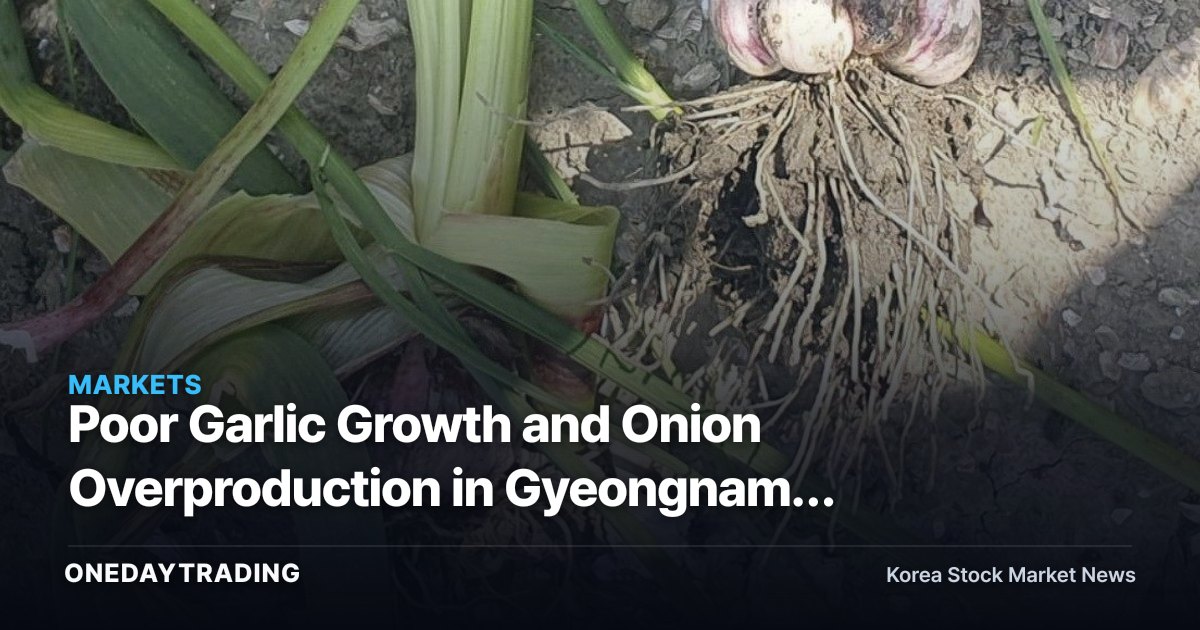
In Gyeongnam, a leading garlic- and onion-growing region, two opposing problems have surfaced at once — poor growth in garlic and overproduction in onions — shaking farm profitability. The crux is that prices are moving in opposite directions by crop, producing a not-so-simple impact on the cost structures of kimchi, sauce, and processed-food makers, as well as restaurant franchises that use garlic and onions in large quantities.
From an investment standpoint, this issue is hard to label as a single positive catalyst or negative catalyst. Falling onion prices are favorable for food-processing costs, but firm garlic prices and crop uncertainty should be viewed as a double-edged variable that increases cost volatility.
What Happened
In Gyeongnam, the country's largest production region for both crops, the worries of farmers growing garlic and onions are deepening. Garlic growth has lagged due to factors such as winter and spring weather, leaving harvest volume and quality short of expectations, while onions are entering an overproduction phase — supported by planted acreage and favorable crop conditions, output has risen and pushed prices down.
It is a contrasting situation: one crop falls short while the other is in surplus. With garlic, prices may rise as supply shrinks, but farms themselves may see revenue decline due to lower harvests; with onions, even a bumper crop puts farmers in a position where the more they ship at falling prices, the more they lose. Both work unfavorably in terms of farm income.
Background and Context
Garlic and onions are essential secondary ingredients found across kimchi, fermented pastes, seasoning sauces, ready meals, and restaurant menus in general. As such, swings in farm-gate prices are directly tied not only to farmers but also to the cost of goods sold at food and restaurant companies that use them as raw materials. That said, garlic and onions make up a relatively limited share of total costs compared with grains, livestock products, and packaging materials, so the impact of this swing on corporate earnings is likely to be limited in proportion to that share.
Impact on the Market and Stocks
- Kimchi, fermented-paste, and sauce processors: Falling onion prices are favorable for the secondary-ingredient costs of kimchi and seasonings. However, if accompanied by rising garlic prices, the cost-saving effect may be offset, leaving the net effect limited.
- Large diversified food companies: The broader their ready-meal and sauce lineups, the easier it is to absorb swings in secondary-ingredient prices, but garlic and onions account for such a small share of costs that they are hard to view as a variable that will determine earnings.
- Restaurants and franchises: Sectors that use onions in large volumes may benefit at the margin from falling onion prices, but other cost burdens such as labor and rent are bigger variables.
- Agricultural distribution and contract-farming-related businesses: In the event of a sharp drop (plunge) in prices, volumes and unit prices may shift depending on policy responses such as farm-gate disposal and government purchasing.
Investor Checkpoints
- Track wholesale price trends for garlic and onions using agricultural price statistics, and check how the cost-of-sales ratio and cost-related commentary of food stocks are addressed in quarterly earnings.
- Check the schedule and scale of any government supply-demand (order flow) adjustment measures — such as purchasing or farm-gate disposal — in response to onion overproduction.
- In the next quarter's earnings releases, assess how changes in secondary-ingredient costs affected food companies' operating profit margins.
- Monitor, via macro indicators, how garlic and onion price swings are reflected in the fresh-food and agricultural-product components of the consumer price index.
Outlook
For food companies, stable onion prices could be a favorable factor that partly eases the burden of secondary-ingredient costs. On the other hand, if poor garlic crop conditions persist, the cost-saving effect will be limited, and should farmers' difficulties deepen, policy-driven supply-demand (order flow) adjustments could once again become a variable for unit prices. Given that garlic and onions themselves do not account for a large share of corporate costs, it is reasonable to approach this issue not as a key variable determining the direction of food and restaurant stocks, but as a supplementary indicator for reading cost trends.
CJ CheilJedang in Real-Time Data
CJ CheilJedang's latest closing price is 193,300 won (+0.21% from the previous day), and its signal light — combining foreign investors' and institutional investors' supply-demand (order flow) with news and momentum — is 🟡 Neutral, Wait-and-See. With positive and negative signals mixed, it is a phase to watch.
- ▼ Order-flow continuity — Foreign investors net sellers for 6 straight days (−3.3 billion won)
- ▼ Dual-front selling — Foreign investors −3.3 billion won and institutional investors −2.4 billion won selling in tandem
- ▼ 52-week position — 9% above the 52-week low
Recent related news is favorable, with 1 positive catalyst and 0 negative catalysts.
※ Price and foreign/institutional supply-demand (order flow) data are provided by Korea Investment & Securities (KIS), as of the time of publication.
This article is content automatically summarized and analyzed based on an original news report. View original (Yonhap News, Industry)