
At a Glance
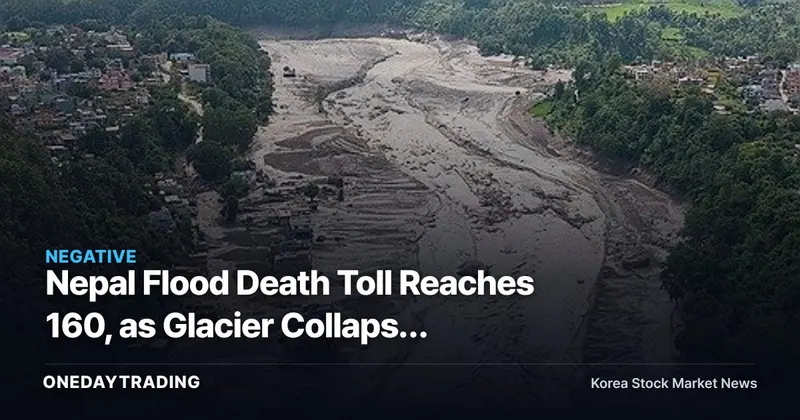
Nepal’s major flooding is not just disaster news. It is an event that adds a climate-risk premium to infrastructure, hydropower, and reinsurance pricing across Asia’s high-mountain regions. According to Yonhap’s 07:30 headline, the death toll has risen to 160, and the cause was presented not as an earthquake but as a glacier-collapse disaster.
A glacier collapse is a physical shock in which ice, soil, and water from high-altitude areas rush downstream all at once. For investors, the key issue is not just the scale of damage but the cause. An earthquake can be treated as a one-off shock, but glacier risk raises fresh questions about the design standards for power plants, roads, dams, and transmission networks.
Why It Matters Now
Infrastructure companies with large order backlogs may look like beneficiaries if investors focus only on disaster-recovery demand. But under Lee Do-yoon’s framework, the sequence is the opposite. First come site shutdowns and higher insurance premiums, then design changes and higher construction costs, and only at the final stage do recovery orders translate into revenue.
The figure of 160 deaths from the Nepal flooding goes beyond human casualties and feeds into the discount rates used by financial markets. High-altitude hydropower, mountain-road, and transmission-grid projects are difficult to build and hard to access on site. When glacier-collapse risk is added, project owners raise safety standards, while contractors seek to reflect contingency reserves and schedule-delay costs in contracts.
For Korean investors, this is not yet an event directly tied to listed-company revenue. Still, when assessing companies exposed to overseas infrastructure, hydropower equipment, disaster-recovery machinery, and non-life insurance or reinsurance, it confirms that climate risk is not an abstract ESG phrase but a real cost variable.
Key Issues
- Cause Yonhap’s 07:30 headline described Nepal’s major flooding as a glacier-collapse disaster, not an earthquake. This means climate and terrain-risk management, rather than seismic shock alone, is the core issue.
- Scale of damage The death toll from Nepal’s major flooding has risen to 160. As casualties increase, recovery budgets, international aid, and insurance-loss assessments follow.
- Industry pathway Glacier collapse raises design standards for dams, hydropower plants, bridges, roads, and transmission networks. Even if orders increase, cost and schedule burdens rise with them.
- Market interpretation Disaster recovery can create a short-term theme for construction and equipment stocks. But actual earnings can only be calculated once order terms, insurance recovery, and site utilization rates are confirmed.
Impact on Related Stocks and Industry Sectors
- Construction and engineering Mountain infrastructure and hydropower projects will require a greater share of safety design, slope reinforcement, drainage, and disaster-prevention work. Cost pass-through terms matter before revenue opportunities.
- Power and hydropower equipment For high-altitude hydropower facilities, response systems for flooding and sediment inflows become important alongside turbines, substations, and transmission networks. Technical specifications for new projects may become more demanding.
- Non-life insurance and reinsurance Glacier-collapse disasters can disrupt natural-catastrophe loss models. Higher premiums give insurers pricing power, but risks already underwritten remain as losses.
- Heavy machinery and recovery equipment If roads are washed out and sediment must be cleared, demand arises for excavators, dump trucks, and mobile power-generation equipment. However, local access conditions in Nepal and international procurement structures limit the actual scale of potential benefits.
Investment Considerations
- Be wary of thematic buying The Nepal flooding has not been confirmed as an immediate earnings event for any specific Korean listed company. It is risky to bring forward revenue recognition assumptions simply because a company is labeled as a related stock.
- Check order disclosures For recovery projects to become a real investment point, the project owner, contract value, construction period, and cost-recovery clauses must be confirmed through disclosures or official materials.
- Insurance-loss variable If reinsurance costs rise, financing costs and insurance premiums for infrastructure projects increase together. This pressures cash flow before profitability.
- Climate-risk premium If glacier collapse is assessed as a recurring risk, required returns for high-altitude development projects will rise. Multiples respond more to risk-adjusted returns than to growth narratives.
Overall Outlook
The optimistic scenario is one in which recovery and disaster-prevention investments are ordered quickly, creating selective opportunities for construction, engineering, and power-equipment companies. In that case, investors should watch actual order disclosures and improvements in utilization rates rather than the headline news alone.
The opposite scenario is more realistic. If glacier-collapse risk is first reflected in construction costs, insurance premiums, and schedule delays, margins on overseas infrastructure projects will narrow. What the market has currently priced in is the expectation of disaster recovery; what it has not yet fully priced in is how quickly climate risk flows into contract costs.
Frequently Asked Questions
What caused the Nepal flooding?
Yonhap’s 07:30 headline described Nepal’s major flooding as a glacier-collapse disaster, not an earthquake. A glacier collapse is a high-altitude disaster in which ice, water, and sediment surge rapidly downstream, worsening flood damage.
Which industry sectors are related to the Nepal flooding?
No specific Korean listed company has yet been confirmed as directly linked to the Nepal flooding. From an investment perspective, however, construction and engineering, hydropower equipment, non-life insurance and reinsurance, and recovery-equipment industry sectors fall within the area of indirect impact.
Why does glacier collapse matter to the stock market?
Glacier collapse is a cost variable that changes design standards, insurance premiums, and construction timelines for high-altitude infrastructure. Nepal’s major flooding, with the death toll rising to 160, shows that climate risk is not an ESG phrase but a real-world variable that can disrupt project margins.
This article is automatically summarized and analyzed based on the original news report. View original article (Yonhap News)