
Key Takeaways
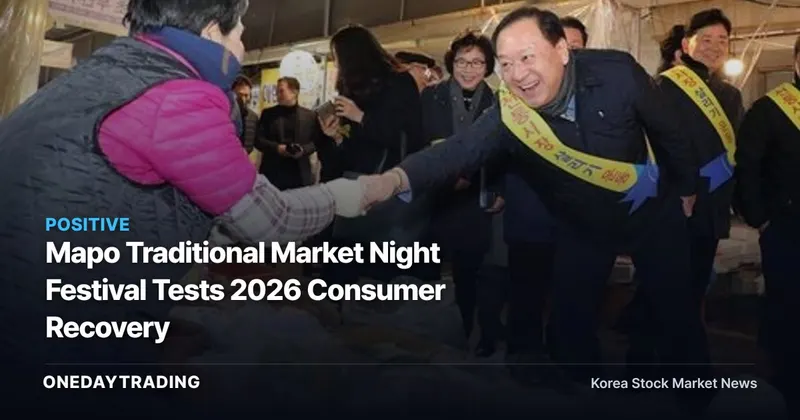
The night market festival at Mapo District's traditional markets and shopping streets is more than a local event — it is a test of whether offline retail can revive evening-hour consumption. Seoul's 2026 nighttime and food culture revitalization support program funds the event costs and programming, but the metric investors should watch is not the festival itself, it's whether store-level revenue and per-visit spending prove durable.
Editorial board member Park Se-ra looks past the headline event scale to the gaps in the data. If higher visitor counts translate only into discounting and one-off food sales, merchant profits stay limited. Conversely, if nighttime foot traffic converts into weekday revenue and repeat visits, the reproducibility of traditional-market revitalization policy improves.
What Happened
According to Yonhap News industry coverage, Seoul's Mapo District has been running a series of night-market-style festivals across its traditional markets and shopping streets. The events are tied to Seoul's 2026 nighttime and food culture revitalization support program, which bundles traditional markets, shopping streets, and food content to extend evening dwell time.
The night-market model expands traditional market consumption — historically centered on daytime grocery shopping — toward meals, snacks, and experiences. Market merchants can extend hours and revamp menus, but they also take on added labor costs and food-waste risk. Even if sales during the event period exceed normal levels, success can't be confirmed without checking whether operating profit, after costs, actually improved.
Background and Context
Large discount marts and online platforms have secured an edge in price comparison and delivery convenience. The ground traditional markets can compete on is non-price factors: immediate consumption, on-site experience, and local food. Night markets can be read as a strategy that concentrates these strengths into evening hours to extend time spent in the commercial district.
Still, the support program is a demand-priming measure, not a permanent backstop for profit and loss. Once subsidies taper off, merchant associations need to be able to cover joint marketing and hygiene/safety management costs on their own. Even if festival visitor counts rise, if per-visit spending falls, overall market profitability may not improve.
Market and Stock (Ticker) Impact
- Mapo District traditional market merchants: Higher nighttime foot traffic expands sales opportunities for food, beverage, and snack stalls. But event discount rates and added labor costs must be weighed together to determine whether net profit actually rises.
- Local restaurant and food businesses: Small manufacturers and food-service operators participating in the festival get a chance to test new menu items and acquire customers. If sales stay confined to short-term, on-site purchases, the repeat-purchase effect is limited.
- Convenience stores and franchises: Expanding nighttime commercial activity could boost demand for ready-to-eat food and drinks at nearby stores. However, if competition with the traditional market intensifies, nearby stores may simply be splitting existing sales rather than gaining new ones.
- Large retail stocks: This event is not large enough to directly move earnings at major retailers like Shinsegae or Lotte Shopping. But if local experience-driven consumption spreads more broadly, large retailers may have more incentive to invest in food courts and nighttime content.
Investor Checkpoints
- Watch whether Mapo District and merchant associations disclose store-level revenue, visitor counts, and per-visit spending before and after the event. Visitor counts alone can't establish profitability.
- Track whether weekday evening revenue and repeat-visit rates hold up for 4 to 8 weeks after the event ends. A revenue drop-off immediately after the event suggests a one-off effect.
- Follow Seoul's follow-up budget for the 2026 support program and any additional markets selected. A wider support scope could accelerate the spread of similar night-market models.
- If merchant costs — labor, food waste, and safety management — outpace revenue gains, profit can shrink even as top-line sales grow. Managing participating stores' break-even points is the key variable.
Outlook
In the optimistic scenario, the night market draws repeat visits not just from tourists but from nearby residents. Standardizing local specialty menus and payment/reservation data could allow expansion to other traditional markets, while merchant group purchasing could lower costs. In this case, policy support evolves from one-off subsidies into investment in commercial-district operating infrastructure.
The risk lies in mistaking festival buzz for genuine consumption recovery. Rain or poor transit access can sharply cut visitor numbers, and even a single food-safety incident could damage trust across the entire commercial district. In some cases, nighttime sales may simply be a shift from existing daytime sales rather than new demand. If post-festival revenue holds at elevated levels, the policy effect is validated; if it drops off within two months, debate over the cost-effectiveness of further support is likely to intensify.
FAQ
When is the Mapo traditional market night festival held?
Yonhap News reported that festivals are being held in succession across Mapo District's traditional markets and shopping streets, but the article did not specify individual event dates or operating hours. Visitors should check official announcements from Mapo District Office and each market's merchant association before visiting.
What is Seoul's 2026 nighttime and food culture revitalization support program?
It is a Seoul city support program aimed at extending nighttime dwell time and food content at traditional markets and shopping streets. It helps with event operations and promotion, but the subsidy does not guarantee operating profit for participating stores.
Does this festival directly affect stock investing?
A single Mapo-area event is unlikely to move earnings at listed major retailers. Rather than buying related stocks, investors would be better served tracking whether post-event revenue, per-visit spending, and repeat-visit data get disclosed, and whether similar programs expand to other commercial districts, as an industry trend to watch.
This article is an automatically summarized and analyzed version based on the original news report. View original (Yonhap News Industry)