
What the Samsung Electronics and SK Hynix Plunge Signals
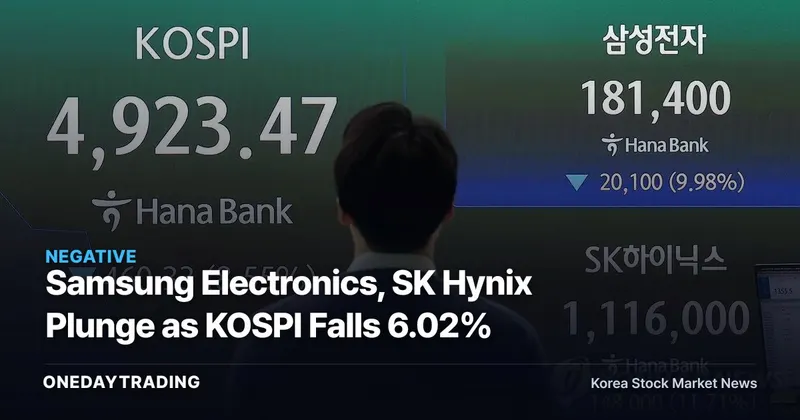
The simultaneous sharp drop (plunge) in Samsung Electronics and SK Hynix went beyond a correction in individual stocks, shaking two central pillars of the KOSPI at once. The KOSPI’s 6.02% decline and the intraday circuit breaker triggered on November 6, 2026, show that the market had entered a phase in which investors were reducing risk exposure across the board rather than carefully distinguishing among individual company valuations.
According to figures reported by Yonhap News’ securities desk based on data from the Korea Exchange (KRX) and Koscom CHECK, the combined market capitalization of Samsung Electronics and SK Hynix stood at 1,930.1102 trillion won on November 6, 2026. What can be confirmed for now is the shock to prices and supply-demand (order flow). The available data does not yet show the two stocks’ subsequent trajectory or quantify the contribution of each factor behind the sharp drop (plunge).
KOSPI Falls 6.02% and Triggers Circuit Breaker
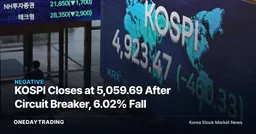
The KOSPI closed at 5,059.69 points on November 6, 2026, down 324.11 points, or 6.02%. Over two days, it lost 624.11 points, or 10.98%. This is why the sustained correction warrants more attention than a single day’s move.
A circuit breaker is a market-stabilization mechanism that suspends trading on the main stock market for 20 minutes when the KOSPI remains at least 8% below the previous session’s close for one minute. The trading halt does not explain the cause of the losses. It indicates that sell orders became so concentrated within a short period that normal price discovery was impaired.
Market-Cap Decline Highlights Semiconductor Concentration Risk
The combined market capitalization of Samsung Electronics and SK Hynix fell by 2,245 trillion won, or 53.77%, between June 25 and November 6. The total market capitalization of the KOSPI market stood at 4,175 trillion won that day, with 267 trillion won erased in a single session. The real message goes beyond the index’s percentage decline: price moves in semiconductor heavyweights exert substantial pressure on the valuation of the entire market.
Samsung Electronics closed at 188,700 won on November 6, 2026, down 6.35% from the previous day. SK Hynix fell 10.44% in the same session. Simply watching which stock’s losses begin to narrow first is not enough. Whether both stocks stabilize together will determine the breadth of any KOSPI recovery.
Foreign Investors and Broad-Based Selling Pressure
Foreign investors recorded foreign net selling of 11.9949 trillion won on the main stock market over six consecutive trading days. If this trend continues, a recovery in Samsung Electronics and SK Hynix alone would not be enough to conclude that the KOSPI’s supply-demand (order flow) pressure has eased. Conversely, a decline in net selling would provide an opportunity to assess whether large-cap stocks and the index are stabilizing together.
The decline was also broad. On November 6, 2026, 669 KOSPI and KOSDAQ stocks closed at their lowest levels of the year. This means the shock was not confined to selected semiconductor stocks; price benchmarks moved lower across the broader market.
KOSDAQ and Volatility Indicators Flash Warning Signs
The KOSDAQ index closed at 644.27 points on November 6, 2026, down 5.03%. The fact that the KOSPI and KOSDAQ fell together on the same day shows that risk aversion was not limited to a particular index.
The KOSPI 200 Volatility Index closed at 65.17 points that day, up 11.96% from the previous session. With prices falling as volatility rose, investors should first watch whether volatility subsides rather than focus on the size of any rebound. Even if the index rises, its price trajectory will remain unstable if this indicator stays elevated.
Indicators for Samsung Electronics and SK Hynix Investors
- Foreign investor supply-demand (order flow): Monitor whether consecutive net selling on the main stock market continues and whether the cumulative 11.9949 trillion won in net selling diminishes or reverses.
- Large-cap synchronization: Watch whether Samsung Electronics and SK Hynix stabilize together. If only one stock recovers, the momentum may have limited scope to spread across the broader KOSPI.
- Market breadth: A decline from the 669 KOSPI and KOSDAQ stocks at yearly lows would be a benchmark for easing selling pressure.
- Volatility: Compare price movements with the KOSPI 200 Volatility Index to see whether it turns lower from 65.17 points.
Conditions That Will Determine a Rebound or Further Decline
In the bullish scenario, foreign investors reduce their net selling while Samsung Electronics and SK Hynix regain stability at the same time. A decline in the KOSPI 200 Volatility Index would strengthen the case that the market is moving beyond the urgent risk-reduction phase.
The downside scenario is driven by the combination of persistent selling and elevated volatility. If foreign net selling continues and a broad range of KOSPI and KOSDAQ stocks remain at yearly lows, an index rebound alone would not be sufficient to confirm a trend reversal. The specific details and implementation status of data-center regulations have not been confirmed, so there is also no basis for immediately translating them into changes in corporate earnings or fair value.
KOSPI Index MetricsAs of 2026-11-06
| Performance by Period | 1 Week -11.71% 1 Month -25.64% |
|---|
Index, commodity, and exchange rate figures are based on global markets and reflect values at the time of publication.
Samsung Electronics Key MetricsAs of 2026-11-06
| Returns by Period | 1 Week -15.51% 1 Month -29.20% |
|---|---|
| Trading Value · Trading Volume | 70.4 billion won · 52,400,780 shares |
| Supply-Demand (Order Flow) | Foreign Investors −137.4 billion won net sold (4 consecutive days) Institutional Investors −41.5 billion won net sold |
| Recent News Tone | Positive Catalyst 4 · Negative Catalyst 4 |
Price and supply-demand (order flow) data are real-time figures from Korea Investment & Securities (KIS); supply-demand (order flow) and news-tone tallies are calculated independently by OneDayTrading.
Upcoming Events to Watch
- 11.12Index Options ExpirationLowKOSPI200 options expiration
- 11.26Bank of Korea Monetary Policy BoardHighBenchmark interest rate decision meeting
- 12.09FOMC Policy Rate DecisionHighU.S. Federal Reserve monetary policy announcement — direction of interest rates and the dollar
- 12.10Futures and Options ExpirationMediumQuadruple witching — watch for volatility and supply-demand (order flow) disruptions
This article was automatically summarized and analyzed from the original news report. View the original article (Yonhap News)