
At a Glance
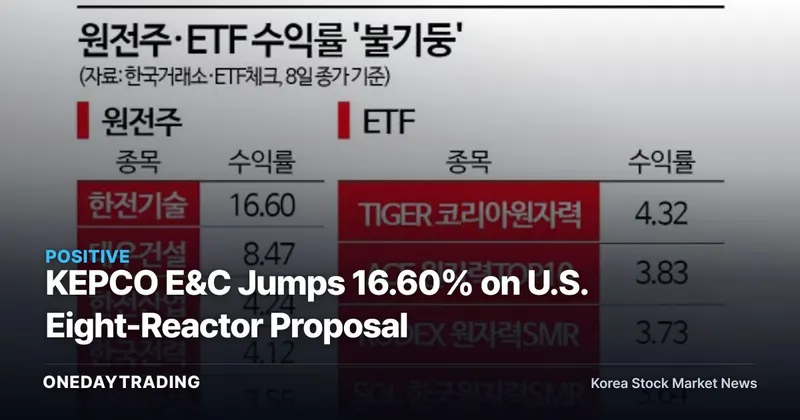
KEPCO E&C shares jumped 16.60% on September 8, 2026, closing at 142,600 won. The price reflected both reports that South Korea’s U.S. investment projects could include eight large nuclear reactors and expectations for additional reactors at home. Investors need to distinguish between expectations surrounding construction plans and the time required for design and equipment suppliers to recognize revenue.
The rally signals that the nuclear industry’s order backlog could expand; it does not mean profits have already been secured. The next turning points will be whether a stake in Westinghouse is acquired, how U.S. projects are contracted, and whether new reactors are included in the final 12th Basic Plan for Electricity Supply and Demand.
Why It Matters Now
According to Asia Business Daily’s securities coverage, plans to build eight large nuclear reactors in the U.S. were discussed at a closed-door government-ruling party meeting on September 7. Speculation also emerged that the South Korean government and KEPCO could acquire a stake in Westinghouse. Securing a stake could ease the recurring burden of intellectual-property negotiations in nuclear exports and give South Korean suppliers broader access to AP1000 projects.
KEPCO E&C would play a central role in design. KB Securities said Westinghouse is struggling to expand its nuclear design workforce, while KEPCO affiliates have secondary-system design capabilities that could enable them to participate in parts of AP1000 design work. Because design contracts are awarded before equipment supply contracts, order backlog and engineering-services revenue could begin rising even before construction starts.
The case for domestic demand has also strengthened. According to Korea Investment & Securities, South Korea’s projected peak electricity demand for 2040 has been raised by 26.6GW to 158.4GW. The analysis concludes that large nuclear reactors will be needed to ensure a stable power supply even with expanded renewable energy and BESS capacity and the conversion of coal-fired generation to LNG. Expectations that the 12th Basic Plan could include two to six new large reactors improve the long-term visibility of domestic EPC and operating work.
Key Issues
- Legal stage of the U.S. projects: The eight-reactor proposal is reportedly still under discussion and must proceed through an intergovernmental agreement and project-owner orders before becoming revenue-generating contracts.
- Impact of a Westinghouse stake: A completed acquisition could reduce intellectual-property coordination costs and scheduling uncertainty, but the acquisition price, voting rights and investment burden have not been disclosed.
- Timing gap between design and equipment: KEPCO E&C would recognize design orders first, while Doosan Enerbility’s earnings would depend on reactor and turbine equipment production and supply-chain utilization rates.
- Domestic nuclear power’s dependence on policy: The estimate of two to six reactors is based on recalculated electricity demand. The final Basic Plan, local acceptance and permitting schedules will determine the actual volume.
Impact on Related Stocks and Industry Sectors
- KEPCO E&C: Shares rose 16.60% on September 8, with trading volume of 2,238,809 shares. Brokerage analysts say expectations for U.S. expansion are not yet fully reflected in existing earnings estimates, leaving the stock highly sensitive to related developments. An actual partial-design contract would allow the order backlog to support the share price.
- Doosan Enerbility: The company supplies equipment for both Korean-designed reactors and AP1000 units. Kiwoom Securities named it its top pick in the industry sector, and the shares gained 1.82%. Continued reactor orders would first lift factory utilization rates and improve fixed-cost absorption.
- KEPCO: The company could become the vehicle for acquiring a Westinghouse stake and participating in overseas projects, making the profit-sharing structure important. Its shares rose 4.12% on September 8, but investors must also account for the investment cost and burden on consolidated finances.
- Hyundai E&C, Daewoo E&C and Korea Electric Power Industrial Development: Their potential benefits differ across EPC, maintenance and operations. On the same day, Hyundai E&C rose 3.55%, Daewoo E&C 8.47%, and Korea Electric Power Industrial Development 4.24%. Future orders will need to be confirmed by work category.
- Nuclear energy ETFs: TIGER Korea Nuclear Energy gained 4.32%, ACE Nuclear Power TOP10 3.83%, KODEX Nuclear Power SMR 3.73%, and SOL Korea Nuclear Power SMR 3.64%. ETFs carry exposure to the valuation of all constituent stocks, not just individual contract wins.
Investment Risks
- Investors should confirm whether the U.S. eight-reactor proposal advances to an intergovernmental agreement and binding contracts. If talks are delayed, the expectation premium already priced into shares could unwind first.
- A Westinghouse stake acquisition would provide rights while also creating a financial burden. Until the acquisition price and financing structure are disclosed, it will be difficult to calculate the impact on KEPCO’s net profit.
- New domestic reactors would still face environmental and permitting procedures after inclusion in the Basic Plan. If the planned volume is reduced, long-term order-backlog forecasts for EPC companies would also decline.
- Nuclear stocks are highly sensitive to policy news and can become more volatile after a short-term sharp gain (surge). Investors should separately assess whether order-backlog growth translates into revenue and operating profit in the next earnings releases.
Overall Outlook
In the bullish scenario, an official agreement on the U.S. projects, the acquisition of a Westinghouse stake and the inclusion of new reactors in South Korea’s Basic Plan would be confirmed in sequence. This would create a structure in which KEPCO E&C expands its backlog through design revenue, Doosan Enerbility through equipment orders, and construction companies through EPC work. Continued orders would raise utilization rates, ease fixed-cost pressure and improve margins.
The downside scenario involves protracted negotiations and rising costs. If the financing or regulatory terms for U.S. reactors change, or South Korea scales back its plans, share prices could give back expectations faster than earnings improve. The market is currently pricing in the possibility of nuclear expansion; contract values and profit margins remain unconfirmed. The next assessment will hinge on official government announcements and company order disclosures.
Frequently Asked Questions
What directly triggered the rally in nuclear stocks?
The direct positive catalysts were discussions about potentially including eight large nuclear reactors in South Korea’s U.S. investment projects and the possibility of acquiring a stake in Westinghouse. The move was also supported by South Korea raising its projected peak electricity demand for 2040 to 158.4GW and considering two to six new large domestic reactors under the 12th Basic Plan.
How do the potential benefits differ for KEPCO E&C and Doosan Enerbility?
KEPCO E&C would benefit first from nuclear design and secondary-system engineering contracts. For Doosan Enerbility, revenue and margins depend on production volumes for equipment such as reactors and turbines, as well as factory utilization rates.
What indicators should investors monitor next?
Investors should monitor an intergovernmental agreement on U.S. nuclear cooperation, the terms of any Westinghouse stake acquisition and the final number of new reactors in the 12th Basic Plan. Subsequent company order disclosures specifying contract values, construction periods and expected margins will be the benchmark for testing current share-price expectations.
KEPCO E&C Key MetricsAs of 2026-09-09
| Period Return | 1 Week +29.05% 1 Month +39.94% |
|---|---|
| Supply-Demand (Order Flow) | Foreign Investors Net Selling of 800 Million Won Institutional Investors Net Buying of 17.4 Billion Won |
| Recent News Tone | Positive Catalysts 0 · Negative Catalysts 1 |
Price and supply-demand (order flow) data are real-time figures from Korea Investment & Securities (KIS), while supply-demand (order flow) and news-tone metrics are calculated independently by OneDayTrading.
Supply-Demand (Order Flow) and Momentum Assessment🔴 Caution
Foreign-investor and news indicators are showing negative signals.
Upcoming Events to Monitor
- 09.10Futures and Options ExpirationMediumQuadruple witching — watch for volatility and supply-demand (order flow) disruptions
- 09.16FOMC Policy Rate DecisionHighFederal Reserve monetary-policy announcement — direction of interest rates and the dollar
- 10.08Index Options ExpirationLowKOSPI 200 options expiration
- 10.22Bank of Korea Monetary Policy BoardHighBenchmark interest rate decision meeting
This article was automatically summarized and analyzed from the original news report. View the original article (Asia Business Daily Securities)