
Key Takeaways
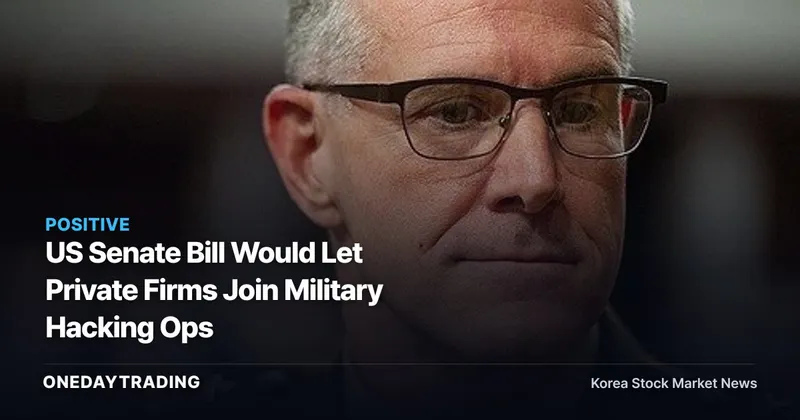
As the U.S. Senate advances a bill allowing private companies to participate in military cyber operations, the cybersecurity industry's growth path could widen from selling defensive solutions to providing offensive capabilities. Even if the bill passes, however, actual contracts will likely be limited to companies that meet chain-of-command, rules-of-engagement, and liability requirements — so it's premature to read this as a blanket positive catalyst for the entire security sector.
What investors should watch is not the bill's language but the budget and procurement process. Company valuations will hinge on which missions U.S. Cyber Command outsources to the private sector, and whether that work converts into recurring revenue and long-term contracts.
What Happened
According to the securities desk of Yonhap News Agency, the U.S. Senate is advancing legislation that would allow private companies to conduct military cyber hacking operations under the command of U.S. Cyber Command. Currently available information does not include the bill's detailed provisions, review timeline, or a list of target companies.
The change this bill represents is that part of the military's operational authority could be combined with private-sector technical capability. Under this structure, private companies would supply technical resources such as penetration tools, threat intelligence, and personnel, while the military would handle mission approval and operational command. Unlike simple security monitoring services, this could create high-value contracts directly tied to national security missions.
Background and Context
Cyber warfare is an area where the line between offense and defense blurs quickly. Vulnerability analysis and penetration techniques used for offense are simultaneously research assets that improve defensive products. If private-sector participation becomes institutionalized, the government can rapidly secure specialized talent, but private companies take on confidentiality management and legal/reputational risk tied to operational failures.
The market should therefore watch three follow-up signals rather than the bill's introduction itself. First, how far the scope of private companies' operational authority extends. Second, whether contracts are one-time development fees or multi-year operating expenses. Third, how Congress designs oversight and liability rules. If the rules remain unclear, companies may win contracts but struggle to protect margins due to cost and litigation risk.
Market and Stock (Ticker) Impact
- U.S. cybersecurity companies: Firms with military hacking capabilities and threat intelligence could gain new government contract opportunities. However, companies lacking defense procurement qualifications and security certifications may be excluded from this market expansion.
- Cloud and network security: Separating and controlling operational data between the military and private sector will increase demand for access management, encryption, and log auditing. This is the transmission channel through which offensive-operation authorization translates into defensive infrastructure spending.
- Defense-IT convergence firms: Existing defense contractors that acquire or partner with cyber specialty firms could secure prime-contractor status on large deals. Conversely, pure software firms face a steep cost of entry into the military procurement network.
- Domestic (Korean) security industry: U.S. policy could also affect allied nations' cyber cooperation and technical standards. However, this report does not mention Korean companies or domestic contracts, so there is no basis to assume a direct benefit.
Investor Checkpoints
- Track whether the Senate bill is reviewed and passed, and whether Cyber Command's private-contract budget actually increases.
- Watch U.S. Department of Defense procurement disclosures for multi-year contracts related to cyber operations, penetration testing, and threat intelligence. If only one-off R&D contracts repeat, earnings-power improvement will be limited.
- Check the share of government revenue and contract renewal rates for participating companies. Continued order flow improves utilization and economies of scale, but rising compliance costs could compress operating margins.
- Monitor insurance premiums, litigation reserves, and potential customer attrition in case private-sector operations lead to civilian harm or data-leak controversies.
Outlook
If the bill passes and defense budgets support it, the cybersecurity market could expand from defense-software-centric offerings to mission-execution services. Companies that already possess military-grade analysis and penetration capabilities would have an advantage in contract pricing and barriers to entry.
The opposite scenario is equally clear. If Congress narrows private offensive authority or tightens oversight provisions, the bill could end up as a symbolic statement. If liability for failed operations concentrates on companies, government contracts may increase in volume while risk-adjusted profitability deteriorates. The market is likely to react more to actual orders and contract terms than to the headline of passage itself.
FAQ
What does the U.S. Senate's private hacking bill allow?
As reported, the bill would allow private companies to conduct military cyber hacking operations under the command of U.S. Cyber Command. The detailed scope of authority and liability cannot be confirmed from the public reporting alone.
Is this an immediate positive catalyst for cybersecurity stocks?
The bill's advancement could serve as a catalyst that raises expectations for government contracts. However, the actual beneficiaries may be limited to companies that hold military procurement qualifications, security certifications, and favorable contract terms and margins.
When and what should investors check?
Investors should track, in order, the Senate's review schedule and bill text, followed by related budget and procurement disclosures from Cyber Command and the Department of Defense. Whether contract announcements continue and renewal revenue grows is the benchmark for verifying policy expectations against actual earnings.
This article was automatically summarized and analyzed based on the original news report. View original (Yonhap News Agency)