
Summary
The 50% Canadian auto tariff is a cost shock that rewrites North American production economics for GM, Ford, and Stellantis. From Lee Do-yoon's perspective, the key issue isn't the share price drop itself, but how much order flow and production allocation shifts to U.S. plants before 2027.
An auto tariff is a border tax levied on finished vehicles, trucks, and auto parts produced overseas and brought into the United States. In this case, the measure raises the cost of bringing Canadian-made vehicles and parts into the U.S. to 50%, effective January 1, 2027.
What Happened
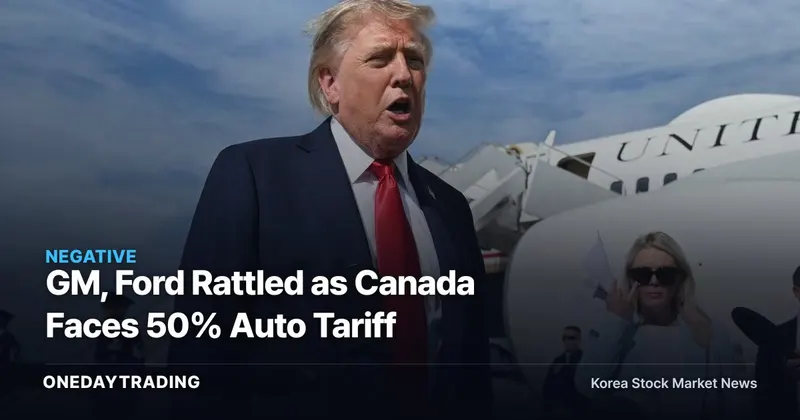
According to CNBC, U.S. President Donald Trump said on August 24, 2026 that tariffs on Canadian-made passenger cars, trucks, and auto parts would rise to 50% starting January 1, 2027. In the same announcement, Canadian steel was also included among goods subject to the 50% tariff.
The announcement came after U.S.-Canada trade talks broke down last week. The AP and other major outlets reported that Canada has signaled retaliatory tariffs on U.S. steel, dairy products, and electronics starting September 8, 2026. If the tariffs are actually enforced, the North American auto supply chain faces more than a trade friction issue — it becomes a question of relocating production.
Markets have already reacted unevenly. According to media reports, Ford slid roughly 3-4% intraday, GM fell about 1-2%, and Stellantis dropped around 4%. By contrast, some U.S. auto parts retailers gained, reflecting expectations of higher replacement-part prices and increased repair demand. Automakers are absorbing the cost, while the aftermarket is seeing price pass-through.
Structural Backdrop
Canada accounts for roughly 8% of North American vehicle production. That figure may look small, but the auto industry is one where engines, transmissions, chassis, and electronic components cross borders multiple times. On a single vehicle's cost sheet, a 50% tariff isn't a one-time charge — it cascades through parts sourcing, plant utilization, and dealer pricing.
Automakers essentially have three options: raise the share of U.S.-based production, pass the tariff cost on to consumer prices, or absorb the hit to margins. The first requires capital and labor investment and takes time. The second is difficult given the mounting burden of auto financing on U.S. consumers. The third compresses valuation multiples.
Stock (Ticker) and Sector Impact
- GM: With heavy exposure to a North American production network linking Canada and the U.S., GM would face unavoidable production reallocation by model if the tariff takes effect. Investors should watch for changes in North American plant assignments and any price increases before 2027.
- Ford: Since pickup trucks and commercial vehicles drive Ford's profitability, tariffs on trucks and parts hit margins directly. If cost pass-through is delayed, operating profit margin will wobble before sales volume does.
- Stellantis: The North American production network for Chrysler and Jeep is tied to Canada. A prolonged tariff would bring both North American capacity reallocation and labor union costs into play simultaneously.
- Hyundai Motor and Kia: Korean automakers aren't directly named in the news, but companies that have expanded U.S.-based production gain relative protection. Still, given their Canadian sales and parts sourcing networks, it would be premature to call them unconditional beneficiaries.
- U.S. steelmakers: A 50% tariff on Canadian steel would be supportive for domestic steel pricing. However, rising costs for automakers could feed back into softer steel demand.
Bull vs. Bear Scenarios
In the bull scenario, the tariff ends up being a negotiating tool. If the U.S. and Canada agree on exemptions or a phased increase before the January 2027 implementation date, automaker share prices could partially reverse the cost-related sell-off. Companies with U.S.-based production capacity may command a relative premium even amid policy uncertainty.
In the bear scenario, both the tariff and retaliatory tariffs materialize simultaneously. If Canada begins retaliatory tariffs on September 8, 2026, and the U.S. enforces the 50% auto tariff in January 2027, North American automakers would face pressure on both sales pricing and production costs. In that case, the market's focus would shift from unit sales to per-vehicle margin.
Investor Action Points
- Watch what items and scale Canada's retaliatory tariffs cover starting September 8, 2026. The more autos, steel, and electronic components included, the greater the cost burden on North American manufacturing.
- In GM, Ford, and Stellantis's next quarterly earnings, focus on North American operating profit margin guidance — how tariff costs are absorbed matters more than revenue.
- Track whether U.S.-Canada negotiations resume and whether USMCA exemptions are discussed before January 1, 2027. A delay in implementation could be a trigger for a share price rebound.
- For Hyundai Motor and Kia, watch their U.S. production expansion timeline and parts localization rate together. Any relative benefit will show up in the cost sheet, not just the production location.
FAQ
When does the 50% Canadian auto tariff take effect?
According to CNBC, the U.S. said tariffs on Canadian-made passenger cars, trucks, and auto parts would rise to 50% starting January 1, 2027. There is room for adjustment through negotiations before implementation, but the currently announced effective date is January 1, 2027.
Why are GM and Ford shares weak on the tariff news?
GM and Ford split parts and vehicle production across North America. A 50% tariff on Canadian-made vehicles and parts raises production costs, and if that cost cannot be fully passed on to consumer prices, North American operating profit margins decline.
Are Hyundai Motor and Kia beneficiaries of the Canadian tariff?
Hyundai Motor and Kia gain relative protection compared to GM and Ford as their U.S.-based production share grows. However, since Canadian sales, parts sourcing, and slowing U.S. auto demand move together, it's difficult to simply classify them as beneficiaries.
This article was automatically summarized and analyzed based on the original news report. Read original (CNBC)